Tips for Truck Bed Tent Camping With Kids: A Practical Family Guide
77% of campers bring their families along. If you own a pickup truck and have been doing truck bed tent camping solo or with a partner, the question of whether the format works with kids is a natural next step, and the answer is more practical than most people assume.
Truck bed tent camping with kids is genuinely possible and in several ways better suited to families than ground tent camping. The elevation keeps young children off wet, rocky, and insect-active ground. The truck provides locked, secure storage for gear and valuables. Setup is faster than a large family ground tent. And the truck itself is always right there, which matters when a three-year-old has a middle-of-the-night upset and needs to be driven home.
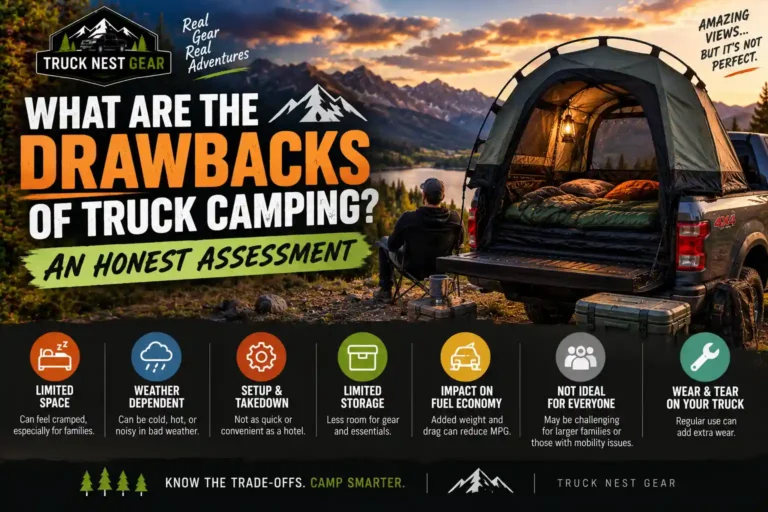
The honest part: a standard truck bed tent sleeping two adults does not automatically sleep a family of four. The sleeping configuration, the age of the children, and the specific tent and truck setup all determine what is practical. This guide works through those decisions honestly, then covers the safety, gear, and activity considerations that make family truck bed tent camping a genuinely good experience rather than a stressful one.
The Sleeping Configuration Reality
Before anything else, the sleeping math deserves direct attention because it is where most family truck bed tent planning goes wrong.
A truck bed tent with a standard short-bed or standard-bed truck sleeping a couple works because two adults in a 5.5 to 6.5-foot bed fit with reasonable room. Adding children changes the math in a way that depends heavily on their ages and sizes.
Infants and toddlers (under age 3): Sleep in the truck bed tent with an adult, sharing the sleeping surface in the same way co-sleeping works at home. One adult and one toddler in a standard truck bed tent is comfortable. Two adults and one toddler are workable. Two adults and two toddlers in a short-bed tent is genuinely cramped. A long-bed truck with an 8-foot bed provides meaningfully more interior space for a family with very young children.
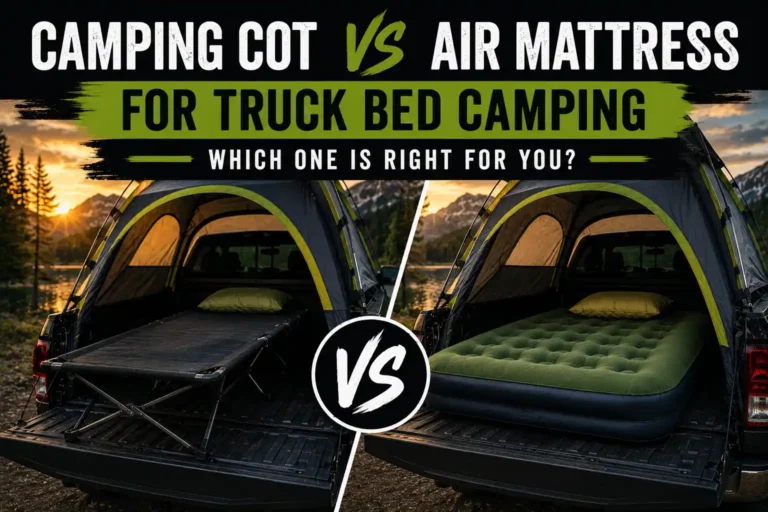
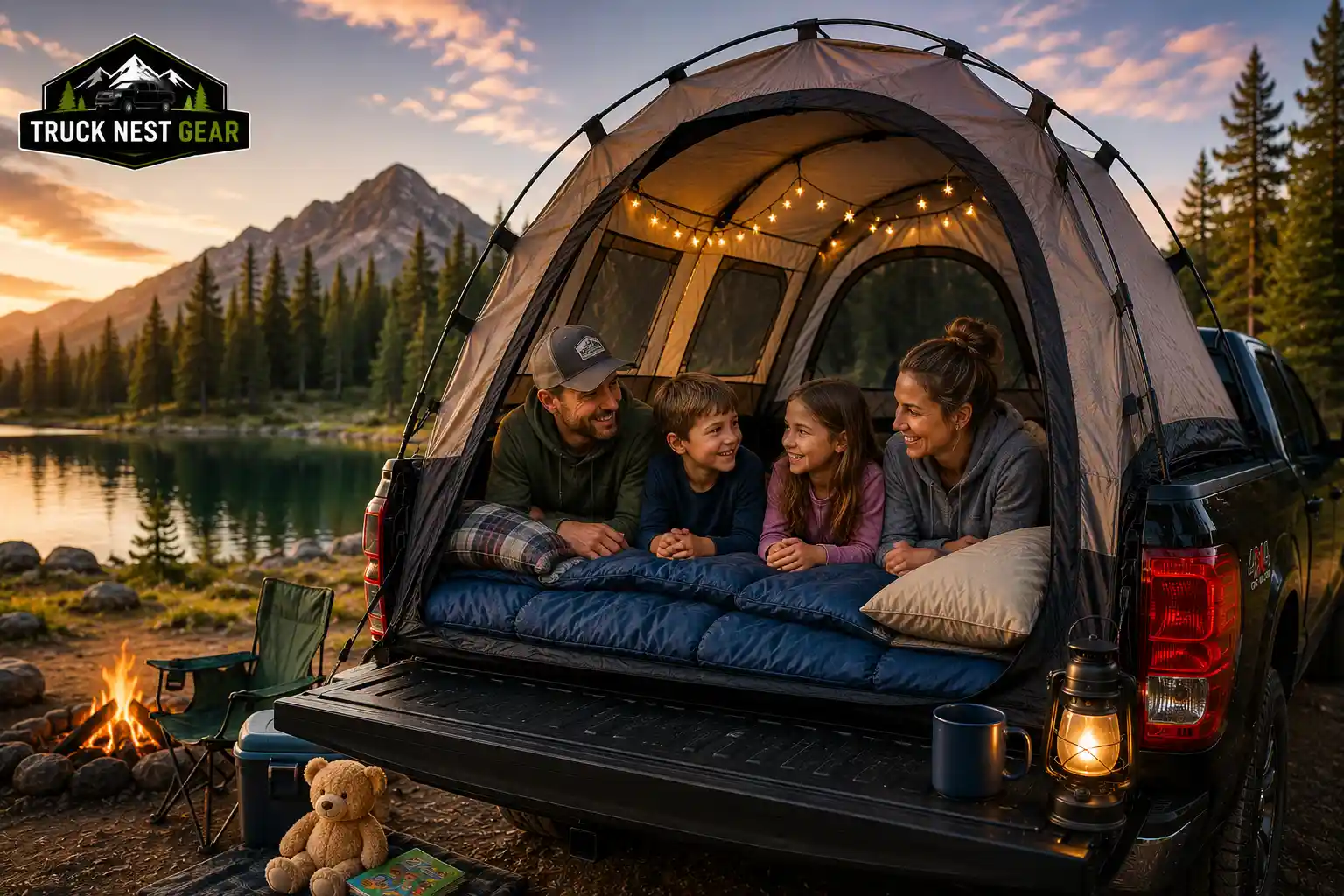
Young children (ages 4 to 8): Children in this age range are often genuinely excited by the novelty of sleeping in the truck bed. They fit alongside adults more easily than a second adult would. Two adults and one child in a standard truck bed tent is the most common comfortable configuration. Two adults and two children in a long-bed tent is workable with a truck-specific queen air mattress that spans the full width.
Older children and tweens (ages 9 and up): A child this age occupies nearly as much sleeping space as an adult. The most practical family truck camping configuration for children in this age range is the truck bed tent for the adults plus a separate ground tent for the older children pitched alongside the truck. This provides each sleeping group with appropriate space, gives older kids a degree of independence they typically enjoy, and uses the truck bed tent’s awning as a covered shared space between the two sleeping areas.
If your kids are outdoor newbies, pitch a tent in the backyard or even inside your home first. For truck bed tent camping specifically, a driveway dry run that includes children sleeping in the actual truck bed tent is the best way to identify what works before a campsite four hours from home reveals what does not.
Starting Right: The Backyard First Rule
Ask yourself if your kids are developmentally ready for sleeping outdoors. Test their comfort with a backyard campout night before venturing further.
The backyard dry run is the single most important family truck bed tent preparation step, and it serves more purposes than just gear testing.
It tells you whether your specific child can settle and sleep in the confined, elevated, unfamiliar space of a truck bed tent. Some children take to it immediately; the novelty is exciting, and the security of being in the family truck is reassuring. Others find the unfamiliar movement, sounds, and space unsettling. Finding this out in the driveway is infinitely less stressful than finding it at a campsite two hours away after dark.
It reveals setup logistics specific to children. Getting a four-year-old into and out of a truck bed tent through the tailgate sleeve entry in the dark requires a specific technique. A toddler who rolls during sleep near the tailgate entry needs a different sleeping arrangement than an older child who stays put. The driveway is where you solve these specific problems in advance.
It builds familiarity with a novel environment before that environment also involves darkness, wildlife sounds, and the absence of home. Outdoor experience can also help kids understand the importance of following camping best practices. A child who has already slept in the truck tent in the backyard arrives at the campsite with existing comfort rather than encountering everything unfamiliar simultaneously.
Campsite Selection for Families
Start small, stick close to home, and choose more developed campgrounds with buckets of amenities. Work your way up to more remote or adventurous locations or longer trips.
The campsite selection guidance for truck bed tent camping in general, dispersed BLM land, remote Forest Service roads, and backcountry access is the right recommendation for experienced solo or couple campers. For a first family trip with young children, a developed campground within an hour or two of home is the appropriate starting point.
A developed campground provides bathroom facilities within walking distance, which transforms overnight camping with young children from a logistical challenge into a manageable routine. It provides help nearby if something goes wrong. And it allows the family to drive home in under two hours if the children are genuinely not ready for overnight camping yet, without having traveled so far that turning back is a significant consequence.
When camping with children, it’s best to select a campground that caters to families and offers child-friendly amenities. Look for sites with accessible restrooms, running water, and playgrounds. Avoid remote or rugged locations for your first trip.
For the truck bed tent specifically, campsite selection also involves the safety of the truck bed height relative to young children. A truck bed at 24 to 36 inches off the ground is a fall height that is meaningful for a toddler. Entering and exiting through the tailgate sleeve requires adult supervision for children under age 5 or 6. Choose a campsite that allows the truck to be parked without significant height differentials behind the tailgate; a campsite where the ground behind the tailgate drops away steeply creates a more significant fall risk than a level pullout.
Tip 1: Set Clear Campsite Boundaries Before Anyone Gets Out of the Truck
Set clear boundaries ahead of time so kids know if and how far they can wander on the campsite and other safety rules. Ensure they understand what to do in an emergency and what major hazards to avoid.
Before children leave the vehicle at a new campsite, establish the boundaries of the safe zone verbally and, for younger children, physically by walking the perimeter with them. This is not an abstract safety lecture; it is a two-minute walk that establishes the spatial vocabulary they need to stay oriented in an unfamiliar outdoor environment.
Teach kids basic outdoor safety skills like what to do if they get lost. Bring a whistle for each child; it’s louder than yelling if they need help.
A safety whistle on a lanyard, worn throughout the camping trip, is the most practical child safety tool for campsite camping that most families do not bring. A child who is separated from the campsite has a tool they can use to signal their location that carries much further than a child’s voice, requires no skill or instruction to use effectively, and is inexpensive enough that losing it is not a concern.
Under normal circumstances, your kids should remain together with you and any other direct family members camping with you, including pets. But if an emergency occurs and an adult is hurt, you can instruct them to run to the nearest campsite and summon help. Discuss this scenario with children old enough to understand it, not to frighten them but to give them a clear action they can take if adult supervision is suddenly unavailable.
Tip 2: The Truck Bed Entry and Exit Protocol
Getting young children safely into and out of a truck bed tent is the logistical detail most family camping guides miss entirely, because most family camping guides are written for ground tent camping where entry is through a standard zippered door at ground level.
A truck bed tent entry is through the tailgate sleeve, a fabric opening at the rear of the truck that requires climbing up to truck bed level and then through the sleeve opening. For adults, this is routine. For a three-year-old at 2 AM in the dark, it requires specific management.
The practical protocol for young children: an adult always exits the truck bed tent first, positions at the tailgate, and helps the child exit feet-first through the sleeve opening with the adult’s hands supporting the descent. The same sequence in reverse for entry. Never allow a young child to navigate the tailgate sleeve entry or exit independently at night.
For children under approximately age 5, a portable step stool placed at the tailgate provides a platform that reduces the height they need to climb or descend by 8 to 10 inches, a meaningful difference in confidence and safety. A two-step plastic step stool from any hardware store weighs under 3 pounds and stores under the truck.
Tip 3: Build the Sleep System Around the Children, Not the Adults
For a family truck bed tent trip, the sleeping configuration and the sleeping surface decisions should start from what works for the children and build outward.
Temperature: Children are less effective at thermoregulation than adults and lose body heat faster in cool conditions. A sleeping bag rated appropriately for the expected overnight low, with the 20°F buffer that truck bed camping’s metal floor requires, is more important for a child than for an adult. A sleeping bag liner inside the child’s bag provides adjustable warmth for unpredictable shoulder-season temperatures.
Sleeping position safety: Young children who roll during sleep should not be positioned near the tailgate entry opening. Place young children against the cab side of the sleeping arrangement where the solid cab wall provides a physical stop, and place an adult between the child and the tailgate end.
Familiar comfort items: Pack familiar items that help children feel secure in a new environment. A stuffed animal, a specific pillow, or a blanket from home that a child associates with sleep significantly reduces the novelty of the sleeping environment and shortens the settling time before sleep.
Tip 4: Food, Water, and Routine
Remind your children to drink plenty of water throughout the day, especially during physical activities or on hot days. Encourage them to carry their own water bottles and refill them regularly.
Children on active camping days deplete hydration faster than they typically do at home, and thirst is not a reliable signal in young children; by the time they report being thirsty, mild dehydration has already begun. Scheduled water breaks during activity periods, every 30 to 45 minutes regardless of whether the child reports thirst, prevent the fatigue and irritability that dehydration produces.
Meal timing matters significantly for children’s camping behavior. Hungry children at a campsite are a different challenge than well-fed ones. Plan meals with children’s appetites in mind rather than adult camping meal schedules. Trail snacks accessible throughout the day, a hot dinner eaten well before dark, and a light bedtime snack if hunger is a factor in settling are the scheduling decisions that produce the calmest camping experience.
Keep the bedtime routine as similar to home as the camping context allows. Make trip planning a family affair, ask kids for ideas, and take their input seriously. Children who help choose the campsite activities and have some input into the camping schedule arrive at bedtime with less unresolved excitement and settle more easily than children who have been entirely managed through the day.
Tip 5: Age-Appropriate Activities Keep Everyone Engaged
Younger kids might enjoy short nature walks, scavenger hunts, or simple outdoor games, while older kids may be ready for longer hikes or fishing. Keeping activities fun but manageable ensures everyone stays engaged and safe.
The campsite activities that work best for truck bed tent camping with kids leverage what the truck and the outdoor environment uniquely provide, not activities that could be done anywhere.
Nature scavenger hunt: A list of items to find at the campsite, a specific leaf shape, a bird feather, a smooth rock, a piece of lichen, keeps children engaged in the immediate environment and builds observational skills that develop naturally in outdoor settings.
Campfire cooking participation: Roasting marshmallows, cooking hot dogs on sticks, and helping with foil packet meals over the fire gives children active participation in camp cooking that a kitchen stove at home does not provide. The campfire safety guidance that applies to any fire situation- supervised at all times, clear rules about distance, no unsupervised fire interaction- is more important with children than in any other camping context.
Stargazing from the truck bed: On clear nights, the truck bed with the rainfly removed and children lying on sleeping bags looking up through the mesh roof is one of the genuinely memorable truck bed tent camping experiences for children. The Milky Way visible from a dark-sky campsite, the same experience that makes stargazing camping one of the most distinct truck tent activities for adults, makes an equally strong impression on a seven-year-old.
Truck bed as base of operations: The truck bed itself is endlessly interesting to young children. With the tent not deployed in the afternoon, the truck bed becomes a fort, a lookout, a snack-eating platform, and a map-reading station. Channeling children’s natural interest in the elevated truck bed position into supervised play, with adults present and tailgate managed, turns the truck itself into an activity.
Tip 6: First Aid and Safety Gear for Family Camping
Pack a well-stocked first aid kit that includes bandages, antiseptic wipes, insect repellent, sunscreen, tweezers, and any necessary medications. Familiarize yourself with basic first aid procedures and know how to respond to common camping injuries.
The family truck bed tent first aid kit expands the standard adult kit with several child-specific additions:
- Children’s pain reliever and fever reducer, ibuprofen and acetaminophen in children’s formulations at the correct weight-based dosage
- Antihistamine in children’s formulation for allergic reactions to insect stings or plant contact
- EpiPen if any family member has a known severe allergy
- Tick removal tool, children running through vegetation at campsite level are higher-risk for tick exposure than adults
- Children’s sunscreen, SPF 50 minimum for sun-exposed outdoor activity
- Blister treatment: children’s footwear on hiking terrain produces blisters faster than broken-in adult footwear
Keep in mind that if you frequently camp in more remote locations, children should also understand how to use technology in the event of an emergency, including satellite phones or the emergency signal on most smartphones. For children old enough to understand it, a brief explanation of how to use the emergency SOS function on a smartphone, and the location of the satellite communicator in the truck, gives them an actionable step if adult supervision is suddenly unavailable.
The Family Truck Bed Tent Configuration That Works Best
After all the logistics are sorted, the configuration that produces the best family truck bed tent camping experience most consistently is:
One parent and young children (under age 8) sleep in the deployed truck bed tent. The second parent sleeps in the ground tent pitched alongside the truck, with older children who want their own space. The truck bed tent’s awning creates a covered shared zone at the tailgate that functions as a family gathering space in the evening and a rain-protected exit point for middle-of-the-night bathroom trips.
This configuration gives young children the secure, familiar presence of a parent in the truck’s elevated, enclosed sleeping space. It gives older children the independence camping can provide, making the experience genuinely their own. And it provides both parents with sleeping arrangements appropriate for their respective sleeping companions, without crowding everyone into a single truck bed that is not designed for four people.
The truck bed tent’s advantages, elevation, weather protection, fast setup, and the truck’s locked storage for valuables, serve a family camping context just as well as a solo or couple context. The adjustments required are mostly about sleeping configuration, entry and exit management for young children, and the boundary-setting and safety protocols that any family outdoor experience requires. None of them are complicated, and all of them become automatic after one or two trips.