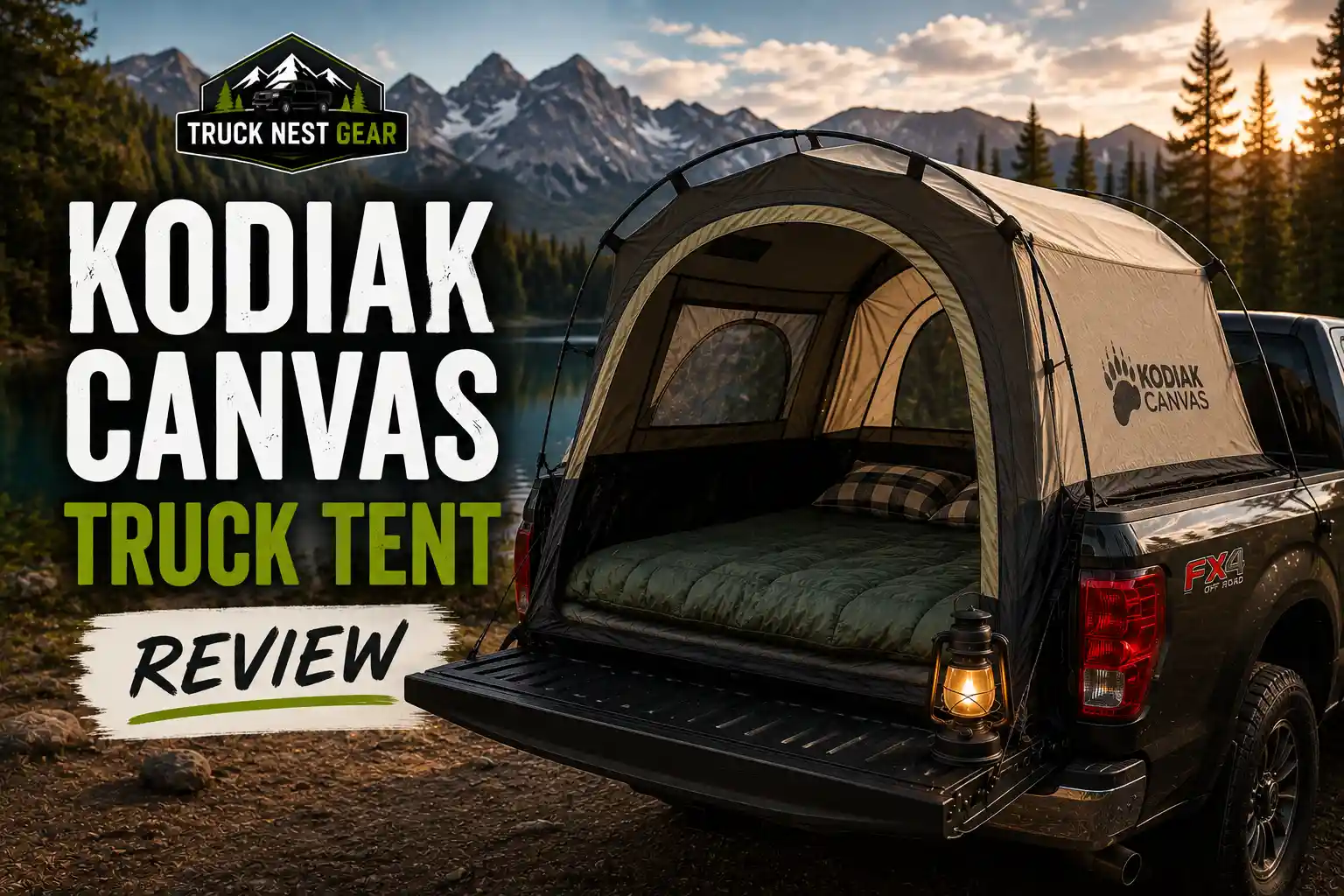
Kodiak Canvas Truck Tent Review (2026): Brand Guide + Honest Assessment
Kodiak Canvas occupies a different tier of the truck bed tent category entirely. Where most competitors build around lightweight nylon or polyester and threaded fiberglass poles, Kodiak builds with 100% cotton duck canvas and a 3/4-inch steel tube frame, a heavier, more expensive, and by owner accounts, dramatically more weatherproof approach.
The company’s truck tent holds 4.6 stars across 583 Amazon reviews, and its own site describes it as the best-selling canvas tent in America. This guide covers Kodiak Canvas as a brand, what makes its canvas construction genuinely different from the synthetic tents covered elsewhere on this site, and an honest breakdown of what owners actually experience once they’ve set one up.
About Kodiak Canvas
Kodiak Canvas is based in Salt Lake City, Utah, and traces its origin to a specific frustration: the founders were dissatisfied with cheap polyester tents and flimsy poles, and couldn’t find a rugged, quality alternative on the market. That led to the 2006 launch of their original Flex-Bow tent built from heavy-duty steel poles and durable cotton canvas, and the company has expanded steadily since, adding a patented Z Top sleeping bag line in 2019 designed to solve a specific problem the founders identified: sleeping bags that were either comfortably loose but drafty, or warm but too constrictive.
The brand is direct about where its tents are manufactured, addressing the question head-on in its own FAQ: production happens in China with an expert canvas tent maker, using cotton grown in the U.S. and top-grade zippers and components, while noting that many competitors marketing tents as “Made in the USA” are frequently using canvas sourced from Pakistan or India regardless. That kind of unprompted transparency about sourcing is unusual in this category and worth noting as a genuine trust signal, whatever you make of the underlying manufacturing debate.
Kodiak backs its tents with a Limited Lifetime Warranty covering defects in materials and workmanship for as long as the original purchaser owns the product, a meaningfully longer commitment than the 1-year warranties standard elsewhere in this category, though it explicitly excludes normal wear and tear like exhausted zippers, weather and animal damage, and damage from mold, mildew, or improper storage.
Why Canvas Changes the Equation
Every other truck tent covered on this site uses synthetic fabric, polyester or nylon, with waterproof ratings measured in PU coating thickness. Kodiak’s canvas approach works on entirely different principles, and understanding this is the key to understanding why owner reviews for this tent read so differently from the rest of the category.
The tent is built from what Kodiak calls Hydra-Shield canvas, a tightly woven cotton duck treated for water resistance while remaining breathable, a real technical tradeoff synthetic tents don’t have to make, since coated polyester blocks both water and airflow together.
Kodiak’s own FAQ is candid that new canvas tents can experience some leaking out of the box, and that the fix is a one-time “seasoning” process: spraying the tent down with water (or setting it up during its first real rainstorm) causes the canvas to shrink slightly and close the tiny needle holes left by stitching. This is standard practice for any canvas tent, not a defect specific to Kodiak, and it’s a meaningfully different first-use ritual than anything required by the synthetic tents in this category.
The frame is 3/4-inch steel tubing rather than fiberglass or aluminum poles, connected to clamp-on rails that mount to the truck bed. That steel construction shows up repeatedly in owner reports as the source of the tent’s standout wind performance; multiple reviewers independently describe the tent holding rigid through 30+ mph gusts and winter storms that damaged or collapsed nearby campers’ gear, with one owner specifically noting the tent “acted like a solid piece of my truck” while the truck itself rocked in the wind.
Who This Tent Is For
This tent is built for a truck owner who camps often enough, in weather serious enough, that canvas durability and genuine four-season performance are worth a meaningfully higher price and heavier setup than a typical synthetic truck tent.
It’s a strong fit for hunters, cold-weather campers, and anyone who camps solo regularly and is willing to invest a few practice setups to get a smooth solo routine down; several long-term owners describe exactly this pattern, going from an hour-plus first attempt to a reliable 15-to-20-minute solo setup once they’d built custom rail extensions or learned the tent’s specific quirks.
It’s a weaker fit for anyone who wants to buy a tent and be camping the same weekend without any practice runs, or anyone unwilling to handle the extra weight; this tent runs roughly 30 pounds, meaningfully heavier than the synthetic alternatives in this category.
What You Actually Get
The tent uses a tunnel-shaped design with a 5-foot ceiling height, a large D-shaped door with YKK zippers, a covered entry, two gear pockets, and five windows, including a dedicated cab access window that lets you reach into your truck’s rear window from inside the tent. It’s rated for compatibility with the Ford F-Series, Chevy Silverado, GMC Sierra, Dodge Ram, Toyota Tundra, and Nissan Titan in full-size configurations.
Waterproofing performance is where owner reports diverge sharply from typical synthetic tent complaints. Once properly seasoned, owners report genuinely exceptional rain and snow performance; one detailed review describes the tent staying up through two full weeks of intermittent Maryland rain with zero leaking, and a Canadian owner reports no condensation or moisture issues at -1°C overnight temperatures.
Kodiak’s own FAQ sets a clear expectation here: a properly sealed tent should stay completely dry inside even during drenching rain, and if leaking does occur, the fix is a specific silicone-based waterproofing spray, Kiwi Camp Dry, Atsko Silicone Water-Guard, 3M Scotchgard Outdoor Water Shield, or Sofsole Heavy-Duty Silicone Waterproofer, applied directly to the affected seam. Critically, the brand explicitly warns against non-silicone treatments like Canvak, since those can clog the canvas’s breathable pores.
Setup is the tent’s most consistent point of friction, and it’s worth addressing directly rather than downplaying it. Nearly every detailed review in the sample, regardless of the reviewer’s camping experience level, describes real difficulty stabilizing the primary support poles solo on the first few attempts, with first-time setups ranging from 20 minutes up to a full 90 minutes for solo campers working out the process for the first time.
Two independent owners solved this the same way: building simple wooden or PVC support jigs to stabilize the main rail poles during setup, since the core problem is the poles wanting to fall over before the canvas is draped across them. Once past that learning curve, two-person setup consistently lands around 15-20 minutes, and solo setup with practice (or a stabilizing jig) drops to a similar range.
The tent’s overall build quality draws some of the most specific praise in the review sample. Owners describe canvas and stitching quality as clearly superior to prior synthetic tents they’d owned, YKK zippers holding up without snagging, and one owner explicitly comparing it favorably to military-grade canvas tents based on a career of military tent experience.
What Owners Actually Report
Fitment is confirmed across a genuinely wide range of trucks by long-term owners, including a Chevy Colorado, a 2014 Dodge 1500 with a 6’4″ box, a 2015 GMC Sierra with a 6’6″ box, a 98 Chevy Silverado, a 2013 F-250, and a GMC Sierra 1500 for the 8-foot version. Several owners specifically address a common size-selection concern from Amazon’s Q&A sections, worried that the smaller model wouldn’t fit their roughly 6.5 to 6.8-foot bed, and report that following Kodiak’s recommended sizing produced a better fit than sizing up, since an oversized tent left excess material rather than a snug, symmetrical fit.
Tonneau cover compatibility comes up repeatedly, and Kodiak’s clamp-on rail system handles this differently than tents relying on truck-bed hooks. One owner with a BakFlip cover fabricated custom spring-clamp attachments since the stock C-clamps couldn’t reach the cover’s inset rails; another owner with a folding bed cover worked out a mounting method for painted, permanently installed rails.
This is more setup customization than most synthetic tents require, but it also means Kodiak’s rail-based mounting system is genuinely adaptable to unusual bed configurations rather than being a fixed, one-size-fits-all hook design.
Cold-weather performance draws consistently strong praise, which makes sense given the brand’s stated four-season design intent. Owners report staying warm through 17°F winter storms with 30+ mph winds, no snow or water intrusion, and one owner running a propane heater on the tailgate reporting the tent got warm enough to need to shut the heater off entirely, with the specific caveat, echoed by Kodiak’s own safety guidance, that adequate ventilation is essential when using any heat source near the tent.
The gap at the tailgate opening comes up as a minor, recurring complaint; several owners note small gaps between the tent and tailgate that let in some wind or require minor sealing with items like cut foam padding to fully block drafts, particularly in genuinely cold conditions.
Long-Term Care Owners Should Know
Kodiak’s own documentation is unusually thorough about long-term canvas care, and it’s worth understanding this before buying rather than discovering it after. The brand is direct that storing a tent wet, even briefly, can ruin the canvas and void the warranty; canvas rot occurs specifically when the material stays in constant contact with moist ground or is packed away before fully drying.
Mold and mildew are preventable with daily airing and occasional direct sunlight exposure, and Kodiak sells a specific mold treatment (Iosso Mold & Mildew Stain Remover) for cases caught early, while acknowledging that canvas far gone with black mold generally can’t be saved and requires a replacement tent body rather than a whole new tent. None of this is unique to Kodiak; it’s inherent to any canvas product, but it is a meaningfully different maintenance relationship than a wipe-down synthetic tent requires.
The Honest Limitations
Solo setup difficulty is the tent’s clearest and most consistently reported drawback. This isn’t a minor first-attempt fumble the way it is with most synthetic tents; multiple independent, experienced campers describe genuine struggle stabilizing the pole structure alone for the first several attempts, with real fixes requiring aftermarket modifications like wooden jigs or drilled pole extensions rather than simply “practicing more.” If you specifically need a tent you can trust to go up solo on the first try, this is worth weighing seriously against the tent’s other strengths.
Weight is a real, if less discussed, tradeoff. At roughly 30 pounds, this tent is meaningfully heavier than the 8-to-16-pound tents common elsewhere in this category, which affects storage and transport, not just setup.
New-tent leaking before seasoning is expected behavior per Kodiak’s own documentation, not a defect, but it does mean the tent isn’t fully rain-ready straight out of the box the way marketing language around “waterproof” might suggest to a first-time buyer. Budget time for the spray-and-dry seasoning process, or plan your first trip around a real rain event, before trusting it in serious weather.
Canvas-specific maintenance is a genuine ongoing responsibility. Between preventing canvas rot, managing mold and mildew risk, and never packing the tent away wet, this tent asks more of its owner over its lifetime than a synthetic alternative; the tradeoff for that added care is a Limited Lifetime Warranty and reportedly exceptional durability, but it’s a real difference in ownership experience worth going in aware of.
Small gaps at the tailgate opening are a minor but recurring complaint, generally solved with basic DIY sealing rather than a design flaw serious enough to affect overall satisfaction, but worth knowing about if you plan to camp in genuinely cold or windy conditions regularly.
Which Trucks It Fits
Kodiak’s truck tent is confirmed compatible with full-size trucks including the Ford F-Series, Chevy Silverado, GMC Sierra, Dodge Ram, Toyota Tundra, and Nissan Titan, sold in sizing that spans roughly 5.5 to 8 feet of bed length.
Given how often bed-length sizing questions come up in the review sample, particularly around trucks near the 6.5-to-6.8-foot range, measuring your exact bed length and following Kodiak’s specific size recommendation rather than assuming “close enough” is worth the extra few minutes.
For a broader look at how to evaluate fit and features across this entire category before committing to a premium canvas option, our truck bed tent buyer’s checklist is a useful starting point.
Final Verdict
Kodiak Canvas earns its reputation through a genuinely different set of tradeoffs than the rest of this category: heavier, pricier, and harder to set up solo on the first several attempts, in exchange for canvas durability, wind resistance, and cold-weather performance that owners consistently describe as a different class of product entirely.
Buy it if you camp seriously and often enough, especially in genuinely cold or windy conditions, that a Limited Lifetime Warranty and steel-frame durability are worth the upfront cost and setup learning curve. Look elsewhere in our full lineup of truck bed tent reviews if you want a tent you can buy Thursday and camp with Saturday, no practice runs required, or if the weight and canvas maintenance routine don’t fit how you actually camp. For the serious, cold-weather, or long-term truck camper, though, this is one of the most trusted names in the category for good reason.
This article contains affiliate links. As an Amazon Associate, TruckNestGear.com earns from qualifying purchases at no additional cost to you.