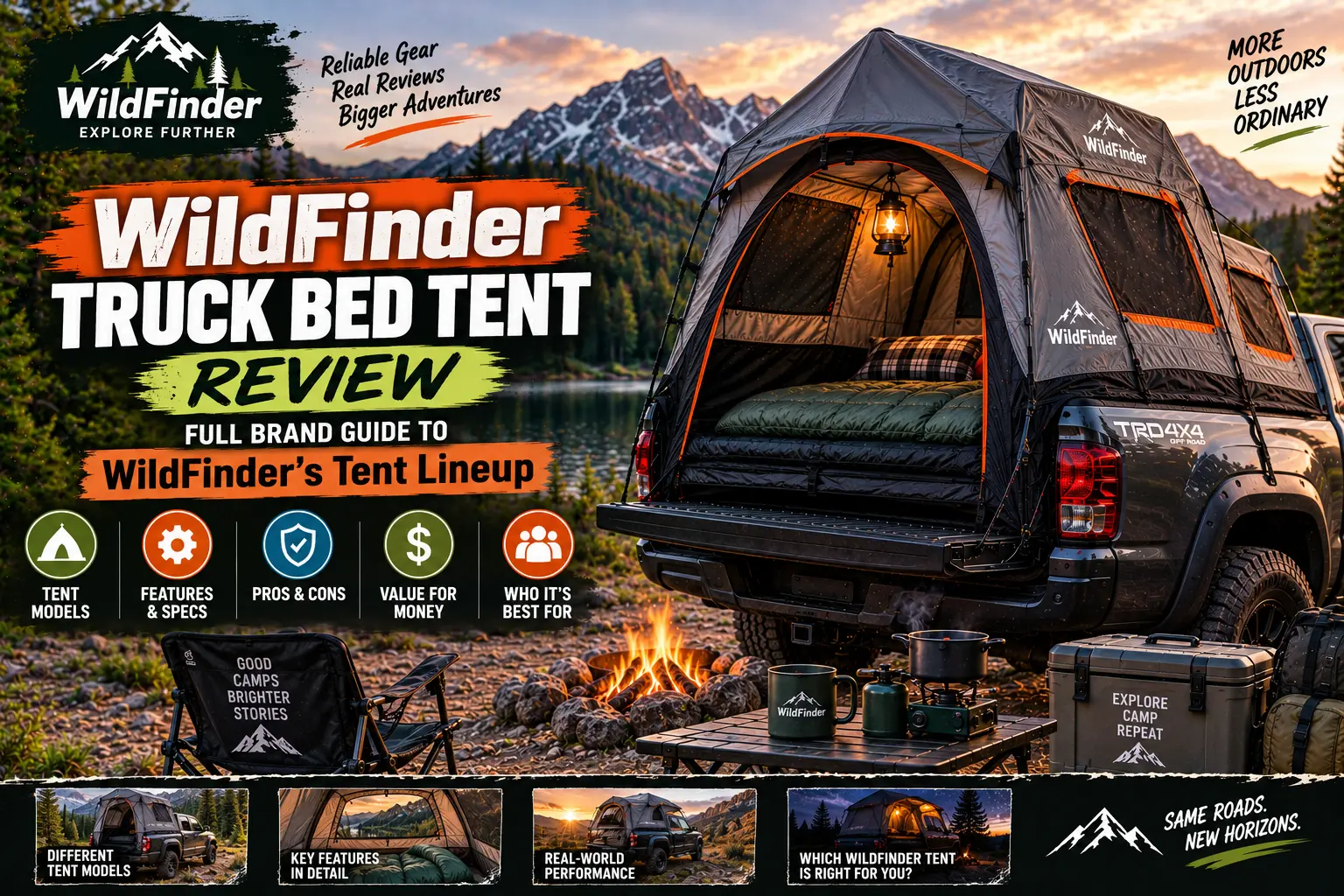
WildFinder Truck Bed Tent Review (2026): Full Brand Guide to WildFinder’s Tent Lineup
WildFinder isn’t a single-product tent company. It sells four distinct camping shelter formats, hard-shell rooftop tents, SUV and truck bed tents, inflatable air-beam tents, and folding camp tables, built around the idea that setup speed shouldn’t come at the cost of real weather protection.
The Truck Bed Tent is the company’s primary pickup-specific product and the one with the deepest base of verified Amazon owner reviews, so this guide goes deepest there, while giving each of WildFinder’s other three tent formats a fair, honest look at what they claim to offer.
About WildFinder
WildFinder’s own account of its founding is straightforward: the company felt that while other camping gear brands kept making tents heavier and slower to pitch, there was room for a brand built around the opposite idea, shelters you can trust in real weather, deployed in minutes rather than hours.
That translates into a genuinely broad catalog rather than one flagship tent iterated on repeatedly, and WildFinder backs its products with a stated Limited Warranty covering material and workmanship defects, handled through Amazon contact channels, with standard exclusions for misuse, improper assembly, and normal wear and tear.
Worth knowing upfront: WildFinder’s own site content, its About page, FAQ answers, and several of its customer “testimonials”, reads in a notably generic, templated style, with repeated boilerplate phrasing across sections (“this section outlines…”, “based on standard tent construction principles”) and short, unverifiable customer quotes attributed to first-name-only personas.
That’s a different category of evidence than a verified Amazon purchase review, and this guide treats it accordingly, useful for understanding what WildFinder claims about its products, but not a substitute for real owner feedback. Fortunately, the Truck Bed Tent has a substantial base of genuine, verified Amazon reviews to draw on instead, and that’s where this guide leans hardest.
The WildFinder Lineup at a Glance
| Truck Bed Tent | Rooftop Tent (Hard Shell) | SUV Tent (Dome, 5-9 Person) | Inflatable Tent (Skylight) | |
|---|---|---|---|---|
| Mounting | Pickup truck bed | Roof rack | Rear hatch attachment | Ground-based, standalone |
| Capacity | 2-4 person | 2-4 person | 5-9 person (4-6 adults comfortably) | 4-7 person depending on size |
| Setup structure | Color-coded pole frame | Gas-assisted hard shell | Pole-based frame | Air-beam, pump-inflated |
| Setup time | Standard manual setup | ~30 seconds (mounted) | ~5 min (2 people) / ~10 min solo | ~5 minutes |
| Waterproof rating | PU3000mm | Not specified by brand | PU3000mm | Not specified by brand |
| Wind resistance | Ground-secured, standard | Vehicle-mounted stability | Tested to force-5 wind | Ground-secured, standard |
| Standalone use | No — requires truck bed | No — requires roof rack | Yes, detaches to ground tent | Yes, always standalone |
| Weight | ~10.2 lbs | Not specified by brand | ~18 lbs | Not specified by brand |
| Best for | Pickup owners, solo/paired camping | Frequent movers, overlanding | Families, SUV/crossover owners | Base camps, group stays |
Truck Bed Tent: Who It’s For
This tent is built for a pickup owner who wants a straightforward, budget-friendly pole tent and is comfortable doing some troubleshooting if their specific unit has a quality-control issue, the review sample for this tent runs a genuinely wide range from delighted to frustrated, more so than most established brands in this category.
It’s a reasonable fit for someone prioritizing price and simplicity over guaranteed consistency, and a weaker fit for anyone who wants confidence that every unit shipped matches the marketing copy exactly.
Truck Bed Tent: What You Actually Get
The tent uses 210D polyester Oxford fabric with a PU3000mm waterproof coating and seam sealing, a genuinely strong number on paper, ahead of the PU2000mm rating common across most budget competitors in this category.
Interior dimensions run 88.6 by 74.8 by 63 inches, officially rated for up to 4 people though WildFinder’s own marketing describes it as comfortably fitting two, with three windows (two for general visibility, one specifically for hunting or wildlife observation) and an internal hook for hanging a light.
A distinctive feature is the “connection tunnel”, a pass-through specifically designed to run power cables or air conditioning from the truck cab into the tent, a feature not every competitor includes standard.
Assembly uses a color-coded aluminum pole system, and the tent is sized for 5.5-to-6-foot beds in the version reviewed here, with additional sizes available for other bed lengths based on the product line WildFinder sells. The tent currently sits at 3.9 stars across 264 Amazon reviews, a noticeably wider spread than the 4.3-to-4.6 star range typical of the established brands covered elsewhere on this site, which lines up with the genuinely mixed review pattern detailed below.
Truck Bed Tent: What Owners Actually Report
Fit and setup draw a real split in owner experience. Several reviewers describe the tent as straightforward once assembled once, one owner specifically praised the fit on a 2020 Ford F-150 short 5’5″ bed and noted plenty of room for a cot with the tailgate down, while another confirmed a clean fit on a GMC Sierra All Terrain in Mexico, adding that it “sealed well” through actual rain.
But fit isn’t universal: one detailed, critical review reports the tent running both too narrow and too short for a properly measured 5.8-foot bed on a 2020 GMC despite matching the tent’s stated 5.5-to-6.0-foot range, and that same reviewer explicitly recommends a Rightline Gear tent instead as the better budget alternative.
Pole durability is the single most recurring concern across the review sample, and it’s worth reporting honestly rather than downplaying. Multiple independent owners specifically report the yellow-coded poles snapping, one during first setup, another on the first two nights of use, with the same color of pole failing each time, suggesting a specific weak point in that component rather than random bad luck.
One reviewer with two decades of fiberglass-pole tent experience across many other brands called the pole failure on this tent unprecedented in their own experience. Seam and stitching issues show up alongside the pole complaints in a few reviews, pulling threads around the doorway zipper in one case, and clip loops tearing under normal tightening pressure in another (though that reviewer was careful to note the failure was arguably due to their own force rather than a clear defect).
Rain and weather performance splits along similar lines to fit and pole quality. One detailed account describes the tent successfully weathering a genuine Pacific Northwest storm with no leaking at all, while another reports the tent holding up to light rain but letting water through during a heavier downpour.
Wind performance draws no specific complaints in the sample. Condensation is flagged specifically by one storm-tested owner, who found bedding getting damp from internal moisture buildup and solved it by cracking the door and running a fan, worth planning for if you camp in genuinely wet, cool conditions, since the tent’s ventilation apparently needs active management rather than passive venting alone in tougher weather.
Tonneau cover compatibility comes up directly in one review: with a folding cover in place, the tent doesn’t sit exactly as intended, shifting back toward the tailgate by roughly 4 inches, still functional, but not a precision fit the way it would be without a cover installed. Setup speed and ease draw consistent praise once past the first attempt, with several owners specifically calling out that assembling the tent on the ground first and then lifting it into the bed works better than trying to build it in place.
Truck Bed Tent: The Honest Limitations
Pole quality is this tent’s clearest and most consistent weak point. The pattern of yellow-coded poles specifically failing, reported independently by multiple owners, suggests a real component-level issue worth taking seriously rather than dismissing as isolated bad units, though it’s also worth noting most reviewers who experienced a broken pole still rated the tent positively overall once they’d worked around it.
Sizing precision is inconsistent enough across reviews that measuring your exact bed dimensions and comparing carefully against the tent’s stated range is more important here than with more established competitors, given at least one detailed report of the tent running short on both width and length despite matching the advertised size bracket.
Condensation management appears to require more active intervention, cracked doors, a fan, than some competing tents in genuinely wet or humid conditions, based on the one detailed storm-test account available.
The 3.9-star rating and the genuine spread between delighted and frustrated owners in this review sample is itself a limitation worth weighing: this isn’t a tent with the tight, consistent quality record that Napier or Rightline Gear have built over years in this category.
Which Trucks the Truck Bed Tent Fits
Based on verified owner reports, the 5.5-to-6.0-foot version fits cleanly on a Ford F-150 with a 5’5″ short bed and a GMC Sierra All Terrain, while at least one owner reports a tighter-than-expected fit on a GMC bed measured at 5.8 feet. Given that inconsistency, measuring your exact bed length, from the inside of the tailgate to the bulkhead behind the cab, before ordering matters more with this tent than with tighter-tolerance competitors. For a broader look at how to take that measurement correctly and cross-check it against any tent’s stated size range, our truck bed tent buying guide is worth reading alongside this review.
Rooftop Tent (Hard Shell)
Who It’s For
WildFinder’s hard-shell rooftop tent is a genuinely different category of product from the truck bed tent, it mounts to a compatible roof rack rather than sitting in a truck bed, and it’s aimed at road-trippers and overlanders who change campsites frequently and want a setup measured in seconds rather than minutes.
This is the pick for someone who moves between short overnight stops often, not someone settling into one site for several days, the core tradeoff of any rooftop tent applies here too: you’re elevated well off the ground, which is genuinely appealing for uneven or wet campsites, but the vehicle stays committed to the tent’s mounting location for the duration of the stay.
What’s Claimed
WildFinder states an aircraft-grade aluminum shell with anti-rust coated steel components, built to hold its shape season after season, and an assisted, gas-strut opening mechanism that deploys the tent in roughly 30 seconds once it’s mounted, no separate pole assembly required the way a truck bed tent needs.
The lineup comes in two capacity tiers, a 2-to-3-person model and a larger 3-to-4-person version, both using the same hard-shell design principle: rigid panels and a hinge system maintain the tent’s shape once open, rather than relying on tensioned fabric and poles the way ground and truck bed tents do.
On weatherproofing, WildFinder’s general fabric specifications for its vehicle-mounted tents state a 5000mm waterproof rating, Level 6 wind resistance, and Level 4 heavy snow protection, notably higher numbers than the PU3000mm rating quoted for the truck bed and SUV tents, though the company’s own product pages list the rooftop tent’s specific waterproof rating as “not listed” on the model-by-model spec sheet, so treat the 5000mm figure as a general brand-level claim rather than a number confirmed on this specific model’s listing.
Integrated features include reinforced stitching, layered insulation, and a built-in LED light strip powered independently of external accessories. Mesh panel ventilation is included to manage condensation and airflow overnight, following the same general design logic used across the rest of WildFinder’s vehicle-mounted lineup.
The Honest Limitation Here
This is the section of WildFinder’s catalog with the least independent verification available. Unlike the Truck Bed Tent, which this guide was able to check against more than 260 real Amazon reviews with specific, sometimes critical owner accounts, the rooftop tent’s claims, the 30-second setup, the 5000mm rating, the anti-rust steel, currently rest on WildFinder’s own marketing copy without a comparable base of verified purchaser feedback to check them against.
If fast, elevated setup is genuinely your priority, this is worth a look, but go in treating the specific performance numbers as manufacturer claims rather than proven track record, and check the current Amazon listing’s own review count and content before buying, since that will have moved since this guide was written.
SUV & Truck Bed Tents (Dome / Rectangle Family Models)
Beyond the pickup-specific truck bed tent, WildFinder also sells SUV-attached tents that connect to a vehicle’s rear hatch rather than sitting inside a truck bed — most notably a dome-style model rated for 5-to-9 people with an 8-foot-by-8-foot floor and 7.2 feet of peak height.
This format is built specifically around vehicles with an upward-lift rear hatch, not side-hinged rear doors, so confirming your vehicle’s hatch style before ordering is a hard requirement rather than a nice-to-have.
WildFinder states the dome uses the same PU3000mm waterproof coating as the truck bed tent, premium fiberglass poles tested to force-5 wind, and roughly an 18-pound packed weight, with the ability to detach and function as a standalone ground tent when you don’t want it connected to the vehicle. Interior touches include a lantern hook and mesh storage pockets, and the tent ships with a carry bag, rainfly, poles, wind ropes, and ground pegs included.
This is the strongest option in WildFinder’s lineup for a family or small group traveling in a single SUV or minivan who want to centralize sleeping and gear storage around the vehicle for a multi-night stay, rather than a solo or paired pickup owner, that use case is better served by the dedicated truck bed tent above.
As with the rooftop tent, this guide did not have access to an independent base of verified owner reviews for this model, so its performance claims should be weighed with the same caution.
Inflatable Tent (Skylight)
Who It’s For
WildFinder’s inflatable tent line replaces poles entirely with reinforced air beams, inflated in roughly 5 minutes with the included pump, and is explicitly marketed as a standalone ground tent rather than a vehicle-mounted product, meaning it doesn’t require a truck or SUV at all, just a flat patch of ground.
This is the right pick within WildFinder’s catalog for a genuinely different use case than the truck bed tent: a stationary base camp where the tent stays pitched for several days rather than being broken down and moved with the vehicle each night, or a group trip where interior floor space matters more than vehicle integration.
What’s Claimed
The brand states 420D Oxford fabric construction, heavier-duty than the 210D fabric used on the truck bed tent, described as waterproof and suited to all four seasons, though WildFinder’s own specification comparison lists the inflatable line’s precise waterproof rating as “not listed” rather than a specific PU number, unlike the truck bed and SUV tents.
Standout features include a large PVC skylight with a removable privacy cover for stargazing, a stove jack for safely venting a wood stove in cold-weather camping, and dual doors with mesh windows for ventilation and bug control on both sides of the structure.
Capacity spans a genuinely wide range depending on which configuration you choose: a mid-size model, a larger model built for 5-to-7 campers, and, at the top of the line, an extra-large configuration WildFinder lists at roughly 157 by 118 by 78 inches, sized for 8 to 12 people with enough height to stand comfortably inside, aimed at family camping, festival use, or larger group base camps.
Setup relies entirely on the air-beam structure achieving shape through internal air pressure rather than poles, which the brand states simplifies deployment meaningfully compared to a traditional pole tent, though as with the rooftop and SUV lines, actual setup time in practice depends on user familiarity, ground conditions, and correct anchoring, factors that a larger base of verified owner reviews would normally help confirm.
The Honest Limitation Here
Air-beam construction is a genuinely different failure mode than the fiberglass poles used on the truck bed tent, and this guide wasn’t able to find an independent, verified review base for WildFinder’s inflatable line the way it could for the truck bed tent.
The stove jack and skylight features are specific and appealing if accurate, but treat the setup-time and durability claims as unverified manufacturer statements until a real track record of owner experience exists to check them against, the same caution that applies to the rooftop and SUV tents above.
Which WildFinder Tent Fits Your Situation
If you own a pickup and want to sleep directly in the bed without any vehicle modification, the Truck Bed Tent is the natural fit, just measure carefully given the fit inconsistencies noted above. If you move between campsites frequently and want the fastest possible setup once parked, the hard-shell Rooftop ,nt trades ground flexibility for that speed.
If you’re traveling as a family or small group in a single SUV or minivan and want to centralize sleeping and storage around the vehicle for a multi-night stay, the SUV Dome Tent is built for exactly that. And if your plan is a stationary base camp, one setup, several days, no vehicle dependency, the Inflatable Tent is the format designed around that specific pattern.
For anyone deciding between the truck bed tent specifically and a Honda Ridgeline’s genuinely unusual bed shape and lockable trunk, our Ridgeline-specific truck tent guide is worth checking before ordering any tent for that platform, since the Ridgeline’s bed geometry doesn’t always match standard pickup sizing charts.
Final Verdict
WildFinder’s broader catalog covers real, distinct camping use cases well on paper, and the company’s stated focus on setup speed and weatherproof fabric construction is a genuinely sensible pitch across all four formats. But the evidence quality varies sharply by product: the Truck Bed Tent has a real, substantial base of verified owner reviews that paint an honest, mixed picture, solid value and decent weatherproofing for many owners, alongside a real and recurring pole-quality issue and some sizing inconsistency worth going in aware of.
The Rooftop Tent, SUV Tent, and Inflatable Tent are harder to vouch for with the same confidence, since this guide wasn’t able to find anywhere near the same volume of independent, verified owner feedback for those three formats specifically.
If you’re a pickup owner considering the Truck Bed Tent, buy with realistic expectations about pole durability and take the extra step of measuring your bed precisely. If you’re considering one of WildFinder’s other three formats, weigh the brand’s own claims a little more skeptically until a larger, more established review record exists to check them against.
This article contains affiliate links. As an Amazon Associate, TruckNestGear.com earns from qualifying purchases at no additional cost to you.