VEVOR Truck Bed Tent Review (2026): Brand Guide + Honest Assessment
VEVOR is a different kind of company than every other brand covered on this site. It isn’t a tent specialist, it’s a global equipment and tools retailer, founded in 2007 in Shanghai, that now sells across more than 30 product categories ranging from power tools and welding equipment to hydroponics gear and forestry equipment. The Truck Bed Tent covered here, sized for 5.5- to 6-foot pickup beds with a PU2000mm waterproof rating, is a small piece of a genuinely massive catalog rather than a flagship product the way the Backroadz is for Napier or the Flex-Bow line is for Kodiak. Understanding that context matters for reading the rest of this review honestly.
About VEVOR
VEVOR’s own positioning is built around one core promise: professional-grade equipment at a meaningfully lower price than established specialty brands, achieved through scale and lean manufacturing rather than category focus. The company reports serving more than 30 million customers across 50-plus countries through a network of over 180 warehouses, and its catalog spans thousands of SKUs across categories as varied as commercial kitchen equipment, automotive gear, and industrial machinery.
That breadth is the brand’s whole business model, VEVOR isn’t trying to out-engineer Napier or Kodiak Canvas on truck tent specifics, it’s trying to offer a “good enough” version of nearly everything at a lower price point than specialists charge.
That business model has a direct, verifiable consequence for this specific product. One detailed UK reviewer, after struggling with confusing instructions and mismatched pole segments, did some digging and reported that the exact same tent is sold under several different brand names at prices ranging from roughly £39 to £120, with VEVOR’s version simply carrying VEVOR’s name stamped on otherwise identical hardware.
This lines up with how VEVOR’s business model actually works, a multi-category retailer selling manufacturer-sourced products across dozens of unrelated categories, rather than a company that designs and iterates on its own tent engineering the way Napier or Rightline Gear do. Take this as one reviewer’s observation rather than a confirmed fact, but it’s consistent with what you’d expect from a company built the way VEVOR is.
Who This Tent Is For
This tent is a reasonable fit for someone who wants to try truck bed camping at the lowest possible price point and is comfortable troubleshooting assembly issues without much manufacturer hand-holding. It’s a weaker fit for anyone who wants clear, accurate instructions on the first attempt, or anyone driving a non-North American pickup; several reviewers report real fitment problems specific to trucks common outside the U.S. market.
What You Actually Get
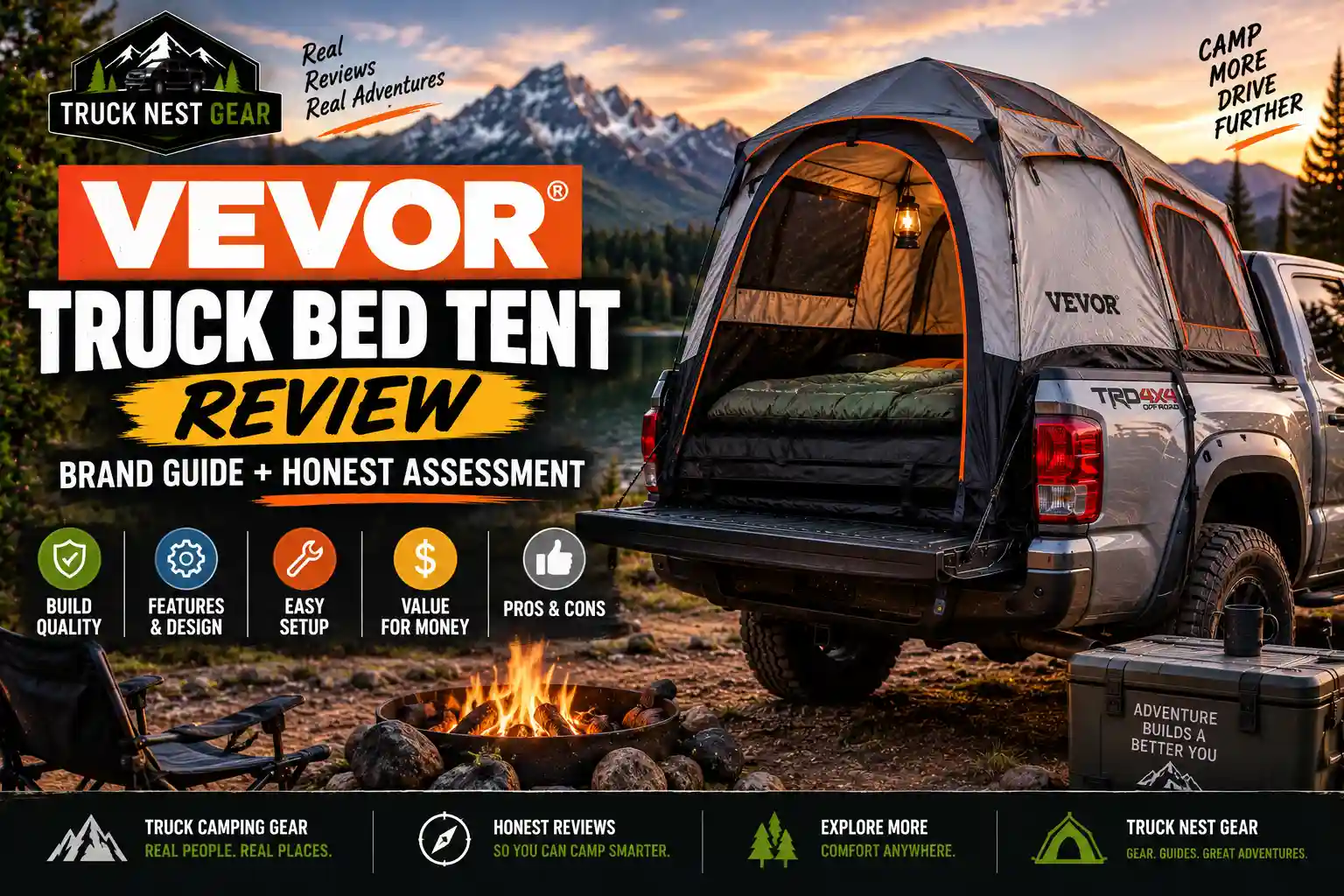
The tent is rated for a 5.5-to-6-foot bed and lists compatibility with the Ford F-150, Dodge Ram 1500, GMC Sierra, Chevrolet Silverado, Nissan Titan, and Toyota Tundra. Construction uses 9mm thickened fiberglass poles described as corrosion-resistant, a streamlined design meant to reduce wind resistance, and a stated ability to withstand force 5 winds (roughly 19-24 mph on the Beaufort scale), a specific, checkable claim rather than vague marketing language, though it’s worth noting force 5 is moderate breeze territory, not a storm-level rating.
Waterproofing is rated at PU2000mm with a double-layer design and a 120g fully sewn PE floor using a waterproof pressing process, aimed at keeping the interior dry during heavy rain. Headroom in the middle of the tent runs 5.58 feet, and the tent is marketed for 3-person occupancy, though the interior dimensions suggest a cozy fit for three adults rather than a spacious one. Ventilation comes from high-density mesh windows designed to keep bugs out in summer conditions, plus a smaller window in the outer rainfly layer specifically to maintain airflow with the rainfly attached.
The listing’s own safety documentation is worth noting directly: it includes explicit warnings that the tent isn’t intended for children under 36 months, requires direct adult supervision for any child use, and should never be used near overhead power lines or during thunderstorms, standard tent safety boilerplate, but worth reading since it’s more prominent in this listing than in most competitor pages.
What Owners Actually Report
Fitment reports are mixed in a way that’s specifically tied to which country’s truck market the buyer is in. On North American-style trucks, fit is generally reported as workable, one owner with a 2019 Chevy Colorado described the tent working out perfectly despite initial worry about sizing, with a solo setup completed in about 10 minutes.
But the sizing story is meaningfully different for buyers with non-U.S.-market pickups. One detailed UK review specifically flagged that the tent runs 15-20cm too wide for a genuinely compact truck bed like a Mitsubishi L200 double cab, common across UK, EU, and Asian pickup markets, resulting in wrinkled excess fabric under the tent floor, workable but clearly not a precision fit.
Another owner testing the tent on a Ford Ranger Wildtrak (a global-market Ranger, distinct from the U.S. Ranger) reported the tent ran a bit long on the sides of the bed but was manageable with some adjustment.
Instructions and included parts are the clearest, most specific complaint in the review sample. One detailed reviewer described the printed instructions as referencing poles that don’t exist in the actual package, encountering one pole segment that was precisely one section too long, and finding two extra unlabeled segments not mentioned anywhere in the instructions or parts list, ultimately solving the mismatch by taping the extra segment to an adjacent one rather than getting a clear answer from the manual. This is a more serious documentation problem than the “instructions could be clearer” complaints common across the budget end of this category generally.
Setup speed, when the parts and instructions do line up correctly, is reported as genuinely fast, multiple reviewers across different countries describe straightforward assembly, including one reviewer specifically noting a five-foot-two solo camper completed setup in about 10 minutes with no help. Rain performance also draws some positive, if limited, feedback: one owner reported the tent handling a night of genuine rain and wind without leaking, and a French reviewer’s brief but positive review echoed the same.
One specific setup caution comes up independently in an Italian-language review: don’t overtighten the tent’s securing straps, since doing so risks tearing the seams. This is the same overtightening warning that shows up across nearly every tent in this category from every brand, but it’s worth repeating here since it appears as a direct, specific caution from an owner rather than manufacturer boilerplate.
The Honest Limitations
Instruction quality and parts consistency is this tent’s clearest weak point, based on the most detailed review in the sample. A tent that ships with mismatched pole lengths, undocumented spare parts, and instructions referencing components that don’t match what’s in the box is a meaningfully worse out-of-box experience than any other brand covered in this guide, all of which at minimum ship instructions that match their actual hardware.
Fitment on non-U.S.-market truck beds is a real, specific limitation rather than a general caution. If you’re shopping for this tent for a genuinely compact pickup common outside North America, an L200, a global-market Ranger, or similar, expect the tent to run wider than your bed, resulting in excess material and wrinkles you’ll need to work around rather than a precision fit.
The brand’s own manufacturing model, mass-sourced products resold across dozens of unrelated categories rather than tents engineered and refined by a specialist, means you’re less likely to get brand-specific innovation or iteration here compared to a company like Napier or Rightline Gear that lives and dies by its tent lineup specifically.
One reviewer’s finding that ostensibly identical tents show up under multiple different brand names at different price points is consistent with this model, and it’s worth knowing before you pay a premium for the VEVOR name specifically over a cheaper unbranded or differently-branded equivalent.
Force 5 wind resistance, while a specific and checkable claim, tops out at a moderate breeze rather than genuinely severe weather, treat this as a real spec worth knowing, not a marketing exaggeration, but also not a promise of storm-level performance the way the steel-framed Kodiak Canvas tent claims.
Which Trucks It Fits
For North American buyers, VEVOR’s own compatibility list covers the Ford F-150, Dodge Ram 1500, GMC Sierra, Chevrolet Silverado, Nissan Titan, and Toyota Tundra in the 5.5-to-6-foot bed size, with other VEVOR truck tent listings covering additional sizes down to roughly 5 feet and up past 6.5 feet for different truck platforms.
If you’re specifically shopping in the budget tier of this category and want a broader sense of what else is available at a similar price point before deciding, our guide to the best cheap truck tents under $150 is a useful next stop. As with every tent in this category, measuring your exact bed length by hand before ordering matters, doubly so here, given the documented fit issues on non-standard bed shapes.
Final Verdict
VEVOR’s truck bed tent is a genuinely low-cost entry point into truck camping, and for a straightforward North American full-size truck bed, several owners report it working exactly as advertised, quick setup, decent rain performance, and a price well below the specialist brands covered elsewhere on this site. But it comes from a company whose entire business model is built on breadth rather than tent-specific expertise, and the most detailed review in the sample, mismatched parts, contradictory instructions, is a real warning sign about quality control consistency you’re less likely to encounter from a company that lives and dies by getting truck tents specifically right. Buy it if the price gap over a specialist brand is what matters most to you, you’re comfortable troubleshooting a parts or instructions mismatch if you get an inconsistent unit, and you’re on a standard North American full-size bed. Look toward a dedicated tent brand if you want confidence that the box you open matches the manual inside it, or if you’re outfitting a compact or non-U.S.-market truck bed where this tent’s fit has been specifically reported as too wide.
This article contains affiliate links. As an Amazon Associate, TruckNestGear.com earns from qualifying purchases at no additional cost to you.