
10 Sleeping Tips for Truck Bed Tent Campers That Actually Make a Difference
Sleeping well in a truck bed tent is not automatic. The first night often produces a passable result; you slept, technically. The third or fourth trip, after applying what you learned on the first two, produces something genuinely better than a hotel room.
The gap between those two experiences is almost always explained by the same set of avoidable mistakes. This guide covers the ten sleeping tips that experienced truck bed tent campers have consistently found most impactful, specific to the truck bed tent format, not generic camping advice recycled for a different context.
Tip 1: Fix the Floor Before Everything Else
The single most common sleeping quality problem in truck bed tent camping is not the tent, not the sleeping bag, and not the campsite. It is the metal truck bed directly beneath the sleeping surface.
Steel and aluminum conduct heat away from anything resting on them significantly faster than soil, grass, or any surface a ground tent sits on. A sleeping bag rated to 35°F placed on a bare metal truck bed in 45°F conditions will not perform to its rating; the metal defeats the bag’s floor insulation from below faster than the bag compensates.
The fix has two components. Place a closed-cell foam pad, the accordion-fold type like the Therm-a-Rest Z Lite Sol, directly on the metal bed surface as a base layer. It cannot compress, cannot absorb moisture, and creates the thermal break the sleeping bag assumes is there. On top of the foam base, add your air mattress, self-inflating pad, or cot. This two-layer system addresses the problem at its source.
Everything else in this guide improves sleep quality at the margins. This one fixes the foundation that all other improvements build on.
Tip 2: Rate Your Sleeping Bag for the Metal Bed, Not the Forecast
Sleeping bag temperature ratings are established in laboratory conditions that include an insulating pad beneath the bag. The metal truck bed is not that surface; even with a two-layer floor system in place, a 20°F buffer between the bag’s lower limit rating and the expected overnight low is the appropriate margin for truck bed tent camping.
If the forecast overnight low is 40°F, use a bag rated to 20°F. If the forecast is 25°F, use a bag rated to 0°F or below. This sounds like significant over-preparation until the first night you apply it correctly and wake up genuinely warm rather than technically not cold.
A sleeping bag liner adds 10 to 25°F of adjustable warmth without requiring a separate bag for each temperature range. A merino wool liner manages moisture actively, which matters in a truck tent where condensation accumulates on cool nights. A synthetic liner retains warmth even when damp, the better choice for consistently cool, humid conditions.
Tip 3: Wear the Right Clothes to Sleep
What you wear to sleep affects the sleeping system’s effective temperature range more than most campers realize. The layering principle is simple: moisture-wicking base layer next to skin, insulating mid-layer when needed, extremities always covered in cool conditions.
Avoid cotton base layers entirely in any camping below 60°F. Cotton absorbs and holds moisture against your skin; sweat that does not wick away accelerates heat loss. Merino wool or synthetic moisture-wicking fabric moves perspiration away from your skin continuously, keeping the sleeping environment between your skin and the bag dry and insulating.
Cover your extremities. Heat loss from the head, hands, and feet is disproportionate to their surface area. A wool beanie, liner gloves, and wool or synthetic socks on a cold night add more effective warmth per ounce than any other addition to the sleep system.
Many experienced truck bed tent campers keep a chemical hand warmer in each sock on genuinely cold nights, a low-tech solution that is consistently effective at 10 cents per night.
The modular layering approach, sleeping in a base layer with a lightweight insulated jacket and pants available to add inside the bag, allows temperature adjustment without exiting the sleeping bag. This flexibility is particularly valuable in fall when overnight temperatures can shift 20 to 30°F from one night to the next at the same campsite.
Tip 4: Pre-Warm Your Sleeping Bag Before You Climb In
A cold sleeping bag in cold temperatures requires your body heat alone to warm the interior to a comfortable temperature. In genuinely cold conditions, this process takes 20 to 40 minutes of shivering, during which your core temperature is dropping rather than stabilizing. Starting the night with a shivering period reduces total sleep quality across the entire night, not just for those 40 minutes.
Pre-warm the bag before climbing in. A stainless steel water bottle filled with hot water from dinner preparation and placed inside the sleeping bag 20 to 30 minutes before sleep warms the bag interior and maintains heat for 3 to 5 hours. A battery-powered electric blanket inside the bag for 15 minutes before use warms the entire interior more evenly than a single hot water bottle.
The cab access panel available on premium truck bed tent models, including the Napier Sportz 57 Series, allows a power cord from the truck’s interior into the tent, making an electric heated blanket or heated mattress pad practical for the entire night rather than just the pre-sleep period.
Tip 5: Manage Ventilation Deliberately: It Applies to Both Hot and Cold Nights
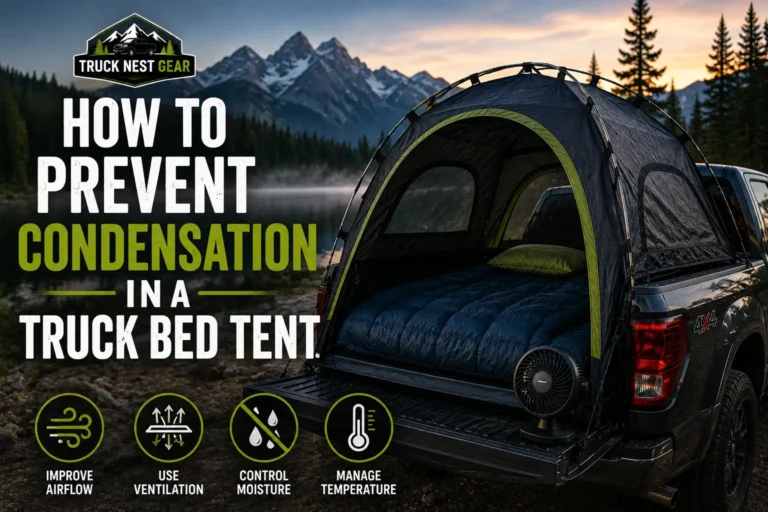
The counterintuitive sleeping tip that most truck bed tent campers discover after their first condensation-soaked sleeping bag: you need more ventilation on cold nights than your instincts suggest.
On cool nights, a completely sealed tent allows warm, moist air from breathing to accumulate against the cooler tent walls and condense into liquid. By morning, the inner tent walls are dripping, the sleeping bag exterior is damp, and a wet sleeping bag exterior means a sleeping bag that is losing thermal efficiency.
Two to three inches of open mesh window on the lee side of the tent, away from the prevailing wind, allows enough airflow to carry moisture vapor out before it condenses without creating a meaningful cold draft.
On hot summer nights, the approach reverses: remove the rainfly, open all mesh windows, and position a fan to create directional airflow from the cab end toward the tailgate entry. Heat rising from the metal bed has a path out. The breeze you would have blocked with the rainfly now cools the sleeping surface directly.
The common principle across both conditions: passive ventilation through open mesh is always better than a sealed tent, and the right amount varies by temperature and humidity. Two or three nights of adjustment establishes the specific balance for your tent, your climate, and your own body’s moisture output.
Tip 6: Choose Your Campsite for Sleep Specifically
The campsite you choose determines the sleeping environment before you unpack a single piece of gear. Decisions made during campsite selection, levelness, surface type, wind exposure, and sun angle, are more impactful on sleep quality than most gear decisions made at the gear store.
Levelness first. A slope that looks insignificant from outside the truck becomes a constant pull toward the tailgate end of the sleeping surface throughout the night. Test levelness by lying in the empty truck bed for 30 seconds; if you feel any slide or brace tendency, find a flatter position or use leveling blocks under the low-side tires.
Orient for your season. In cold weather and wind, position the cab facing the prevailing wind direction; the solid cab wall becomes a windbreak for the tent. In summer, position the tailgate to face the prevailing breeze; the tailgate mesh becomes the ventilation inlet for cooling airflow through the tent.
Avoid east-facing tailgates in summer. Sunrise directly into the tent entry at 5:30 AM ends comfortable sleeping an hour or more earlier than a west, or north-facing position would.
Stay 200 feet from water. Camping near water sources is pleasant but increases overnight humidity, which is the driving factor in condensation accumulation. The regulatory minimum of 200 feet from streams and lakes is also approximately the distance at which humidity levels begin to normalize relative to the surrounding terrain.
Tip 7: Address the Tailgate Gap on Cold Nights
The junction between the tailgate sleeve and the truck’s tailgate surface is the primary cold air infiltration point in a truck bed tent. Even a correctly fitted tailgate sleeve allows cold air convection between the sleeve fabric and the tailgate metal surface, enough to create a perceptible draft that lowers the effective sleeping temperature by several degrees over a full night.
A reflective foam windshield sunshade cut to fit the inside face of your tailgate and placed inside the tent at the tailgate before sleeping eliminates this convection. Available at any auto parts store for under five dollars and weighing less than half a pound, this is the highest value-per-dollar cold-weather sleeping improvement in the truck bed tent system that no product manual covers.
Additionally, confirm that the tailgate sleeve’s bottom closures are fully engaged with no gap at the sides or bottom. Even a two-inch gap along the tailgate edge allows enough cold air to enter the sleeping space to noticeably affect overnight comfort.
Tip 8: Adjust Your Sleep Expectations for the First Two Nights
The first night in a new tent at a new campsite almost always produces lower sleep quality than subsequent nights, regardless of how well the gear is set up. Sleep research consistently shows that the brain maintains partial vigilance in an unfamiliar environment, a phenomenon known as the “first night effect”, which reduces deep sleep stages on night one.
This matters for truck bed tent camping specifically because many campers conclude after one uncomfortable first night that truck camping is not for them. The first night discomfort is partly the unfamiliar environment, partly the learning curve on ventilation adjustment and campsite levelness, and partly the accumulated minor setup errors that experience corrects automatically.
Give the system two nights before concluding. The second night at the same campsite consistently produces better sleep than the first. The third is typically excellent. The improvement is not in the gear; it is in the accumulated micro-adjustments that each night’s experience informs.
Tip 9: Noise and Light Management
Truck bed tent camping involves sounds and light sources that a bedroom does not: wind on the rainfly, rain on the tent fabric, truck engine noise from adjacent campers, and sunrise entering through mesh windows earlier than anticipated.
Foam earplugs rated at 33 NRR, the highest standard rating, reduce wind and rain noise to a level that allows uninterrupted sleep in all but the most extreme conditions. A contoured sleep mask blocks early morning light without the pressure against the eyes that flat masks create.
Both items weigh under two ounces combined and cost under ten dollars. They are among the most impactful sleep quality additions available per dollar and per gram in the entire truck camping kit.
For stargazing nights when the rainfly is removed, early morning light is an especially relevant factor; the mesh roof provides no light blocking whatsoever. A sleep mask is the only solution in this configuration.
Tip 10: Build a Consistent Pre-Sleep Routine at Camp
The habits you establish before getting into the sleeping bag directly affect how quickly you fall asleep and how deeply you sleep. A consistent campsite pre-sleep routine, repeated the same way each night, signals the brain that sleep is approaching and reduces the time spent in the half-awake state after getting into the bag.
A useful truck bed tent pre-sleep routine:
Finish eating and cooking at least one hour before planned sleep time. Digestion raises core body temperature, which conflicts with the core temperature drop that initiates deep sleep.
Take a few minutes to organize the tent interior before getting in the bag, headlamp accessible, water bottle within reach, phone stored in the gear pocket. Reaching for items in the dark at 2 AM disrupts sleep more thoroughly than the time it takes to organize them before sleep.
Close all unnecessary windows and secure the tailgate sleeve before getting into the bag. Discovering a gap or a loose closure after getting settled requires exiting the sleeping bag, which in cool conditions means a restart of the warming process.
Lower your light exposure in the last 30 minutes before sleep. A red-light headlamp mode preserves the melatonin suppression that white light destroys. For stargazing campers, avoiding white light from the phone screen in the last half hour before sleep improves sleep onset significantly.
The routine itself is less important than its consistency. Repeated the same way each night, it becomes a reliable sleep onset signal that works at any campsite in any conditions.
The Sleep System Summary
The ten tips in this guide cover every layer of the truck bed tent sleeping experience, from the foundation (the metal bed and floor insulation) through the sleeping surface, the bag and clothing, the ventilation balance, the campsite decisions, and the pre-sleep habits that prepare the mind and body for genuine rest.
None of them are complicated. None require expensive gear. They are the accumulated practical knowledge of what experienced truck bed tent campers have found consistently impactful across many seasons of sleeping in truck beds in every condition, from summer desert heat to November hunting camps.
The first night you apply all ten, deliberately, as a system rather than individually, is usually the night that turns occasional truck camping into a regular part of your camping life.