
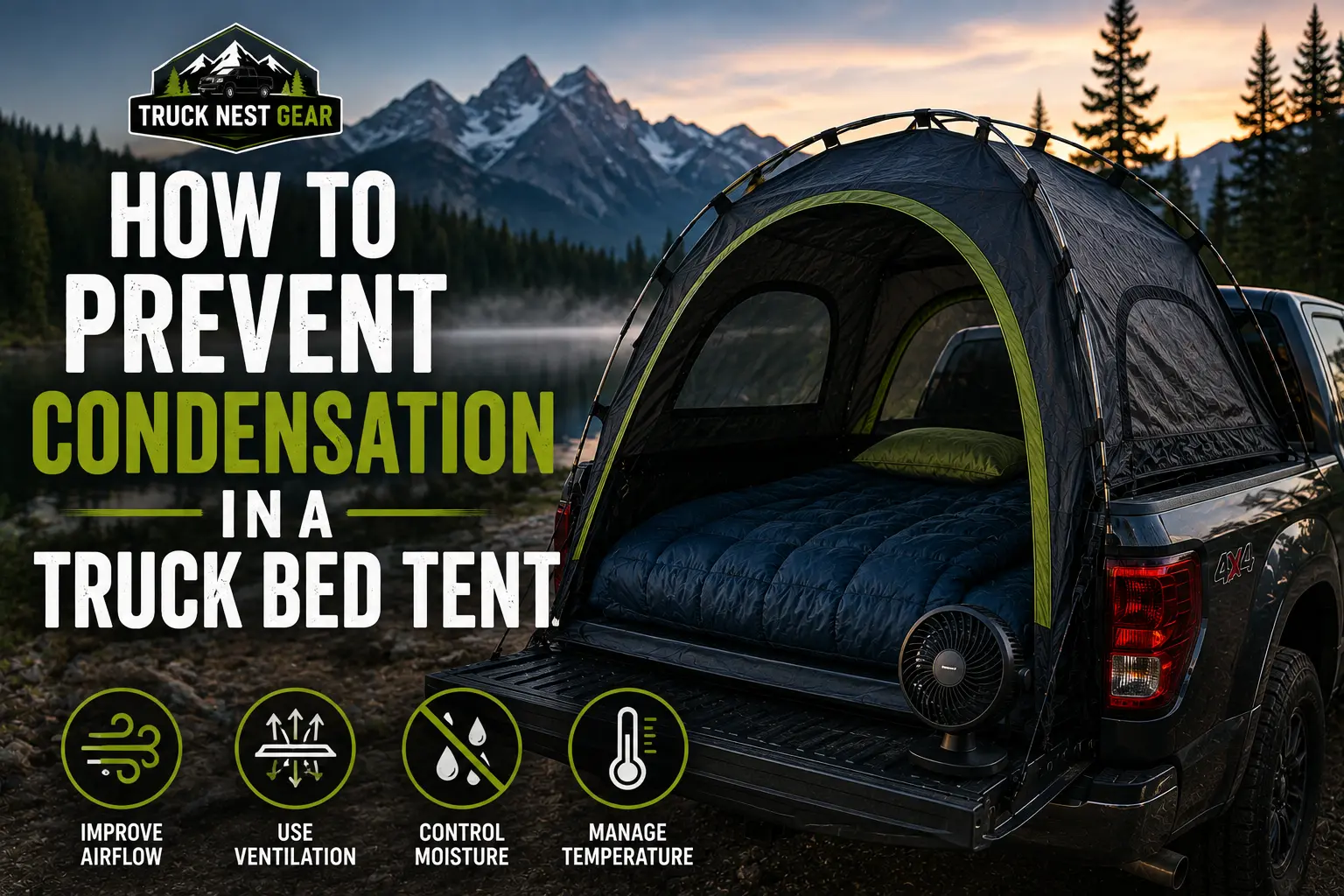
How to Prevent Condensation in a Truck Bed Tent
You wake up at 3 AM and reach for your water bottle. Your hand touches the tent wall instead. It is soaking wet. Your sleeping bag has a damp patch on the outside. Your gear bag is beaded with moisture. The temperature outside is 42°F, and it has not rained once.
This is condensation, and it is the most misdiagnosed problem in truck bed tent camping.
Most campers who experience a wet tent interior after a dry night assume the tent leaked. They apply seam sealer, reapply DWR, replace the rainfly, and wake up wet again on the next trip. The seams were never the problem. The problem was physics, and the solution is ventilation, not waterproofing.
Understanding exactly why condensation happens in a truck bed tent, and why it happens differently than in a ground tent, is the foundation of every practical technique in this guide.
The Science: Why Your Tent Gets Wet Without Rain
Dew point is the temperature air must reach on any given night to become completely saturated, reaching 100 percent relative humidity. When temperatures cool at night and approach the dew point, water vapor in the air condenses on every surface available: grass, moss, leaves, your tent.
The mechanism inside a tent is straightforward. Condensation forms when warm, moist air from breathing hits cold tent fabric and reaches its dew point. You are the warm, humid room, and the tent fabric is the cold glass.
Think of a cold glass of water on a humid summer day; droplets form on the outside because the glass surface is cooler than the surrounding air’s dew point. Your tent walls do the same thing, but in reverse: the warm moist air is inside the tent, and the cold surface is the tent fabric exposed to outside temperatures.
The biggest source of humidity inside a tent is not the outside environment; it is the occupants themselves. A single sleeping adult exhales approximately one liter of water vapor per night through breathing alone. A second person doubles that. Add moisture from wet gear, damp clothing, and any cooking done inside the tent, and the interior humidity accumulates rapidly toward the dew point of the outer tent surface.
On clear, calm nights, tent fabric loses heat to the open sky faster than the air inside cools. The fabric surface temperature can drop 5 to 10°C below ambient air temperature, which is why condensation is often worse on clear, cold nights than on mild, overcast nights. Clouds act as an insulating blanket; without them, your tent fabric radiates heat directly into space.
This explains the experience that confuses many campers: more condensation on a clear, cold night than on a rainy one. Clear skies mean no insulating cloud cover, which means the tent fabric gets colder faster, which means it reaches the dew point sooner.
Why Truck Bed Tents Have More Condensation Than Ground Tents
Everything described above applies to any tent. Truck bed tents have three additional factors that amplify the condensation problem compared to ground tents in the same conditions.
- The metal truck bed below you
The steel or aluminum truck bed conducts heat away from the sleeping environment significantly faster than the soil beneath a ground tent. The metal bed radiates cold upward into the tent interior, accelerating the temperature differential between the warm moist air you exhale and the cool surfaces it contacts. This means the dew point is reached inside a truck bed tent at higher ambient temperatures than it would be in a ground tent with the same ventilation.
- The cab wall creates a sealed end
A truck bed tent has one end, the cab wall, that is a solid, unventilated barrier. In a freestanding ground tent, all four walls are fabric with ventilation potential. In a truck bed tent, one end is permanently blocked by a metal wall with no airflow through it. This reduces the effective ventilation perimeter by approximately 25 percent and creates a pocket of still, humid air at the cab end of the tent where condensation accumulates first.
- The enclosed truck body retains ambient moisture
If the truck bed has been carrying wet gear, a wet sleeping pad, or anything that introduced moisture before the tent was deployed, that moisture remains in the sleeping environment through the night and contributes to interior humidity that a ground tent parked on dry grass would not accumulate.
What Condensation Is Not
Before covering solutions, eliminating the most common misdiagnosis saves time and money.
- Condensation is not a waterproofing failure
Water on the inside of a tent on a dry night came from inside the tent, not through the fabric. Applying seam sealer to a condensation problem fixes nothing. Reapplying DWR to a condensation problem fixes nothing. The tent is not leaking; it is sweating.
- How to tell the difference
Condensation appears across the entire inner surface of the tent walls and ceiling in a relatively uniform distribution. A genuine leak appears at a specific location, a seam, a pole sleeve, the tailgate sleeve junction, and drips in a concentrated area. Condensation produces a fine damp layer everywhere. Leaks produce specific wet spots below the entry point.
If your truck bed tent is wet on the inside on a dry night with uniform moisture distribution, the problem is condensation. Treat it with ventilation, not with waterproofing products.
Technique 1: Campsite Selection, Start Before Setup
Humidity is higher near streams, lakes, ponds, and other wet areas. Steer clear of campsites near these water features to reduce the potential for tent condensation.
Low-lying valleys tend to collect cool air and have far more ground moisture because airflow is diminished. When possible, choose higher points with warmer temperatures and a bit better airflow.
For truck bed tent camping, campsite selection has two condensation-specific considerations beyond the general guidance above.
- Avoid lush, wet grass
Ground moisture rises from lush, green grass, especially after rain. It produces humidity at a level on par with a sauna by the end of the day. Parking on gravel, hardpan, or dry compacted soil rather than wet grass reduces the ambient humidity that contributes to condensation from below the truck.
- Choose positions with airflow across the truck
A campsite in a natural wind corridor, not enough wind to create structural challenges for the tent, but enough to maintain gentle airflow across the truck bed, helps exchange the humid air near the tent walls with drier ambient air. A completely still campsite in a hollow or behind a dense windbreak creates the calm, still conditions where condensation accumulates fastest.
Technique 2: The Rainfly Air Gap, The Most Important Single Factor
Double-layer tent models have a frame, an outer fly and an inner fly with an air gap in between. The dew point is in the space between the layers, where condensation collects. The interior stays dry.
The air gap between your truck tent’s rainfly and the inner tent body is not aesthetic or structural; it is the primary mechanism by which condensation is managed on the tent walls. The gap allows air circulation between the inner tent and the outer fly.
Moisture vapor passes through the inner mesh or permeable fabric, crosses the air gap, and either exits through the fly vents or condenses on the inner surface of the outer fly rather than on the inner tent walls that contact your sleeping bag.
When the rainfly sags and contacts the inner tent walls because guy lines are not staked and tensioned, the air gap collapses. Condensation then forms on the inner tent wall rather than on the outer fly surface. You wake up with wet tent walls at face level rather than moisture on the outer surface that sheds away from the sleeping area.
Always stake and tension the rainfly guy lines, even on calm nights when wind is not a concern. This is the single most impactful condensation prevention step available in a truck bed tent setup. The guy lines are not for wind; they are for maintaining the air gap that keeps the sleeping area dry.
Additionally, confirm that the rainfly extends at least 6 to 8 inches past the tent body walls on all sides. A rainfly that sits close to the tent walls allows air circulation to bridge the gap between inner and outer surfaces, reducing the effective insulation of the gap.
Technique 3: Ventilation, Counterintuitive but Non-Negotiable
The instinct on a cold night is to seal every opening and eliminate every draft. Keep ventilation open in any weather. This ensures constant airflow and reduces condensation. If the interior of your shelter becomes warmer or more humid than the exterior, condensation will occur. This is the controllable factor.
Open opposing mesh windows, one on each side of the tent, to create cross-ventilation. A single open window creates stagnant air. Two opposing windows on opposite walls create actual airflow that carries moisture vapor out of the tent interior before it reaches dew point on the tent walls.
Open the roof vent or peak vent. Warm, moist air rises. A roof vent allows this rising moisture-laden air to exit at its highest point before it contacts the cooler tent walls and condenses. A peak vent open even slightly on all but the most extreme weather nights makes a measurable difference in interior humidity.
The correct window opening amount. A 2 to 3-inch opening on the lee side of the tent, the side facing away from the prevailing wind, provides sufficient airflow for moisture exchange without creating a cold draft across the sleeping surface. This is not a large opening. It is specifically sized to allow moisture vapor out without allowing cold air to blow directly on you.
Test and calibrate across two or three nights. If you wake up with heavy condensation on the inner tent walls, increase ventilation slightly. If you wake up cold with dry inner walls, reduce ventilation slightly. The optimal balance point varies by temperature, humidity, number of occupants, and tent design. Two or three nights of adjustment establishes your specific balance.
Technique 4: A Camping Fan Is More Effective Than You Think
A camping fan running on low speed on the far side of the tent from the sleeping surface actively moves air through the tent interior rather than relying on passive convection through open windows. Active airflow carries moisture vapor to the ventilation openings before it reaches the dew point on the tent walls.
Battery fans outperform moisture absorbers in calm conditions. On still nights, when there is no wind to drive passive ventilation through open windows, a fan provides the airflow that window openings cannot deliver on their own.
The correct fan positioning: place the fan on the cab side of the tent, drawing air from the cab-end pocket where condensation accumulates first in truck bed tents, and directing it toward the tailgate entry. This addresses the dead-air zone that the solid cab wall creates in a truck bed tent that a ground tent does not experience.
At one amp average draw on low speed, a 10,000mAh portable power bank runs a quality camping fan for 8 to 12 hours, sufficient for a full night without recharging. For truck bed tent campers with a portable power station, the fan draws negligible capacity from the battery.
Technique 5: Manage Moisture Sources Inside the Tent
Avoid storing wet clothes inside. Dry them outside if possible. Wet clothing, gear, and footwear inside the tent are significant moisture sources.
Every wet item inside the tent contributes to interior humidity. A wet jacket, damp hiking boots, a partially dry sleeping pad- each evaporates moisture continuously through the night, contributing to the humidity load that eventually condenses on the tent walls.
- Practical management for truck bed tents
Wet gear goes in the truck cab, not the truck bed tent. The locked truck cab provides secure, weather-protected storage for wet gear that does not introduce moisture into the sleeping environment.
If wet gear must come into the tent, place soaked rain jackets and muddy boots, place them in a sealed dry bag before bringing them inside. The sealed bag prevents evaporation into the tent interior through the night.
Do not cook inside the tent. Cooking inside a tent adds significant moisture to the interior air. The combustion byproducts of both propane and liquid fuel include water vapor, which dramatically raises interior humidity in the enclosed space of a truck bed tent. Cook outside, beside the truck, and allow cooking steam to dissipate completely before entering the tent for the night.
Breathe outward toward the tent opening rather than into the sleeping bag interior. Moisture that is exhaled into the open tent air is accessible to ventilation. Moisture exhaled into the sleeping bag accumulates in the bag fill and contributes to bag loft degradation over time.
Technique 6: The Metal Bed and Floor Insulation
The metal truck bed conducts cold upward into the tent interior, accelerating the temperature differential that causes condensation. Insulating the floor does not directly reduce humidity, but it raises the effective temperature of the tent interior, which means the interior air can hold more moisture vapor before reaching the dew point of the outer tent walls.
A closed-cell foam pad placed directly on the metal bed surface reduces the rate at which the metal draws warmth from the tent interior. The warmer interior that results from effective floor insulation maintains a wider margin between the interior air temperature and the dew point of the outer tent walls, which means more moisture vapor stays as vapor rather than condensing.
This is the same floor insulation system that cold-weather sleeping guides recommend for warmth. It serves dual purposes: it insulates you from the cold metal bed, and it reduces the temperature differential that drives condensation formation.
Technique 7: Morning Management, What to Do When Condensation Occurs
Despite the best prevention, some condensation is inevitable in certain conditions. You cannot fully prevent condensation; the goal is to reduce it significantly. When condensation has formed despite prevention measures, the correct morning response protects your gear and tent for future trips.
Upon waking, spend two minutes gently wiping the walls with a microfiber cloth or chamois to absorb most droplets before they drip onto the sleeping bag and sleeping pad. A small microfiber cloth stored accessible in a gear pocket adds nothing in weight and makes this two-minute wipe-down routine effortless.
Open all tent windows and the tailgate entry as soon as you wake up. Morning sunlight and airflow through the fully opened tent will dry interior condensation within 30 to 60 minutes in most conditions. Do not pack a wet tent; condensation packed into the carry bag produces the same mildew conditions as a rain-soaked tent stored without drying.
If breakdown requires packing before the tent dries, a realistic scenario at many campsites, set the tent up again at home within 24 hours and allow it to dry completely before returning it to storage. A tent stored wet for more than 48 hours develops mildew that permanently degrades the fabric coating and creates an odor that is genuinely difficult to remove.
The Condensation vs Leak Diagnostic, Quick Reference
| Symptom | Condensation | Genuine Leak |
|---|---|---|
| Moisture location | Uniform across all inner walls and ceiling | Concentrated at one specific location |
| Moisture pattern | Fine, even dampness across surfaces | Drips or wet spots below entry point |
| Weather conditions | Dry night, temperature drop | Rain or sustained wind-driven rain |
| Timing | Appears gradually through the night | Appears during or immediately after rain |
| Solution | Ventilation, rainfly gap, fan | Seam sealer, DWR reapplication, rainfly coverage check |
What Never Works for Condensation
- DWR reapplication
DWR is an external fabric treatment that causes water to bead off the outer tent surface. It has no effect on condensation forming on the inner tent walls from interior moisture.
- Seam sealing
Seam sealer prevents water from entering through stitch holes. It does not affect humidity or airflow inside the tent.
- Buying a “four-season” tent
A four-season tent’s design optimizes for wind and snow load. It does not prevent condensation; in many cases, the reduced ventilation of a fully sealed four-season design makes condensation worse than in a well-ventilated three-season design.
- Moisture absorbers alone
DampRid and similar calcium chloride moisture absorbers work as a supplement, not a substitute, for ventilation. Battery fans outperform absorbers in calm conditions. Moisture absorbers placed inside a sealed tent address a small fraction of the moisture that active ventilation removes.
The single most effective condensation prevention measure in a truck bed tent, by a margin that makes everything else secondary, is a properly tensioned rainfly with fully staked guy lines maintaining a complete air gap between the fly and the inner tent body. Everything else in this guide adds to that foundation. Nothing replaces it.