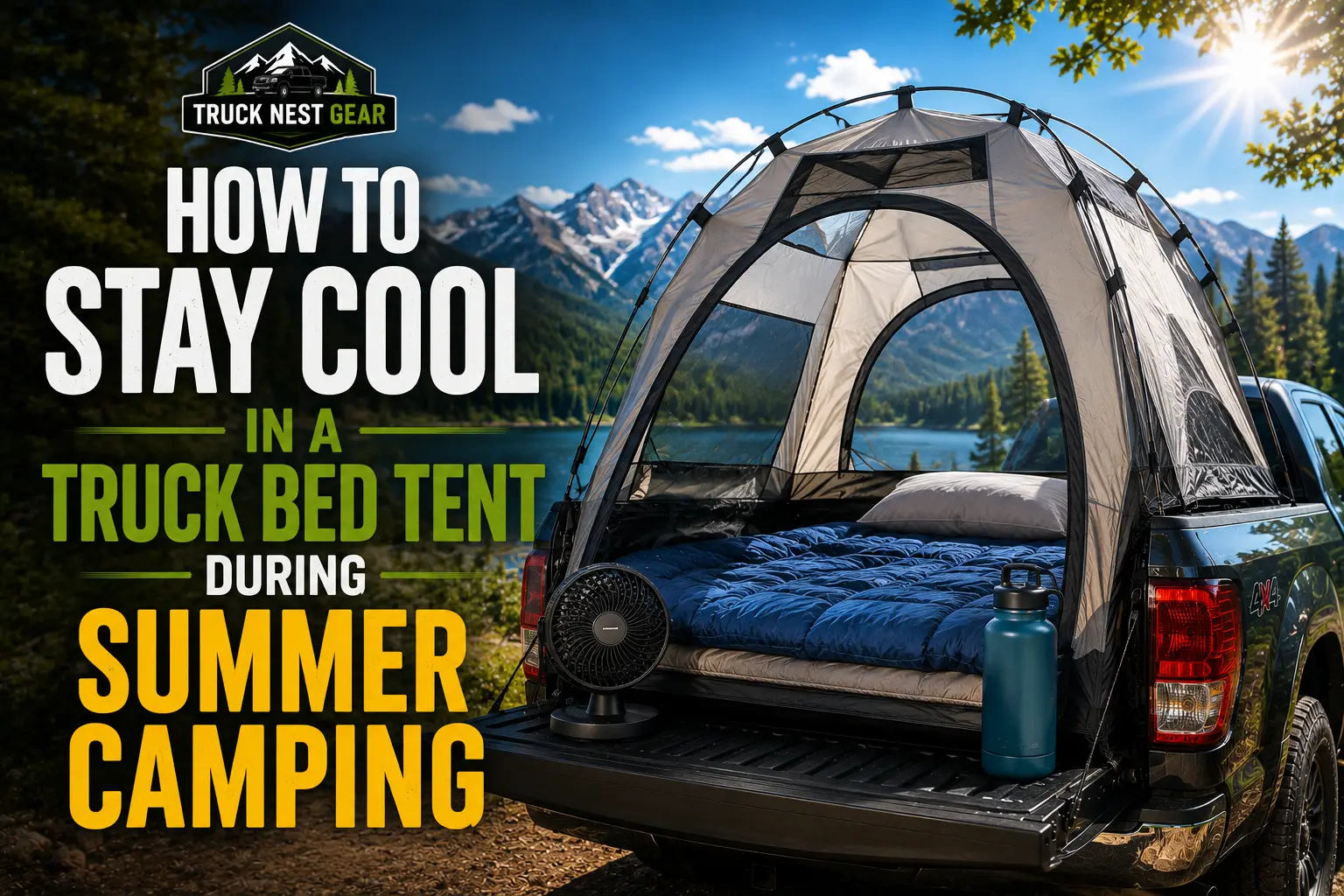
How to Stay Cool in a Truck Bed Tent During Summer Camping
Summer is when truck bed tent camping is most popular, and for good reason: long days, warm evenings, and the kind of dispersed public land availability that disappears the moment school starts in September. It is also when the truck bed tent’s most specific heat challenge becomes a real problem.
A truck bed tent in direct summer sun is not just warm. It is potentially miserable. The metal truck bed absorbs and radiates heat for hours after direct sunlight ends. The synthetic tent fabric, polyester or nylon, traps radiant heat like a greenhouse when the rainfly is on.
Interior temperatures inside a sealed truck bed tent in afternoon sun can exceed ambient air temperature by 20 to 30°F. A tent sealed with a rainfly in direct sunlight traps radiant heat like a greenhouse; internal temperatures can exceed ambient by 20 to 30°F, making sleep physically impossible.
The solutions exist, they work, and most of them cost nothing beyond the gear you already have. This guide covers every technique for managing heat in a truck bed tent, from campsite selection before you arrive to the sleeping surface choices that keep your body temperature down through the night.
The Truck Bed Tent Heat Problem: What Makes It Different
Before covering solutions, understanding what specifically makes a truck bed tent hotter than a ground tent explains why some general camping cooling advice does not fully apply here.
- The metal bed is a heat battery
Steel and aluminum absorb solar energy through the day and radiate it upward into the tent through the night. A black spray-in bed liner sitting in full sun for six hours stores significant thermal energy that continues warming the sleeping space for hours after sunset.
Even during a heatwave with the sun beating down on a black truck bed, interior temperature management requires active airflow strategies. A ground tent has soil beneath it, soil releases heat slowly and never reaches the temperatures that metal does.
- Elevation increases wind exposure, which is an advantage
At 24 to 36 inches above the ground, a truck bed tent sits above the still air layer that accumulates at ground level on calm summer nights. This elevation advantage means even a light breeze that would not be felt at ground level creates some airflow across the truck bed tent’s walls. A ground tent in a calm campsite has no equivalent airflow benefit.
- The enclosed cab wall creates a heat sink
The solid metal cab wall at the front of the truck bed retains warmth from the truck’s engine compartment and from direct sun absorption. On a hot day, the cab end of the truck bed tent is consistently the warmest zone; the dead-air pocket against the metal cab surface has nowhere to go unless ventilation is specifically directed toward it.
Technique 1: Remove the Rainfly, The Highest-Impact Free Adjustment
Unless there’s a chance of rain, remove the rain fly from your tent. That will allow additional heat to escape overnight, keeping your tent cooler while also cutting down on condensation buildup on the inside of your tent.
This is the single most impactful summer cooling adjustment available, and it costs nothing. The rainfly is designed to block rain and wind, which means it also blocks heat from escaping. A deployed rainfly on a hot summer night turns the tent interior into a sealed thermal environment where the heat your body generates has nowhere to go.
With the rainfly removed, the tent body’s mesh windows, and on most truck bed tent designs, the mesh roof panel, become the sleeping environment. You sleep beneath an open mesh sky. Heat rises and exits through the mesh continuously. Light breezes that the rainfly would have blocked reach the tent walls directly.
The practical conditions for removing the rainfly: overnight rain probability below 10 percent, no thunderstorm activity within range, and overnight temperatures warm enough that the temperature drop after midnight is not a concern. In the desert Southwest in summer, these conditions exist on the majority of nights from June through September. In the Pacific Northwest or at elevation in the Rockies, assess the forecast more carefully before leaving the rainfly off.
Keep the rainfly accessible, attached to the tent but not deployed, rather than packed in the carry bag. If conditions change overnight, a 3-minute rainfly deployment from inside the tent protects the sleeping area without requiring full exterior access in the dark.
Technique 2: Campsite Selection for Natural Cooling
An effective strategy for staying cool starts with how you park. Avoid asphalt when you can. It absorbs and radiates heat all day, turning the ground beneath your camper into a heat source. In peak direct sunlight, shade can drop surface temperatures by up to 100°F, so seek it out.
For truck bed tent camping specifically, campsite selection involves three heat-specific considerations:
Find shade for the truck bed. The metal bed liner is the primary heat battery in the system. A truck parked in direct sun all day arrives at the campsite carrying stored thermal energy that continues warming the sleeping space for 2 to 4 hours after sunset. A truck parked in shade all afternoon has a dramatically cooler bed temperature at dusk. When campsite options allow, choose a position where the truck bed, specifically, is in shade from mid-afternoon onward. The cab can be in sun; the bed is the thermal priority.
Seek elevation. On average, you can expect to lose approximately 3 degrees for every 1,000 feet of elevation gained. That means if it is 85°F in a valley, increasing 3,000 feet in elevation produces a comfortable 76°F. For truck bed tent campers who have flexibility in destination, choosing a higher-elevation campsite produces meaningfully lower overnight temperatures than valley-floor alternatives in the same geographic area.
BLM land in the Southwest and national forest terrain in the Rockies both provide accessible high-elevation dispersed camping within a few hours of major highway corridors.
Camp near water where possible. Rivers, lakes, or coastal breezes can help lower the surrounding temperature. Riparian environments and lake shores are consistently several degrees cooler than adjacent upland areas on hot summer nights. The 200-foot setback from water required on BLM and National Forest land still places the campsite within the temperature-modified air mass that water bodies create, close enough to benefit from cooler ambient temperatures.
For a cooler and more comfortable night’s sleep, opt for a forested destination or head to the woods rather than staying in a desert or urban area. Trees naturally lower the temperature, providing a refreshing environment for rest.
Technique 3: Fan Positioning and Cross-Ventilation
This cross-ventilation setup, one pulling, one pushing, is more effective than a single fan circulating air within the same interior volume.
A portable camping fan in a truck bed tent is the highest-impact powered cooling tool available, and its effectiveness depends entirely on positioning relative to the tent’s ventilation openings.
The correct configuration: position the fan on the cab end of the tent, blowing toward the tailgate entry. This setup draws air in through the tailgate entry mesh and the side mesh windows, passes it across your sleeping surface, and exhausts it toward the tailgate end where it exits. The cab-end dead-air zone, the warmest zone in the tent, is where the fan draws from, which both cools the dead air and keeps the whole-tent airflow circuit moving continuously.
Position your battery fan to blow air across your body rather than directly at your face. Cross-ventilation from open tent mesh combined with a fan circulating that air is the most effective night cooling system available without power.
Open all available mesh windows and the mesh roof panel if your tent design includes one. More open mesh means more intake surface for the fan’s exhaust to be replaced by ambient air rather than recirculating the same interior air volume.
Portable fans boost airflow inside your truck bed unit in a way that makes a noticeable difference on hot summer nights. At one to three amps draw on a quality camping fan, a 20,000mAh power bank provides 8 to 15 hours of operation on a single charge — sufficient for a full summer night without recharging.
The frozen water jug hack. When temperatures are severe and no electrical hookup is available, a battery fan paired with a frozen water jug creates a low-tech evaporative cooler. Place a frozen jug or bag of ice directly in front of the fan intake; the air passing over the cold surface drops in temperature before being blown through the tent. The effect is modest but real, and on nights where the difference between comfortable and miserable is only a few degrees, it can be enough.
Technique 4: Tarp and Shade Management
Use tarps and vehicle awnings to keep even more sun off your main camping and sleeping areas. When setting up a tarp, keep it about a foot away from your truck bed, camper, or tent to help it stay cool. You want airflow between the two so hot air isn’t getting trapped under the tarp and inside your sleeping space.
A shade tarp rigged above the truck bed, elevated at least 12 inches above the tent roofline using poles, a rope line between trees, or the Napier Sportz 57’s built-in awning, intercepts direct solar radiation before it reaches the tent fabric. The air gap between the tarp and the tent body allows hot air to dissipate rather than being trapped between the two surfaces.
Adding a reflective mylar blanket on top of your tarp or using an all-weather reflective tarp reflects some of the heat from the sun, helping your space stay even cooler. A reflective silver tarp reflects a significant portion of solar radiation rather than absorbing it, a meaningful difference from a standard dark-colored camp tarp that absorbs sun and conducts heat downward.
The truck bed tent’s awning, available as a standard feature on the Napier Sportz 57 Series, creates partial shade at the tailgate entry point without a separate tarp rigging system. While the awning does not cover the full tent roofline, it shades the most active campsite zone and reduces direct sun on the tailgate sleeve area in afternoon sun.
Technique 5: Truck Parking Orientation for Summer
Parking orientation for summer camping is almost the opposite of the recommendation for cold-weather camping.
In cold weather, the cab faces the prevailing wind so the solid cab wall acts as a windbreak for the tent. In summer, you want airflow through the tent. This means orienting the truck so the tailgate entry faces the prevailing breeze rather than away from it.
The breeze that would be blocked by positioning the tailgate in the wind shadow becomes the cooling airflow that enters through the tailgate mesh and circulates through the tent.
Even a modest breeze becomes significantly less useful if the door faces away from it. When combined with a mesh-heavy camping tent designed for warm-weather ventilation, proper door orientation creates a natural cross-draft that continuously runs through the sleeping area.
Assess wind direction before parking by observing grass movement, leaf direction, and dust patterns. Park with the tailgate facing the prevailing breeze. In calm conditions where no meaningful breeze exists, orientation matters less; focus on shade position instead.
Avoid east-facing tailgate positions in summer. An east-facing tailgate entry means direct sunrise into the tent at dawn, typically 5:30 to 6:30 AM in midsummer. This floods the sleeping space with direct light and heat at the lowest overnight temperature, shortening comfortable sleep time by an hour or more. A west or north-facing tailgate avoids this.
Technique 6: Sleeping Surface for Summer Heat
The sleeping surface affects body temperature through a mechanism that most campers do not fully consider: contact conductivity. A sleeping surface that efficiently transfers body heat away, rather than insulating it back toward you, allows your body’s natural temperature regulation to work more effectively.
Air mattresses can be a better option than foam ones when you are camping in a truck cap. Not only is it easier to store, but it can also actually keep you cool because your body heat dissipates more easily when sleeping on one.
For summer truck bed tent camping, a standard inflatable air mattress or a thin self-inflating pad with an R-value of R-1 to R-2 is actually the correct sleeping surface, the opposite of the recommendation for cold weather.
A high-R-value insulating pad or a thick memory foam pad retains body heat. A lower-insulation surface allows body heat to transfer away from the contact surface, which is what you want in warm conditions.
A cotton or linen sleeping sheet rather than a sleeping bag is the correct summer sleeping solution below the mid-50s°F. A lightweight sleeping bag liner in silk or cotton provides minimal insulation while allowing airflow across the body, far more comfortable in summer than even the lightest synthetic sleeping bag.
Cold water bottle at the feet. Place a cold water bottle or a reusable ice pack at your feet before sleep. The feet and lower legs are major heat dissipation points; cooling this area measurably improves whole-body comfort in warm sleeping conditions.
Technique 7: Pre-Cool the Truck Bed Before Setup
The metal truck bed’s stored thermal energy from afternoon sun is the primary heat source in the sleeping environment for the first 2 to 4 hours of the night. Reducing this stored heat before deploying the tent produces a cooler starting sleeping environment.
Park the truck in shade in the late afternoon if campsite terrain allows. Drive the last section of road to the campsite with the windows down and truck bed exposed to airflow, which begins cooling the metal surface through convective exchange during the approach.
After parking, allow the truck bed to ventilate without the tent deployed for 20 to 30 minutes at the campsite while you set up the cooking area, collect firewood, and prepare dinner. The metal bed, exposed to airflow and radiating heat into the open air without the tent trapping it, cools faster than it would with the tent deployed immediately.
Deploy the tent in the early evening rather than the afternoon. A tent deployed at 7 PM on a hot summer day spends the hottest part of the evening trapping the heat radiating from the metal bed. A tent deployed at dusk begins its night in a cooler, less radiant metal environment.
Technique 8: Destination and Timing Strategies
The most effective summer cooling strategy is not a piece of gear; it is where and when you camp.
Choose elevation. If you’re somewhere with mountains, head up. Gaining elevation helps significantly reduce temperature. Summer truck bed tent camping in the Rocky Mountains, the Sierra Nevada, or the Cascades at 8,000 to 10,000 feet provides overnight temperatures 20 to 30°F lower than valley-floor alternatives in the same region.
National Forest dispersed camping at these elevations is accessible to a standard pickup truck, requires no reservation, and costs nothing.
Camp near water. Lakeshores, river corridors, and coastal areas maintain lower overnight temperatures than inland desert or urban environments. BLM land along river corridors in Utah, Colorado, Idaho, and Oregon provides dispersed camping access within the temperature-modifying influence of moving water.
Avoid places like Texas, Arizona, or Florida in the peak of summer. Camping season in places like this tends to be fall and spring instead of summer. For truck bed tent campers in the southern United States, summer heat is often a destination selection problem rather than a gear problem.
The Southwest desert in August is genuinely hostile to comfortable truck tent sleeping regardless of gear and technique. Moving the summer camping calendar toward higher elevations and northern latitudes, or shifting to the shoulder seasons of spring and fall in hot-weather states, produces more comfortable camping without any gear investment.
Summer Cooling Checklist
Before every summer truck bed tent camping trip, confirm:
- Rain forecast verified, rainfly coming off overnight
- Campsite selected for afternoon shade on the truck bed
- Fan charged and positioned for cab-end to tailgate-end airflow
- All mesh windows and roof vents identified and planned for full-open overnight
- Lightweight sleeping sheet or low-insulation sleeping bag liner packed
- Water bottle for pre-sleep foot cooling ready
- Tarp or shade cloth rigged 12 inches above tent roofline if no natural shade
- Arrival time planned for evening rather than afternoon to allow bed cooling before tent deployment