How Does a Truck Bed Tent Work? Everything You Need to Know
Imagine pulling up to your campsite, dropping your tailgate, and sleeping elevated off the ground, no rocks, no roots, no soggy soil beneath you. That is exactly what a truck bed tent makes possible.
But if you have never used one before, a very natural question comes to mind: how does a truck bed tent actually work?
This guide breaks down the mechanics completely: what the tent is made of, how each component functions, how the whole system comes together on your truck, and what separates a well-designed truck tent from one that disappoints on its first rainy night. By the end, you will know exactly what to expect before you buy and before you head out on your first truck camping trip.
What Is a Truck Bed Tent?
A truck bed tent is a purpose-built camping shelter that mounts directly onto the bed of a pickup truck. Unlike a traditional ground tent that stakes into the earth and needs a flat, debris-free surface, a truck bed tent uses your truck bed as its floor, transforming your vehicle into a raised, secure, and weatherproof sleeping platform.
The elevation is the core advantage. At 24 to 36 inches off the ground, you are above ground moisture, above crawling insects, and completely independent of whatever the terrain beneath your truck looks like. Rocky campsites, gravel lots, sandy beaches, and uneven forest service roads all become equally viable sleeping locations.
Most truck bed tents are engineered to fit standard bed sizes, typically 5-foot, 5.5-foot, 6-foot, 6.5-foot, and 8-foot beds, and they attach using a combination of bed rail straps or clamps, a structural pole system, and a tailgate sleeve that seals the rear entry. The result is a weatherproof sleeping space that most campers can assemble in under 20 minutes after their first practice run.
The Six Core Components and What Each One Does
Understanding the individual parts of a truck bed tent makes the whole system make sense. Every quality truck bed tent consists of these six components, each serving a specific function.
1. The Tent Body
The main fabric shell forms the walls, roof, and interior space of your sleeping area. Most tent bodies are made from polyester or ripstop nylon. Polyester is UV-resistant, holds water-resistant coatings reliably, and is the dominant material in the $150 to $350 price range. Ripstop nylon introduces a reinforcing grid pattern that prevents small tears from propagating; a snag that would create a spreading tear in standard polyester stops at the next ripstop thread intersection.
The denier rating of the fabric, a measure of thread thickness, tells you how durable the material is under repeated use. Look for a minimum of 150D polyester for three-season regular use. Premium canvas truck tents use 100% cotton duck canvas, which breathes naturally to manage condensation in a way synthetic fabrics cannot replicate.
2. The Pole System
Fiberglass or aluminum poles create the structural frame that holds the tent upright above your truck bed. This is where budget and premium tents diverge most significantly.
Fiberglass poles are affordable and adequate in mild, warm-weather conditions. Their weakness is cold temperatures: below freezing, fiberglass becomes brittle and can shatter under sudden wind load rather than bending elastically. A shattered fiberglass pole mid-campout is not a field-repairable situation.
Aluminum poles do not shatter; they bend. A bent aluminum pole is a problem; a shattered fiberglass pole is a camping trip that ends. Quality aluminum poles use 7000-series aluminum alloy, the same standard found in backpacking and expedition shelters. Pole diameter matters too; poles in the 8.5mm to 9mm range provide meaningfully more wind resistance than thinner designs found in budget tents.
3. The Rainfly
The rainfly is a secondary waterproof cover that drapes over the tent body, creating an outer weather shield with an air gap between it and the inner tent walls. It is your primary defense against rain, dew, wind-driven moisture, and condensation.
The air gap is not cosmetic. Warm, moist air from inside the tent rises and escapes through this gap rather than condensing against the cooler tent walls, which is what causes the damp interior that makes a poorly ventilated tent miserable by morning. A full-coverage rainfly that extends at least 6 to 8 inches past the tent walls on all sides provides the best weather and condensation protection.
Not all truck tents include a full rainfly. Some budget designs use only a partial fly or a coated tent body without a separate rainfly. For any camping where rain is a realistic possibility, a full separate rainfly is a non-negotiable feature.
The waterproofing rating of the rainfly is measured in millimeters of hydrostatic head, the water pressure the fabric resists before leaking. A rainfly rated at 2,000mm or above provides reliable protection in sustained heavy rain. Below 1,500mm, performance in real storm conditions becomes unreliable.
4. The Tailgate Sleeve
The tailgate sleeve is the fabric extension at the rear of the tent that drapes over and seals around your open tailgate. It is the component that closes the gap between the tent structure and the truck body; without it, the entire rear of your sleeping space would be open to wind, rain, and insects.
When the tailgate is fully lowered and the sleeve is correctly secured, it creates a sealed rear wall that completes the enclosed sleeping environment. Most sleeves have adjustable straps or hook-and-loop closures at the bottom that wrap under the tailgate to hold the sleeve snug against the surface. A gap of even two or three inches along the tailgate edge lets in enough cold air and moisture to meaningfully affect overnight comfort.
The tailgate sleeve also houses the main entry point of most truck tents; you climb in and out through this opening or, on models that include one, through a dedicated side door.
5. Bed Rail Attachments
Straps, buckles, or clamps that grip your truck’s bed rails anchor the tent firmly to the vehicle. These attachments are what prevent the tent from shifting during the night or lifting in wind, and their quality directly determines how stable the tent feels in real conditions.
Wide webbing straps of 1.5 inches or above distribute attachment force across a larger contact area than narrow straps, reducing the likelihood of slipping under sustained load. Ratchet-style tensioning maintains strap tension through temperature cycles and wind stress more reliably than simple friction buckles. Some premium tents use rigid clamps that grip the rail profile directly for an even more solid connection.
The attachment system is also what determines compatibility with features like RamBox integrated storage on RAM trucks, or the composite bed rails on the Honda Ridgeline, both of which require strap-based systems rather than hook-based designs to attach correctly.
6. Mesh Windows and Ventilation Panels
Zippered mesh windows provide airflow and visibility without letting insects inside. A well-designed truck tent includes at least two mesh windows positioned on opposite sides of the tent to enable cross-ventilation, air movement that carries warm, moist body air out of the tent before it reaches condensation threshold on the cooler tent walls.
Roof vents or peak vents allow rising warm air to escape from the highest point of the tent interior. In warm weather, the combination of opposing mesh windows and a roof vent creates enough airflow to sleep comfortably in temperatures well into the mid-80s°F without a fan.
How a Truck Bed Tent Works: The Mechanics Step by Step
With the components clear, here is how the system works as a complete assembly.
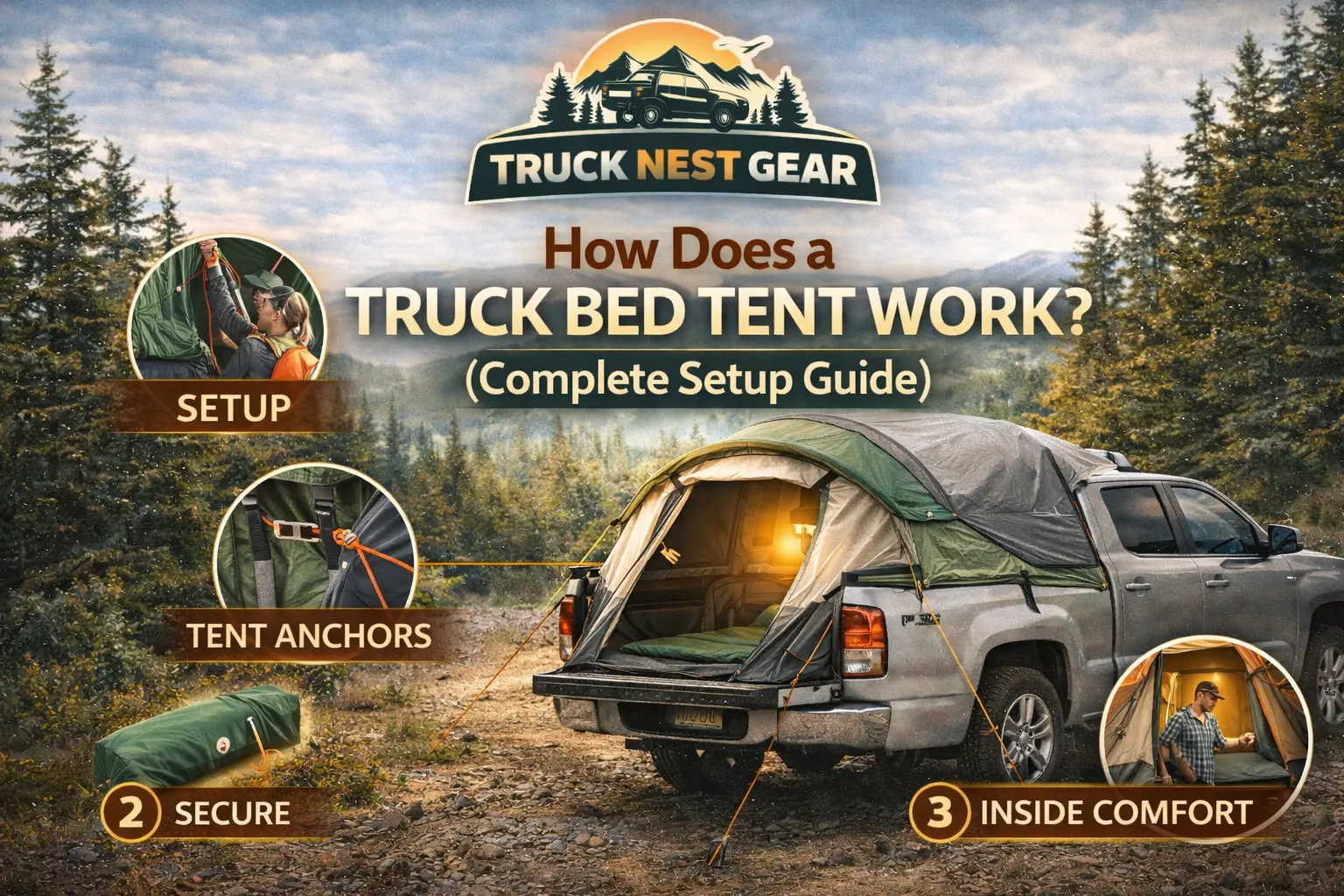
The truck bed becomes the floor. Your truck bed liner or bare metal bed surface acts as the foundation. Many campers add a sleeping pad, foam mat, or inflatable mattress on top for comfort and thermal insulation from the cold metal surface. Because you are already elevated, ground moisture, insects, and uneven terrain are irrelevant to your sleeping surface.
The pole system creates the structure. Assembled poles are threaded through fabric sleeves sewn into the tent body and bent into a curved or A-frame shape above the truck bed. Once the poles are connected at their base grommets or pins and tensioned into their final arc, the tent body stands upright with a rigid structure above the bed.
The tent anchors to the truck. Straps or clamps loop around the bed rails and tighten to lock the tent in position. The tent works in combination with the truck’s physical structure; the solid cab wall at the front acts as a windbreak, the bed rails provide lateral anchor points on both sides, and the tailgate becomes the sealed rear entry.
The tailgate seals the entry. With the tailgate fully lowered, the tailgate sleeve drapes over it and is secured at the bottom to create a sealed entrance tunnel. You enter and exit through this opening or through a side door if the tent model includes one.
The rainfly covers everything. Draped over the assembled tent body and attached at multiple clip or hook points around the perimeter, the rainfly creates the outer weather shield. Guy lines staked into the ground beside the truck pull the rainfly outward and downward, maintaining the critical air gap and preventing wind from getting underneath the fly edge.
The complete step-by-step setup process including the correct pole threading sequence, how to attach the tailgate sleeve correctly, pro tips from experienced truck campers, common first-time mistakes and how to fix them, and a realistic timeline for how fast setup becomes with repetition, is covered in full in the complete guide to setting up a truck bed tent step by step, which walks through every stage from truck bed preparation to final pre-sleep checks.
Truck Bed Tent Size Compatibility
Not every truck bed tent fits every truck, and getting the sizing wrong is the most common and most expensive mistake in this category.
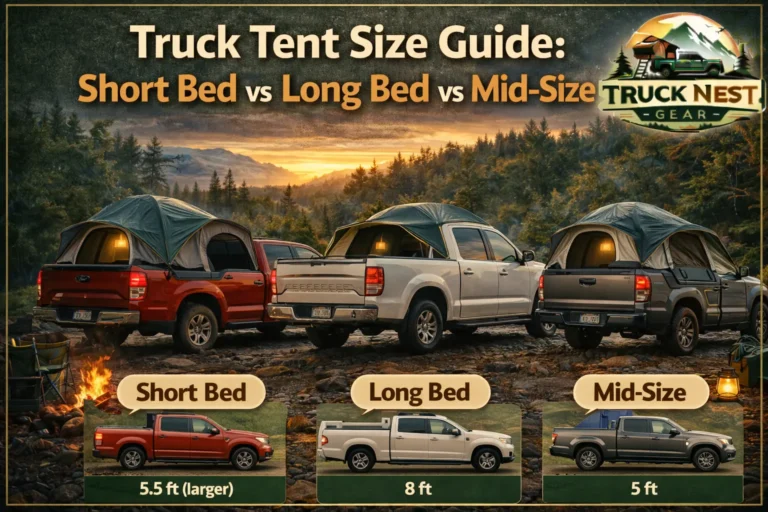
Truck beds come in three standard size groups:
| Bed Size | Approximate Length | Common Truck Examples |
|---|---|---|
| Short Bed | 5 ft – 5.75 ft | Ford F-150 SuperCrew, RAM 1500 Crew Cab, Chevy Silverado Crew Cab, Toyota Tacoma Double Cab |
| Standard/Mid Bed | 6 ft – 6.5 ft | Ford F-150 SuperCab, RAM 1500 Quad Cab, Chevy Silverado Double Cab, GMC Sierra |
| Long Bed | 7 ft – 8 ft | Ford F-250, RAM 2500, Toyota Tundra long bed, Chevy Silverado work trucks |
A tent designed for a 6-foot bed will not seal or anchor properly on a 5-foot or 8-foot bed, the attachment geometry is wrong, and the tailgate sleeve will not conform correctly to the bed opening. Always measure the interior length of your truck bed, from the inside face of the tailgate to the inside wall of the cab, before purchasing any tent.
Do not rely on your truck’s advertised bed size. The Toyota Tacoma Double Cab, for example, is marketed as a “5-foot bed” but measures approximately 59.5 inches inside the rails, slightly under 60 inches. Some tents listed as “5 ft compatible” are sized for a full 60-inch bed and sit loosely on the Tacoma’s actual interior. Napier maintains a publicly available truck fitment lookup tool that covers virtually every truck sold in North America and accepts your specific year, make, model, and cab configuration. Using it before ordering takes two minutes and eliminates the most expensive mistake in this category.
Does a Truck Bed Tent Work With a Tonneau Cover or Truck Topper?
This is one of the most common questions from first-time buyers, and the answer depends entirely on the type of cover.
Retractable covers and roll-up soft covers that sit under 6 inches high when rolled are generally compatible with most truck tents. The tent straps route over the rolled cover without interference, and the tent structure clears the rolled cover height on most configurations.
Folding tri-fold hard covers typically need to be removed before tent setup. The hinged panels cannot fold out of the way within the vertical space the tent pole structure requires.
Hard-hinged covers and truck toppers must be removed entirely. The pole system needs open vertical space above the bed to stand upright; a solid cap over the bed eliminates this entirely.
The Rightline Gear 110730 floorless design has the broadest tonneau cover compatibility of any tent in the category. If you have a non-standard cover configuration and want to avoid removing it for camping trips, this is the design to investigate first.
Common Mistakes to Avoid
Skipping the bed measurement. Always confirm your exact interior bed length before purchasing. An ill-fitting tent will not anchor securely and will let in wind and rain at the tailgate sleeve junction.
Forgetting to clean the bed rails. Dust, dirt, or moisture on the bed rails reduces attachment strap’s grip. A quick wipe-down before setup ensures a firm, stable connection.
Setting up without reading the instructions first. Every tent model has a slightly different pole sequence and attachment order. Reading the manual once before your first setup saves a significant amount of frustration at the campsite.
Leaving the rainfly off in uncertain weather. Even when skies look clear, mountain and forest weather changes rapidly. Always carry the rainfly and be prepared to attach it quickly.
Over-tightening the bed rail straps. Straps that are too tight warp the tent frame and damage the fabric at the attachment points over time. Snug and firm is the goal, not white-knuckle tight.
Packing the tent while wet. Moisture trapped inside the carry bag promotes mildew growth that permanently damages the fabric coating. If you must pack a wet tent, set it up again at home within 24 hours to dry completely before returning it to storage.
How Long Does Setup Take?
For a first-time setup, most truck campers take 20 to 35 minutes to get their tent fully assembled. After two or three practice runs, the same setup typically comes down to 10 to 15 minutes.
The fastest truck tents, particularly hub-style pop-up designs, can be fully deployed in under 5 minutes once you are familiar with the system. Traditional pole tents take slightly longer but reward you with a sturdier, more wind-resistant structure in demanding conditions.
One consistent insight from experienced truck campers: do a complete dry run in your driveway before your first camping trip. Identifying a missing component or a confusing pole sequence at home is infinitely less stressful than discovering it at a remote campsite after dark.
Is a Truck Bed Tent Right for You?
A truck bed tent works exceptionally well for solo campers and couples who want a quick elevated sleeping solution without pitching a ground tent, overlanders and off-road campers who camp on rough or uneven terrain where finding a flat ground site is genuinely difficult, weekend adventurers who value faster setup and consistent comfort regardless of campsite conditions, and truck owners who want to make full use of a vehicle they already own.
It may not be the right choice for families of three or more who need significantly more interior space than a truck bed allows, campers who frequently hike or paddle to their sleeping location where carrying the shelter is part of the trip, or anyone who needs to use their truck bed for hauling during the same trip where they plan to camp.
The truck tent category spans four distinct shelter types: truck bed tents, rooftop tents, camper shells, and slide-in campers, each suited to different camping styles, budgets, and truck platforms. The complete breakdown of all four types, matched to specific buyer profiles with honest assessments of where each fits and where it fails, is worth reading before committing to any specific direction.
Final Thoughts
A truck bed tent works by turning your pickup truck into a purpose-built camping shelter, elevated, weatherproof, and faster to deploy than most ground tent alternatives. The pole system creates the structure, the bed rails anchor it to the truck, the tailgate sleeve seals the rear entry, and the rainfly provides the outer weather shield.
Once you understand how each component functions and how they work together as a system, the setup process becomes second nature. The campers who find truck tent camping genuinely easy and satisfying are the ones who took the time to understand the system before their first trip, not the ones who figured it out in the dark at a busy campsite.