
If you own a pickup truck, you have more sleeping options than almost any other camper on the road, a truck bed tent tucked into your bed rails, a rooftop tent mounted above the cab, a camper shell that turns your truck into a mini-camper, or a slide-in unit with a kitchen and a bathroom. The platform is versatile. The problem is that “truck tent” means four entirely different things depending on who’s using the term, and choosing the wrong category before you even look at specific products is how people end up spending money on something that doesn’t fit their truck, their camping style, or their life.
This guide solves that. We’ll walk through all four categories of truck camping setups, what they are, who they’re actually built for, and where they fail, then give you specific product recommendations across every budget from $80 to $2,200. By the end, you’ll know exactly which type belongs on your truck and which specific model is worth your money in 2026.
The Four Types of Truck Tents: Getting the Category Right First
Most buying guides skip this step and go straight to product lists. That’s why so many people end up with the wrong tent. Spend two minutes here, and you’ll avoid the most expensive mistake in truck camping.
Truck Bed Tents
A truck bed tent sits inside your truck bed. It attaches to the bed rails and tailgate using padded straps and a fiberglass or aluminum pole system, and it creates a fully enclosed sleeping space at truck-bed level. Setup takes 10–20 minutes. Breakdown is equally fast. The tent goes back in its bag between trips.
This is the right choice for most truck campers, weekend warriors, casual overlanders, hunters, anglers, and anyone who wants an elevated, off-the-ground sleeping space without a major financial commitment or permanent hardware installation. Price range runs from $80 for honest entry-level options to around $500 for the premium all-weather Kodiak Canvas.
The limitation worth knowing: a standard truck bed tent requires you to clear your bed before setup. If your truck bed functions as a mobile gear locker and you never fully unload it, the floorless designs from Rightline Gear solve this specifically, the tent walls drape over your rails while your gear stays in place. How waterproofing actually works across different tent materials and price points is something most buyers underestimate; the full breakdown of what hydrostatic head ratings mean in real rain conditions is worth understanding before you choose a specific model.
Best for: Most truck campers. Budget-conscious buyers. Weekend trips to established campgrounds and occasional dispersed camping.
Skip if: You need genuine all-season performance, want to keep your bed fully functional without any teardown, or are camping in the kind of terrain where ground clearance is the priority.
Price range: $80–$500
Rooftop Tents (RTTs)
A rooftop tent mounts on a roof rack above your cab, your truck bed, or both. It unfolds, either via a hinged hard shell or by deploying a soft-shell structure, and you access it via a built-in ladder. The sleeping surface is elevated well above ground level, which matters on technical terrain where rocks, roots, and water make ground-level camping genuinely difficult.
RTTs come in two configurations. Soft-shell models fold out like a traditional tent and are lighter and more affordable, though they take a few minutes to deploy. Hard-shell models open in seconds via a gas-piston mechanism, pack tighter when closed, and insulate meaningfully better in cold weather. Both configurations require a quality roof rack capable of handling the static load, typically 150–200 pounds for the tent plus occupants, which adds $400–$800 to your total investment beyond the tent itself.
For the overlanding and off-road camping community, rooftop tents have become the standard setup. They keep the truck bed free for gear, water, recovery equipment, and food storage while providing an elevated, all-terrain sleeping solution. For general campground camping, they’re an expensive solution to a problem that a truck bed tent handles more efficiently.
Best for: Overlanders, off-road campers, 4×4 enthusiasts, and anyone regularly camping on terrain where ground clearance matters.
Skip if: You don’t already have a roof rack, your truck has a low roofline that creates clearance issues in parking structures, or you’re primarily camping at established campgrounds where a truck bed tent handles everything at a fraction of the cost.
Price range: $900–$3,500, plus $400–$800 for a quality roof rack
Camper Shells
A camper shell, also called a truck cap or canopy, is a hard fiberglass or aluminum enclosure that replaces the open truck bed with a weather-sealed covered space. You sleep inside the bed with the shell overhead, using the truck bed floor as your sleeping platform. Camper shells are the closest thing to van life that a pickup truck offers: the setup looks like a regular truck from the outside, weather protection is excellent, and the enclosed space can accommodate a sleeping platform, gear storage, and basic organization systems.
The trade-off is permanence. A camper shell is not something you remove for a weekend trip and put back on Monday morning. Installation and removal takes time and typically two people. If your truck pulls double duty, hauling materials for work during the week, camping on weekends, a camper shell is an inconvenient solution. For campers who want their truck to be a dedicated camping vehicle, it’s one of the most weather-capable options in this price range.
Best for: Stealth campers, long-distance van-life-adjacent travelers, and truck owners who want a dedicated camping vehicle rather than a dual-purpose truck.
Skip if: You need regular access to your truck bed for hauling, work, or general use.
Price range: $1,500–$4,000
Slide-In Campers
A slide-in camper is a self-contained living unit that drops into your truck bed and locks onto the frame. These are proper campers, many include a sleeping area, a small kitchen, a bathroom, and heating systems. They transform a pickup truck into a functional mobile home.
They also require a ¾-ton or 1-ton truck with sufficient payload capacity, cost between $5,000 and $40,000+, and permanently commit your truck to camper duty while installed. If you’re researching slide-in campers, you’re probably not reading a truck tent guide; this category is its own ecosystem with its own dedicated resources.
Best for: Full-time truck campers, serious long-distance travelers, families who need bathroom and kitchen facilities on the road.
Price range: $5,000–$40,000+
Which Type Fits Your Camping Life? An Honest Matching Guide
Before looking at any product, answer honestly how you actually camp, not how you plan to camp. Most people overestimate the intensity of their camping and underestimate the frequency of their actual trips.
You camp 2–8 times a year at established campgrounds. You want a reliable, comfortable sleeping setup that doesn’t require an engineering degree to assemble. Budget matters. You’re not going to remote technical terrain. A truck bed tent in the $130–$270 range is the right answer. The Napier Sportz 57 Series and Napier Backroadz 19 Series are the two most proven options in this category, covering beginner through regular-camper needs.
You’re an overlander or off-road camper who regularly camps on rough, uneven terrain. Ground clearance matters. You want your truck bed free for gear, recovery equipment, and water storage. A rooftop tent on a quality rack is the right investment. The iKamper Skycamp Mini is the benchmark hard-shell RTT in this category, the standard against which competing models are measured.
You camp in late fall and winter. Temperature swings, condensation, and cold mornings are your reality. Canvas breathes in a way polyester cannot. The Kodiak Canvas truck bed tent is the only option on this entire list engineered for genuine year-round performance. Hunters use it through November and December in conditions that would compromise every polyester tent on the market.
You’re trying truck bed camping for the first time and don’t want to overspend before you know it’s for you. The JOYTUTUS 2.0 and WildFinder are honest entry-level options under $100. Fair-weather performance, simple setup, and a low financial commitment. If you try it twice and love it, you’ll upgrade. If it turns out truck camping isn’t your style, you haven’t lost much.
You have a family. Adults need privacy; kids need space. The FOFANA Automatic Setup tent gives adults a 6-foot standing-height enclosed space in the truck bed, while kids use a conventional ground tent at the site. It’s not an elegant solution, but it works practically and keeps the sleeping arrangements separate.
Top Truck Tent Picks for 2026
1. Napier Sportz 57 Series — Best Overall Truck Bed Tent for Camping
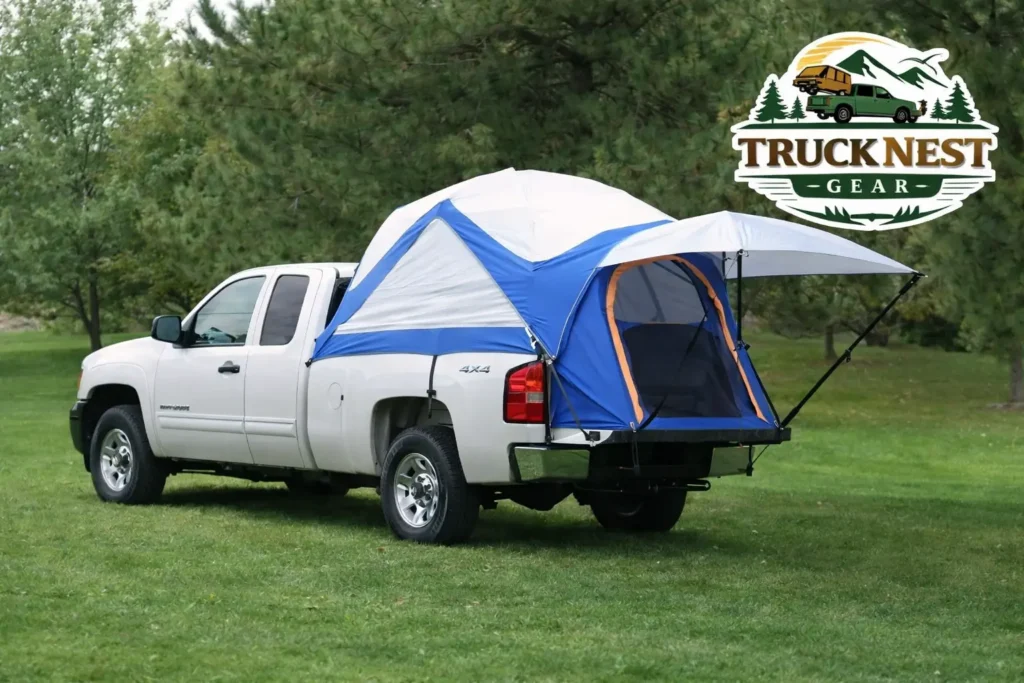
Napier has been manufacturing truck tents for over 30 years, and the Sportz 57 Series sits at the sweet spot of their lineup, premium features at a price that makes sense for campers who get out three to ten times a year.
The standout feature at this price point is the built-in 4×4-foot awning. No other truck bed tent under $300 includes a proper awning as standard equipment. It provides shade and rain protection outside the tent entrance without guy ropes or separate accessories, a genuinely useful addition that competing brands simply don’t offer. The rear cab access panel lets you run a power cord from your truck’s interior for phone charging, a heated blanket, or a small fan. Three mesh windows, two ceiling vents, and 2,000mm PU waterproofing with taped seams complete a feature set that no competitor matches at this price. Six available size variants cover virtually every major truck bed from 5 to 8.2 feet.
For truck owners running a Toyota Tacoma, standard F-150, or Silverado crew cab, this is the tent that delivers the most complete camping experience without requiring an upgrade to a rooftop setup.
- Built-in awning with no guide ropes required.
- Rear cab access for power and warmth.
- 2,000mm waterproofing with taped seams.
- Available in six sizes covering all major truck platforms.
- Backed by 30+ years of Napier manufacturing experience.
- First setup takes 30–60 minutes while learning the pole system.
- No window privacy screens.
- Not compatible with hard tonneau covers.
2. Napier Backroadz 19 Series — Best for First-Time Truck Campers
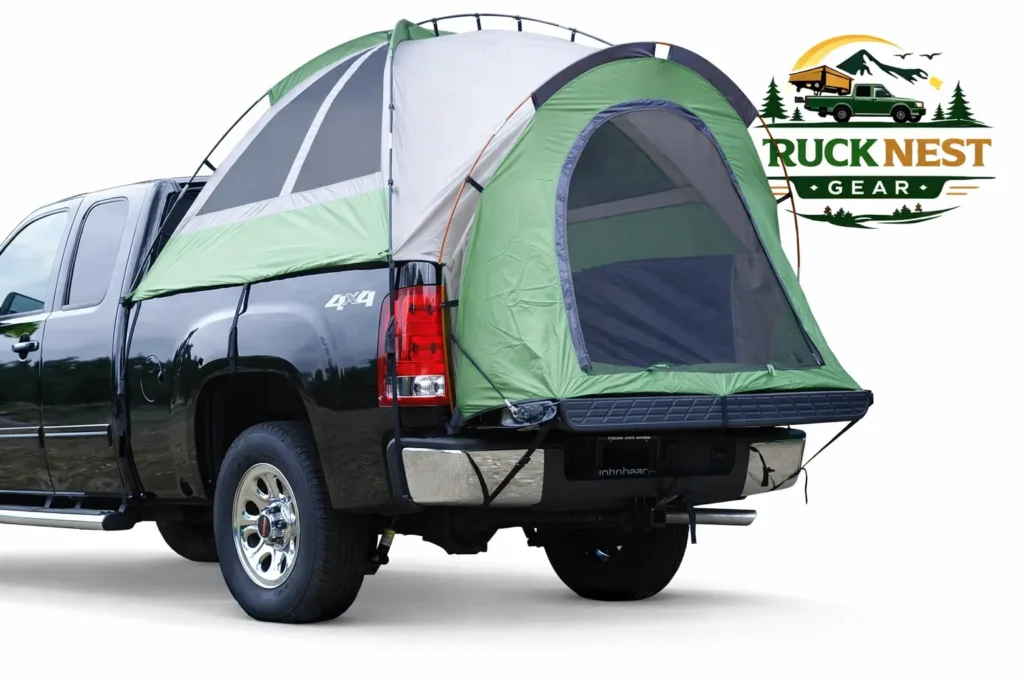
With over 5,000 verified Amazon reviews and a sustained 4.5-star average, the Backroadz 19 Series is the most extensively reviewed truck bed tent available, and for first-time buyers that review volume is a practical asset, you’re reading consolidated feedback from thousands of owners across every truck model and climate zone in North America.
The Backroadz shares Napier’s core design approach with the 57 Series, color-coded fiberglass poles, protective padded straps, quality polyester taffeta, but removes the built-in awning and a few premium details to reach a more accessible price. Setup drops to under 10 minutes after the first use. It works with retractable tonneau covers rolled to under 6 inches, and with most toolbox configurations, which gives it broader compatibility than many competitors. Napier plants one tree per Backroadz purchase through their Trees for the Future partnership, a small but verifiable sustainability commitment.
The one honest limitation: there are no window screens. Privacy requires keeping the rainfly deployed, which limits ventilation in warm weather. If summer camping is your primary use case, the 57 Series handles this better.
- Most verified review base in the category — 5,000+ owners.
- Under-10-minute setup after first use.
- Works with retractable tonneau covers and toolboxes.
- Five size variants. One tree planted per purchase.
- No built-in awning.
- No window screens — privacy requires the rainfly.
- Thinner material than the 57 Series over multiple seasons
3. Rightline Gear 110730 — Best Floorless Truck Tent
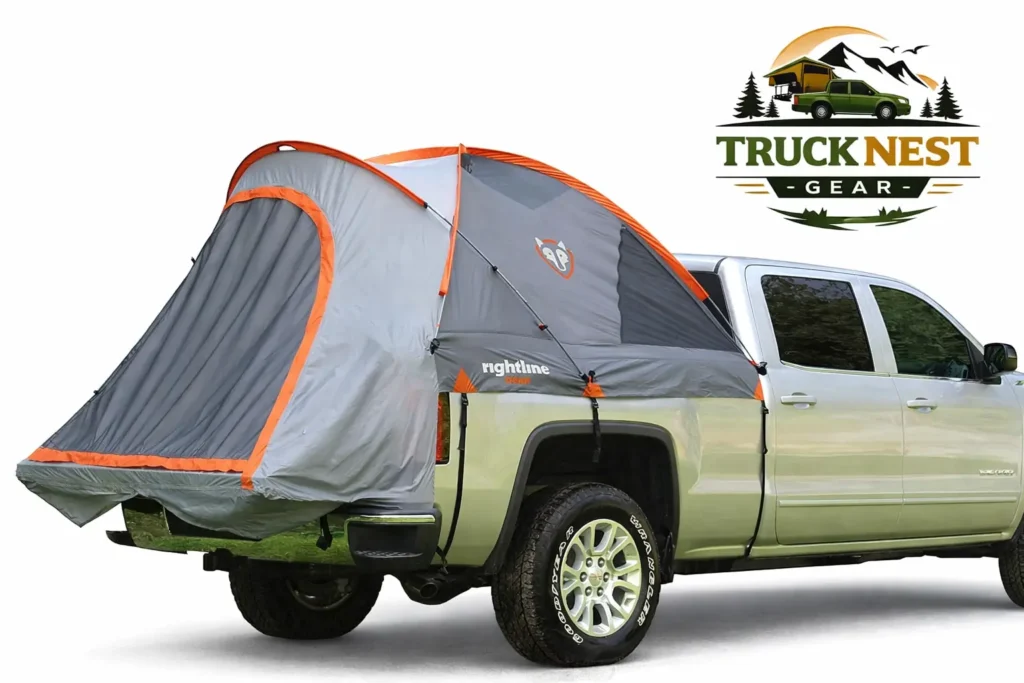
The Rightline Gear 110730 exists because of one specific problem: most truck bed tents require you to completely clear your bed before setup. For hunters, anglers, and campers who live out of their truck beds, that’s a dealbreaker.
The floorless design solves it. The tent walls drape over the bed rails and attach via color-coded poles and protective nylon straps. The truck bed interior stays open, your cooler, gear bags, and equipment stay exactly where they are. One documented owner account describes the tent surviving 40–50 mph winds and sustained rain in the Rocky Mountains without movement or interior leakage, which is a meaningful weather performance data point for a floorless design. A double-wall system, separate inner mesh tent plus a 2,000mm HH-rated rainfly, lets you use the mesh alone in warm conditions and add the rainfly for rain and privacy. Glow-in-the-dark zipper pulls and a sky-view vent are practical details that competitors at this price point typically don’t include.
The real trade-off: without a sewn-in floor, moisture can enter at the gaps between tent walls and truck bed rails during sustained heavy rain. A sleeping pad or air mattress mitigates this significantly in practice.
- Setup without unloading the truck bed — the defining advantage.
- Fastest deployment on this list at around 5 minutes with two people.
- Documented storm performance.
- Double-wall construction with separate mesh and rainfly.
- No sewn-in floor — moisture risk at rail gaps in heavy rain.
- Less thermal insulation than floored tents in cold conditions.
4. Kodiak Canvas 7206 — Best All-Weather Truck Tent for Camping
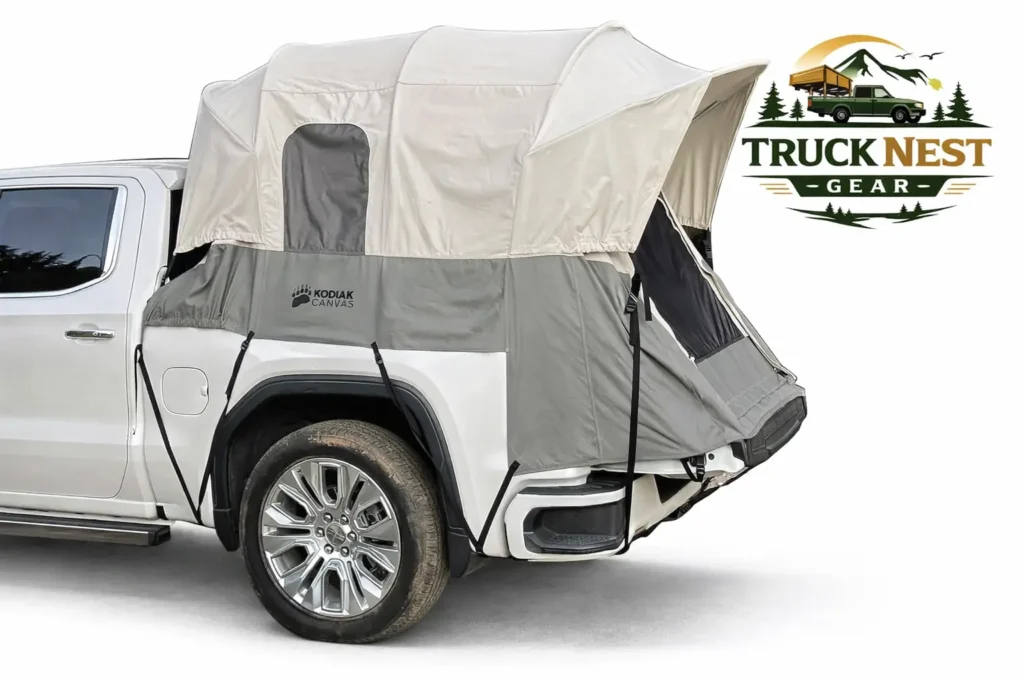
The Kodiak Canvas occupies a different category from every other tent on this list. It costs more, weighs more (~30 pounds), and takes 20–30 minutes to set up. For hunters, serious all-season campers, and overlanders who deal with genuinely variable weather, none of those trade-offs matter compared to what the canvas delivers.
Kodiak’s Hydra-Shield 100% cotton duck canvas is inherently breathable in a way no polyester can replicate. In warm conditions, moisture vapor escapes through the canvas continuously, preventing the overnight condensation that makes polyester tents uncomfortable by morning. In wet conditions, the canvas fibers swell as they absorb initial moisture, creating a near-watertight barrier, multiple owners document camping through extended Pacific Northwest rain without interior moisture, without the rainfly deployed. The ¾-inch steel tube frame with clamp-on aluminum rail mounts directly to your bed rails, creating the most structurally stable setup on this list. Five mesh windows and a dedicated cab access port for power cables complete a premium feature set.
If you camp ten or more times per year across any season, the Kodiak Canvas pays for itself in durability and performance over what you’d spend replacing cheaper tents. The one compatibility note worth checking: the included C-clamps may not fit all bed rail profiles. Several Toyota Tacoma owners reported needing to source larger aftermarket clamps before setup worked correctly.
- 100% cotton canvas — breathable and weatherproof without a separate rainfly in most rain.
- Steel frame — the most structurally stable option.
- All-season rated. Cab power access port.
- Built for 10+ years of use with standard care.
- Heaviest option at ~30 pounds.
- Most involved setup at 20–30 minutes.
- C-clamps may not fit all truck bed rail configurations — verify before ordering.
5. JOYTUTUS Truck Tent 2.0 — Best Budget Truck Tent for Camping
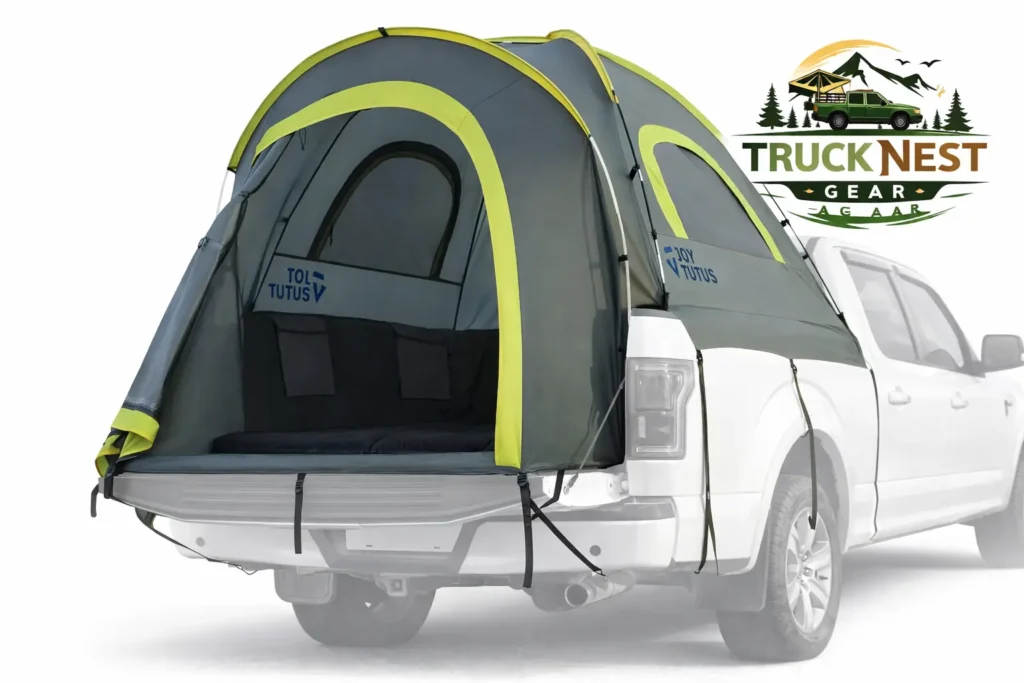
At $80–$110, the JOYTUTUS 2.0 is the right starting point for anyone who wants to try truck bed camping without a meaningful financial commitment. It’s an Amazon bestseller with a large verified review base, double-layer PU 2,000mm construction, and a color-coded pole system that most buyers figure out within 25 minutes on first assembly.
Honest expectations: this tent is built for fair-weather use on short beds in the 5.5–5.8-foot range. It covers the F-150 SuperCrew, Tacoma short bed, and Silverado crew cab configurations. It handles light-to-moderate rain adequately. It is not engineered for sustained heavy rain, cold-weather camping, or rough seasonal handling. Many buyers start here, confirm that truck bed camping suits them, and then move up to a Napier or Rightline after a season or two. As a trial tent, it’s a sensible investment.
- Most accessible price point on this list.
- Large verified review base.
- Double-layer PU 2,000mm construction.
- Good for fair-weather trial runs on short beds.
- Fits only 5.5–5.8-foot beds.
- Not suitable for sustained heavy rain.
- Limited warranty and after-purchase support compared to Napier and Rightline.
6. iKamper Skycamp Mini — Best Rooftop Tent for Truck Camping
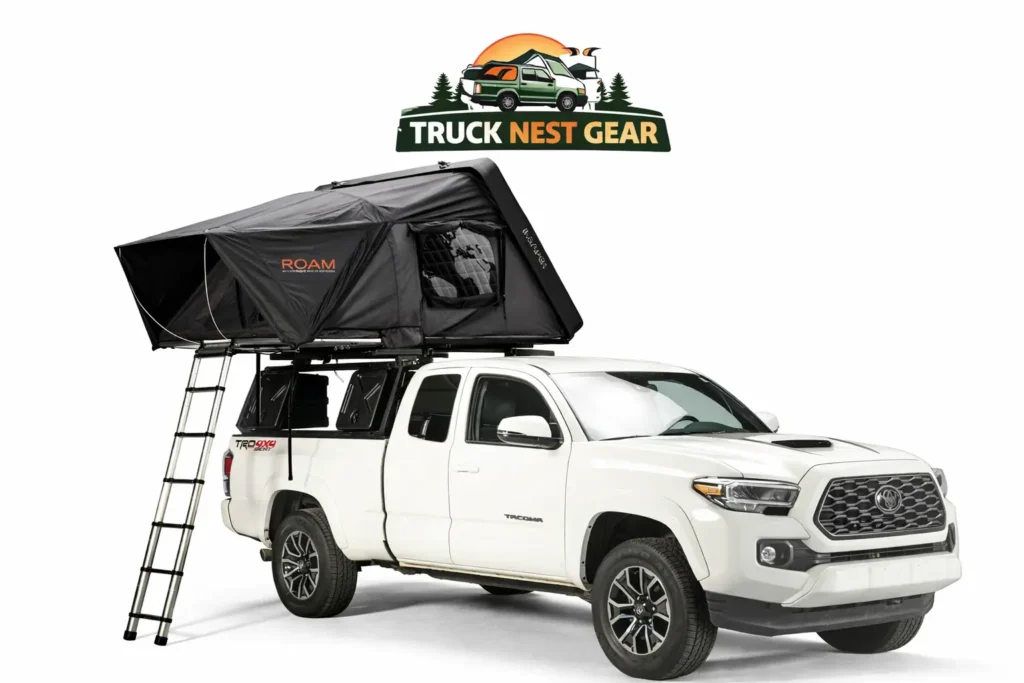
For truck owners ready to step up to rooftop tent camping, the iKamper Skycamp Mini is the model the overlanding community consistently points to as the category benchmark. It opens in under 5 seconds via a gas-piston mechanism, includes a 2-inch memory foam mattress that stays inside when packed, and folds to just 6 inches closed, making it compatible with more roof rack configurations than most hard-shell competitors.
The Skycamp Mini sleeps two adults in a 94×55-inch interior. The fiberglass shell insulates meaningfully better than soft-shell RTTs in cold weather, which matters for fall and shoulder-season camping. The 420D rip-stop nylon inner tent and fly handle three-season conditions reliably in documented owner use.
At $1,800–$2,200, this is a serious investment; it requires a quality roof rack capable of handling the static load, which adds another $400–$800 to your total cost. Fuel economy will decrease modestly from the added roof weight and aerodynamic drag. For overlanders camping on technical terrain where keeping the truck bed free for gear and water storage is the priority, the Skycamp Mini is the most capable hard-shell RTT at a reasonable price relative to the segment.
- Opens in under 5 seconds — fastest hard-shell deployment.
- Memory foam mattress stays inside when packed.
- Hard shell insulates better than soft-shell in cold conditions.
- 6-inch packed height fits more rack configurations.
- The industry benchmark against which competing RTTs are measured.
- $1,800–$2,200 before roof rack cost.
- Adds ~165 pounds of roof weight permanently.
- Requires a quality roof rack to mount correctly.
Six Practical Tips for Getting the Most Out of Truck Tent Camping
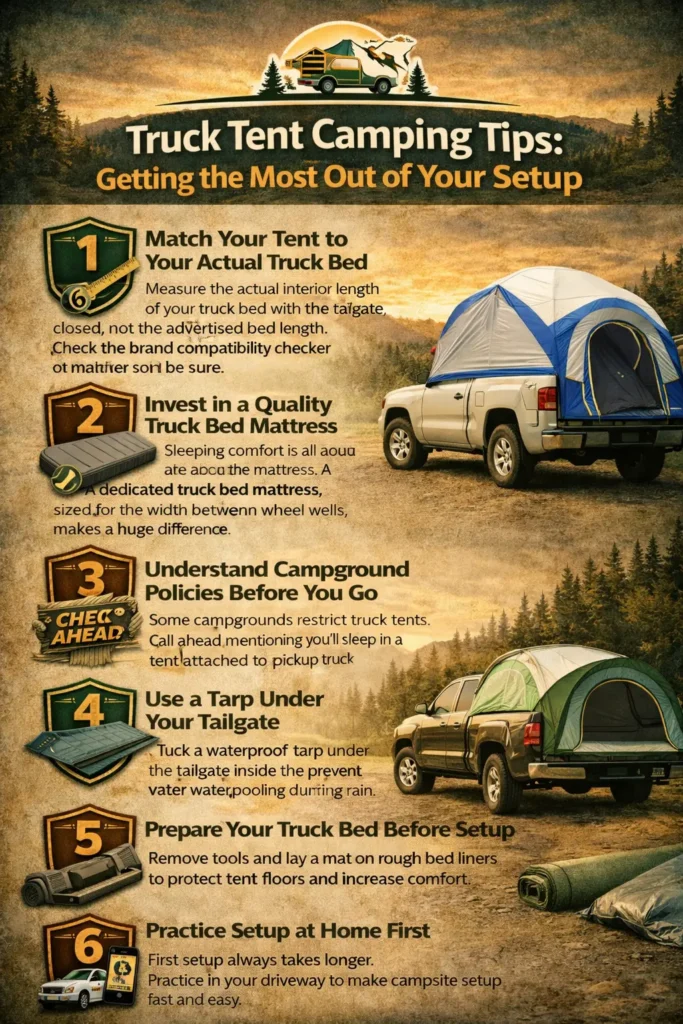
- Measure your actual truck bed before ordering anything.
The advertised bed length and the interior measurement are often slightly different. A “6.5-foot bed” F-150 typically measures around 78 inches inside with the tailgate closed. Use that interior measurement, not your truck’s marketing spec, when matching against any tent’s compatibility range. Both Napier and Rightline Gear maintain truck-specific compatibility lookup tools on their websites that take make, model, and year as inputs.
- Address the sleeping surface before your first trip.
The truck bed floor, even with a drop-in liner, is hard, cold, and uneven at the wheel wells. The sleeping surface determines your comfort more than any tent feature. A purpose-built truck bed air mattress sized for the width between wheel wells (typically 50–52 inches) transforms the experience. Napier makes a dedicated mattress sized specifically for truck beds. Self-inflating camp pads and closed-cell foam pads also work well and pack smaller.
- Practice your first setup at home, in daylight.
This is especially important for the Napier Sportz 57 Series and Kodiak Canvas, both of which have first-setup learning curves that can stretch to 45–60 minutes on the first attempt. One practice session in your driveway reveals any missing parts, teaches you the pole system, and turns a frustrating campsite arrival into a routine 15-minute deployment.
- Understand campground policies before you arrive.
Most established campgrounds allow truck tents without issue, you’ll be assigned a tent site and pay tent site rates. Some campgrounds with strict RV/tent site separation may have questions about classification when they see a truck with a tent attached. Calling ahead and describing your setup as “sleeping in a tent attached to a pickup truck” almost always resolves any ambiguity before arrival day.
- Use a tarp under your tailgate in heavy rain.
Even well-designed truck bed tents can accumulate moisture around the tailgate seal during sustained rain. A small waterproof tarp tucked under the tailgate and extending a few inches inside the tent provides extra protection against pooling. This is particularly useful with floorless designs like the Rightline Gear, where the rail-to-tent interface is the primary moisture vulnerability.
- Apply DWR spray every one to two seasons.
The factory DWR (Durable Water Repellent) coating on polyester tent fabric degrades with UV exposure, compression, and regular use. Reapplying a spray-on DWR treatment at the start of each camping season takes 15 minutes and maintains the water-beading performance your tent had when it was new. Most owners who complain about their tent “leaking” after two seasons are actually dealing with degraded DWR rather than a structural failure — a problem that’s entirely preventable.
Frequently Asked Questions: Truck Tent Camping
What is the best truck tent for camping overall?
For most truck owners camping two to ten times per year in mixed conditions, the Napier Sportz 57 Series is the best overall choice. It offers the most complete feature set in the $200–$270 range, built-in awning, cab access panel, three mesh windows, and 2,000mm waterproofing. For beginners who want to spend less, the Napier Backroadz 19 Series at $130–$160 is the most proven entry-level option with over 5,000 verified reviews to read. For hunters and all-season campers, the Kodiak Canvas stands in its own category.
Are truck bed tents comfortable?
Yes, more comfortable than most people expect, as long as you address the sleeping surface. The elevation puts you at truck-bed height, away from ground moisture, insects, and uneven terrain. Modern truck tents with mesh windows and ceiling vents provide good airflow in warm conditions. The variable is what you sleep on: a quality air mattress or self-inflating pad transforms the experience. Most campers who try truck bed camping once become regulars, largely because sleeping inside a locked vehicle with a raised vantage point is genuinely more comfortable than sleeping on the ground.
How do truck tents attach without damaging the truck?
Truck bed tents use padded V-straps that wrap around the tailgate, adjustable buckle straps that clip to the bed rails, and fiberglass or aluminum poles that create the tent structure inside the bed. Quality tents like Napier and Rightline Gear use protective nylon straps specifically engineered to avoid contact damage with paint and bed liner surfaces. Rooftop tents mount to a roof rack via a bracket system and don’t contact the truck body directly. Neither type requires drilling or permanent modification.
Can you use a truck tent at any campground?
Most established campgrounds allow truck tents at tent-only sites without question. You pay tent camping rates. Some campgrounds with strict RV-versus-tent site policies may have classification questions when they first see a truck with a tent attached. Calling ahead and describing the setup as “a tent attached to a pickup truck” almost always clarifies the situation. On Bureau of Land Management land and national forests, dispersed camping has no restrictions on truck tents, the BLM manages over 245 million acres of public land available for vehicle-based camping.
What’s the difference between a truck bed tent and a rooftop tent?
A truck bed tent sits inside your bed and is accessible from the ground. It costs $80–$500 and is the right choice for most campers. A rooftop tent mounts on a roof rack and requires a ladder for access. It costs $900–$3,500 plus the cost of a rack. Truck bed tents work better for general campground camping, budget-conscious buyers, and anyone who doesn’t need to keep the truck bed free. Rooftop tents work better for overlanders on rough terrain who prioritize ground clearance, all-terrain versatility, and keeping the bed available for gear.
Is truck tent camping safe?
Truck tent camping is generally safer than ground tent camping in several practical ways. You’re elevated off the ground, away from ground-level wildlife and insects. Your gear can be locked in the truck cab while you sleep. You have immediate access to your vehicle. In areas with bear activity, standard food storage protocols still apply regardless of sleeping setup. For weather safety, the Napier Sportz 57 Series and Kodiak Canvas provide reliable protection across a wide range of conditions.
Can truck tents handle winter camping?
Yes, with the right tent and preparation. The Kodiak Canvas is the most capable cold-weather option, its breathable canvas prevents the interior condensation that makes polyester tents uncomfortable in sub-freezing temperatures. For polyester truck bed tents, a sleeping bag rated for the expected overnight low is essential, as the tent itself provides minimal insulation. The cab access panel on the Napier Sportz 57 Series allows campers to run a power cord from the truck’s interior — a practical solution for hunters using a small portable heater in November and December.
Which Truck Tent Is Right for You? Our Final Recommendation
For most truck campers: The Napier Sportz 57 Series at $200–$270 offers the best overall balance of features, weather protection, and long-term value for anyone camping regularly in three-season conditions.
For first-timers: The Napier Backroadz 19 Series at $130–$160 is the most proven entry-level option with the lowest learning curve and the largest pool of verified owner reviews to draw from before buying.
For hunters and all-season campers: The Kodiak Canvas at $400–$500 is the only truck bed tent on this list genuinely engineered for year-round performance. It pays for itself in durability if you camp more than ten times a year.
For overlanders: The iKamper Skycamp Mini at $1,800–$2,200 is the hard-shell rooftop tent benchmark for serious technical terrain camping.
For first-time truck campers testing the concept: The JOYTUTUS 2.0 at $80–$110 keeps financial risk low while giving you a real experience of what truck bed camping involves
Affiliate disclosure: Some links in this guide are affiliate links. If you purchase through them, we earn a small commission at no additional cost to you. This does not affect our recommendations — no brand has paid for placement or ranking in this guide.