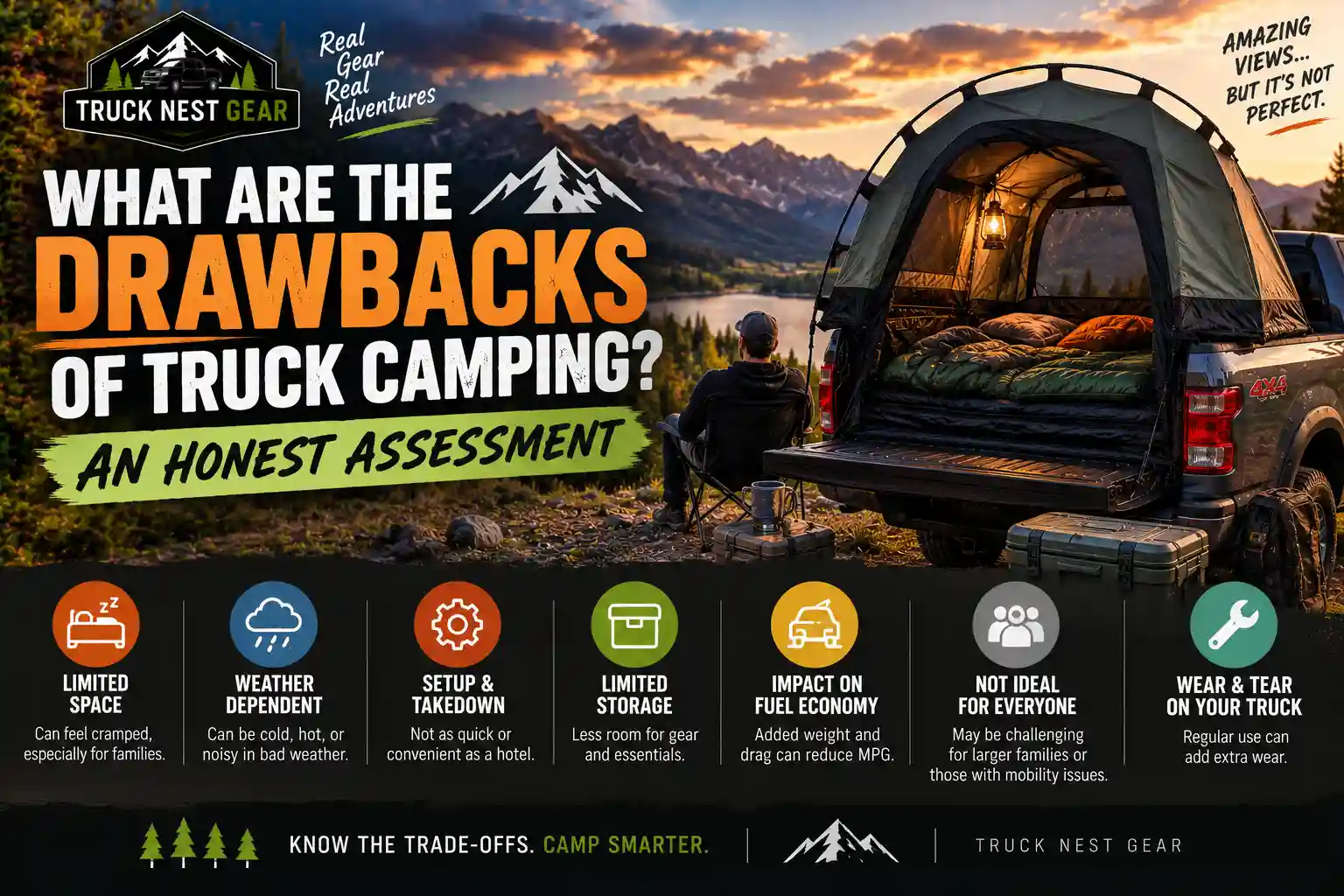
What Are the Drawbacks of Truck Camping? An Honest Assessment
Truck bed tent camping has a well-documented list of advantages that every buying guide enthusiastically covers. The elevation off the ground. The faster setup than a traditional ground tent. The mobility and flexibility of dispersed camping. The lower cost relative to a rooftop tent or slide-in camper.
What those guides rarely cover with equal honesty is the list of drawbacks, real limitations that affect a meaningful percentage of truck campers, and that are worth understanding before you buy a tent, plan a trip, or try to explain to a campsite neighbor why your tailgate has been open for three hours.
This is that honest list.
Drawback 1: The Truck Bed Is Unavailable for Cargo While You Sleep
This limitation surprises first-time truck bed tent campers most consistently because it isn’t obvious until you need something from the truck bed after the tent is deployed.
A truck bed tent occupies the truck bed. Once the tent is set up and your sleeping gear is inside, the truck bed is your bedroom, not your gear storage, not your cooler platform, not your equipment staging area. Anything you did not move to the truck cab or the campsite before tent deployment is either inaccessible overnight or requires partially breaking down the tent to reach.
For campers who are accustomed to using the truck bed as a rolling gear cache, cooler in the bed, recovery gear in the bed, camp kitchen in the bed, the truck bed tent format requires a fundamental reorganization of how gear is distributed across the vehicle. Everything you need after dark goes into the cab before the tent goes up. Everything that can stay in the bed gets covered by the tent and is not accessible until morning.
For hunters specifically, this creates an operational consideration: if the hunting gear, pack, and rifle need to be in the truck bed for a pre-dawn departure, that gear cannot be in the bed while the tent is deployed. It either lives in the cab overnight or the tent is set up over the gear, which the Rightline Gear floorless design specifically accommodates, but which requires pre-trip planning that most buyers do not think through before purchase.
Drawback 2: Your Campsite Is Wherever the Truck Can Go
A ground tent camper can hike to a campsite. A hammock camper can travel by bicycle or kayak to their sleeping location. A truck bed tent camper is camping wherever the truck can park, and not one foot beyond.
This is not a criticism of the format; it is a genuine constraint that shapes which camping experiences are possible. The dispersed BLM site accessible only by hiking three miles from the trailhead is not a truck bed tent campsite. The backcountry fishing spot reached by packraft is not a truck bed tent campsite. The summit camp at 11,000 feet, accessible only by trail, is not a truck bed tent campsite.
Truck bed tent camping is vehicle-access camping. The roads that lead to your campsites must accommodate a full-size or mid-size pickup truck, their width, their clearance, and their surface conditions. This constraint is less limiting in the western United States, where BLM and Forest Service two-track access is extensive, than in the northeast and upper Midwest, where campsite access is more likely to be trail-dependent. But it is a real constraint that determines which camping experiences the format can deliver.
Drawback 3: You Cannot Drive Anywhere Without Breaking Down Camp
Once a truck bed tent is deployed, the truck is a campsite. It is not a vehicle. Moving it to get more firewood, to explore a nearby road, to make a grocery run, to evacuate if the weather changes requires packing the tent, which takes 15 to 20 minutes on a first setup and 10 to 15 minutes with experience.
This is a meaningful operational difference from a rooftop tent, which can be closed in 60 seconds and driven immediately. It is a meaningful difference from a ground tent, which stays at the campsite while the vehicle is free to be used independently.
For campers who prefer to establish a multi-night base camp and not move their vehicle again until departure, this is not a significant limitation. For campers who want the flexibility to drive for day trips from a base camp, it is a genuine constraint: the tent must come down before the truck moves, which creates a 15-minute deployment overhead on every departure and arrival.
The practical workaround: establish base camp before dark, plan day trips on foot or by bicycle rather than by truck, and treat the truck bed tent as a fixed shelter for the duration of a stay rather than as a mobile setup that can be quickly packed and moved.
Drawback 4: Sleeping Capacity Is Fixed and Limited
A truck bed tent sleeps two adults. That is the standard capacity across every design from every manufacturer at every price point. It is not a function of tent quality or price; it is a function of the physical dimensions of a standard truck bed.
The usable sleeping width between the wheel wells of a full-size truck is approximately 50 to 52 inches. Two adults sleeping side by side in 50 to 52 inches of width is tight. Two adults and a child is genuinely cramped. Two adults and a large dog is a puzzle that most configurations cannot solve comfortably.
For solo campers and couples, two-person capacity is adequate, and the format works well. For families of three or more, the truck bed tent format requires a companion shelter, a ground tent set up alongside the truck for additional sleeping capacity, which adds setup complexity and eliminates the simplicity that makes truck bed tent camping appealing in the first place.
This capacity limitation cannot be solved by buying a larger or more expensive tent. The truck bed’s physical dimensions are the constraint. The only format that addresses this within the truck camping category is a slide-in truck camper with a fixed bed and a dinette conversion, which costs $5,000 to $25,000 and is a fundamentally different product category.
Drawback 5: The Metal Truck Bed Causes Specific Sleeping Challenges
A truck bed tent’s floor is a metal truck bed. Steel or aluminum at ambient temperature is a significantly more aggressive conductor of heat than the soil beneath a ground tent, which means sleeping in a truck bed tent in cool or cold conditions requires more floor insulation than a ground tent camper would need in identical weather.
A sleeping bag rated to 35°F performs differently on a metal truck bed than the same bag performs on an insulating sleeping pad on the ground. The metal conducts heat away from the sleeping surface continuously, defeating the bag’s insulation from below in a way that soil never does. Without a two-layer floor insulation system– a closed-cell foam base pad plus insulated sleeping surface- cold-weather truck bed tent camping is significantly less comfortable than the tent’s rating, or the ambient temperature, suggests.
Additionally, the metal bed surface is hard. A sleeping pad that is adequate on the ground may feel firmer than expected on a rigid metal surface that does not absorb any of the pad’s downward pressure. First-time truck bed tent campers frequently report that their first night was more uncomfortable than expected, not because of the tent, but because of what was between them and the truck bed.
Both problems are solvable with the right gear, a proper floor insulation system, and an adequate sleeping surface. But they require deliberate gear choices that a ground tent setup does not, and they add cost and complexity that the simplicity of the format does not advertise.
Drawback 6: Wind and Rain Noise
A truck bed tent is elevated above the ground, which is an advantage for ventilation and for staying above ground-level insects and moisture. It is a disadvantage for noise on windy nights.
A tent on the ground is sheltered by any vegetation, terrain features, or campsite structures nearby. A truck bed tent at 24 to 36 inches of elevation sits above the still air layer that forms at ground level on calm nights, and is exposed to airflow that a ground-level tent would never encounter.
The nylon or polyester tent fabric and rainfly, the standard materials across budget and mid-range truck bed tents, produce a characteristic flapping and crackling sound in sustained wind that is significantly louder than what a ground tent camper in the same campsite would hear.
This is more noticeable on budget tent fabrics than on heavier materials. Canvas truck bed tents, the Kodiak Canvas specifically, dampen wind noise substantially compared to polyester designs. The trade-off is weight and cost. For campers who are light sleepers or who camp frequently in windy environments, tent fabric material is a more meaningful specification than most buying guides acknowledge.
Drawback 7: Privacy at Developed Campgrounds
At a developed campground, a national park campground, a state park site, or a private campground with defined sites, a truck bed tent camping setup is one of the more visible sleeping configurations available. The truck is in the designated parking area; the tent is elevated above the truck bed; the open tailgate and tent entry face the campsite and potentially the road.
Ground tent campers can position their tent behind vegetation, trees, or terrain features for relative privacy. A truck bed tent camper’s sleeping arrangement is largely determined by where the truck can park and where the campsite parking pad is positioned, often facing the road or adjacent sites.
For dispersed camping on public land where campsite position is self-selected, this is not a significant limitation; you choose your orientation. At a developed campground where parking position is fixed, the elevated, visible nature of a truck bed tent setup provides less privacy than a ground tent tucked behind a screen of vegetation.
Drawback 8: Your Shelter Is Dependent on Your Vehicle
A ground tent camper’s shelter exists independently of the vehicle. If the car breaks down on the way to the campsite, the tent still works. If a mechanical issue grounds the vehicle for a day, the campsite still functions.
A truck bed tent camper’s shelter is attached to the truck. If the truck is inoperable- a dead battery, a mechanical failure, a flat tire that takes the vehicle to a shop- the sleeping platform goes with it. This is not a common scenario, but it is a genuine dependency that the format creates and that no other camping format shares to the same degree.
For overlanders who camp in genuinely remote locations, days of driving from the nearest town, on roads with no cellular coverage, this dependency is worth factoring into risk planning. A satellite communicator, a well-stocked vehicle toolkit, and familiarity with basic roadside recovery procedures are more directly relevant for a truck bed tent camper on a remote dispersed site than for a car camper who could walk away from a broken vehicle and pitch their tent on the ground nearby.
Drawback 9: Fitment Errors Are Expensive
A truck bed tent that does not fit correctly, purchased for the wrong bed size, the wrong bed configuration, or without accounting for a spray-in bedliner or bed rack, is a tent that cannot be used until it is returned or replaced. And returning a truck bed tent that has been assembled and tested is more complicated than returning most camping gear.
The fitment problem is specific to truck bed tents in a way that has no equivalent in ground tent camping. A ground tent that is slightly large for your intended use still works. A truck bed tent that is sized for a 5.5-foot bed on a 5-foot Tacoma does not attach correctly, does not seal at the tailgate, and does not provide the enclosed sleeping environment the product is designed to deliver.
The solution is straightforward: measure before you buy, verify against the manufacturer’s fitment database, and check your specific truck configuration, including bedliner and rack, but the consequence of skipping this step is more severe than with almost any other camping gear purchase.
Drawback 10: Dogs Have to Be Lifted In and Out
If you camp with a dog, the truck bed tent entry creates a specific logistical challenge that a ground tent never does. The tailgate sleeve entry requires climbing up to truck bed level, approximately 24 to 36 inches off the ground, which most dogs cannot navigate independently, particularly older dogs, smaller breeds, or dogs with joint issues.
Every entry and exit during the night, which happens more frequently than most people anticipate because dogs that need to go outside at 2 AM are not respectful of sleeping schedules, requires physically lifting the dog in and out through the tailgate sleeve. Over a three-night camping trip with two bathroom trips per night, that is six to twelve lifts of a potentially significant weight.
A portable step stool placed at the tailgate reduces but does not eliminate this challenge. Canvas or mesh side-entry designs on some tent models provide an alternative entry point that some dogs navigate more easily than the tailgate sleeve. Regardless of the specific accommodation, camping with a dog in a truck bed tent involves more physical effort per night than camping with a dog in a ground tent, and it is worth factoring in before the trip rather than discovering it at 2 AM.
The Honest Summary: Who Should and Should Not Use a Truck Bed Tent
The drawbacks above are not reasons to avoid truck bed tent camping. They are the honest trade-offs that belong in any buying decision, stated directly rather than buried at the bottom of a buying guide after five pages of advantages.
Truck bed tent camping works best for solo campers and couples who camp in accessible terrain, who prefer vehicle-access camping over backcountry travel, and who are willing to plan gear distribution around the constraint of the truck bed being their bedroom rather than their cargo hold.
It works less well for families of three or more who need more sleeping space than a truck bed provides, for campers who prioritize the freedom to drive their vehicle independently from the campsite during a multi-day stay, and for anyone whose camping experience depends on accessing gear from the truck bed after dark.
Understanding these trade-offs before the first trip is what produces a good first experience rather than an unexpectedly difficult one. The campers who love truck bed tent camping are the ones who went in with accurate expectations. The ones who do not love it are usually the ones who encountered one of the limitations above without having thought it through in advance.