Truck Tent Sizing Guide: Short Bed vs Long Bed vs Mid-Size (2026)
Choosing the wrong tent size is the most common and most preventable truck tent mistake. It is not a minor fitting issue: a tent that is even six inches too long will not attach at the correct rail positions, will sag at the front connection, and will pool water in rain. A tent that is too short leaves the tailgate area open to the elements. Getting the size right takes three minutes of preparation and saves you from an expensive return.
This guide walks you through the exact process of determining which tent size you need, explains why the standard naming conventions are confusing, and gives you a clear decision path from your truck’s specifications to the correct tent category. For a reference table showing which trucks belong to which size category, the companion guide covers that in detail.
Step 1: Measure Your Bed: Do Not Skip This
The single most important action before buying any truck tent is measuring your bed. Not the truck’s marketing name. Not the cab description. Not the dealership brochure. The actual inside measurement from the inner face of the tailgate (when down) to the inner face of the cab rear wall, taken with a tape measure flat along the bed floor.
| How to measure correctly: Open the tailgate fully. Lay a tape measure flat along the bed floor from the inside face of the tailgate to the inside face of the cab rear wall. Record this number in inches. This is your actual inside bed length. It will likely differ from the number in your owner’s manual or on the manufacturer’s website, which typically reflects outside-to-outside or nominal measurements. Separately, measure the width of your bed at the narrowest point between the wheel well protrusions. This is your inside width. Standard truck beds range from approximately 51 to 55 inches wide between the wheel wells. Wider beds accommodate tents more easily; narrower beds can cause the tent to sit high and bow outward. |
Step 2: Understand Why the Names Are Misleading
The tent industry uses several naming conventions that seem like they should make selection easy, but consistently mislead buyers. Understanding these conventions before you search prevents the most common errors.
‘Short Bed’ Means Different Things for Different Trucks
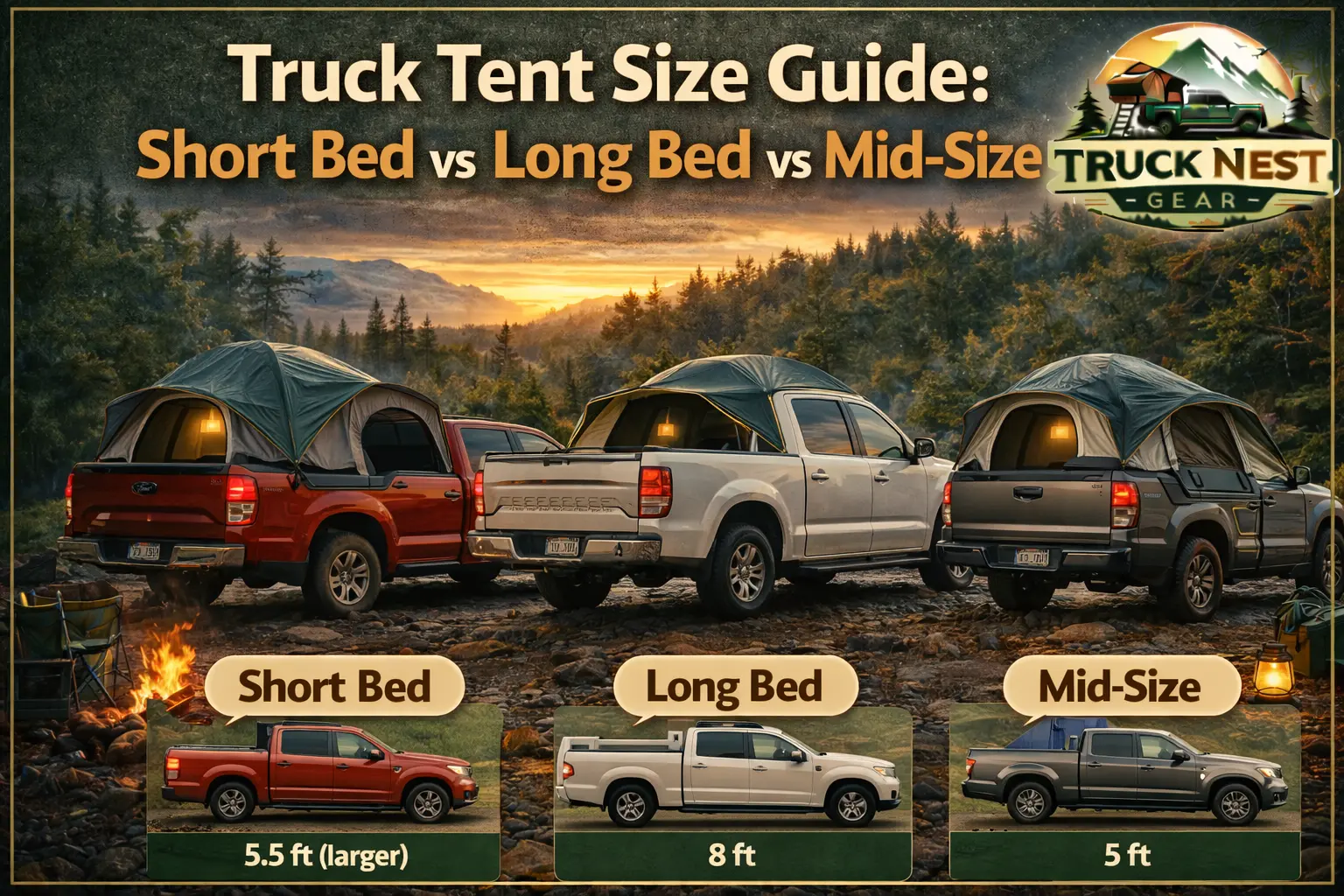
When a tent is marketed as ‘fits short beds,’ it almost always means the 5.5 ft full-size short bed found on the F-150 SuperCrew, RAM 1500 Crew Cab, and Silverado 1500 Crew Cab. It does not mean the 5 ft short bed found on the Tacoma Double Cab, Colorado Crew Cab, or Ranger SuperCrew. Both trucks are accurately described as having a ‘short bed’ by their manufacturers, but they require different tents.
‘Full-Size’ Is Not a Reliable Filter
‘Full-size truck tent’ in product listings typically means the 5.5 ft or 6.5 ft categories, the dominant full-size truck configurations. It rarely covers the 8 ft long-box beds found on Super Duty, RAM 2500, and Silverado HD configurations. If you have an 8 ft bed, filtering by ‘full-size’ will not reliably surface options that fit.
‘Universal’ Does Not Mean It Works on Every Truck
Tents marketed as ‘universal’ use adjustable strap systems that work across a range of standard bed lengths, typically 5 ft through 6.5 ft. Most universal designs do not extend to 8 ft beds. The Honda Ridgeline, Chevy Avalanche, and Cybertruck have bed designs that universal strap systems do not accommodate correctly, regardless of the marketing claim.
The Four Truck Tent Size Categories
Once you have your inside bed measurement, match it to one of the four tent size categories. Every major tent brand designs around these categories, and their fitment databases are built around them.
| Category | Representative Trucks | Key Tent Design Note |
| Mini (4.5 ft / 54 in) | Ford Maverick | Napier Maverick-specific, no other purpose-built options |
| Mid-Size Short (5 ft / 59-62 in) | Tacoma D-Cab, Colorado CC, Ranger CC, Ridgeline | Mid-size tent designs; NOT the same as full-size short bed tents |
| Full-Size Short (5.5-5.75 ft / 66-70 in) | F-150 SC, RAM 1500 CC, Silverado CC | The dominant tent market segment; widest selection |
| Standard Full (6-6.75 ft / 72-81 in) | F-150 SC/RC, RAM 1500 QC, Tundra DC, F-250 CC | Second-largest segment; good selection |
| Long Box (8 ft / 96+ in) | F-250/350 RC, RAM 2500/3500, Silverado HD | Underserved; limited dedicated options |
| Why mid-size and full-size short beds are not interchangeable: The Tacoma’s 59.5 in interior and the F-150 SuperCrew’s 66 in interior are both called ‘short beds.’ That 6.5 inch difference is the difference between a correctly tensioned tent attachment and a loose one that pools water and slides in wind. The mid-size short bed (5 ft) and the full-size short bed (5.5 ft) are different product categories. Know which one your truck belongs to before searching. |
The Sizing Decision Path
Use this decision path after measuring your inside bed length:
| Your Measurement | Category | Search Strategy | Example Trucks |
| Under 56 in (under 4.7 ft) | Mini bed | Use Napier Maverick-specific tent only | Ford Maverick |
| 56-63 in (4.7-5.25 ft) | Mid-size short bed | Search ‘mid-size truck tent’ or ‘5 ft bed tent’; verify by truck model | Tacoma, Colorado, Ranger, Ridgeline |
| 64-71 in (5.3-5.9 ft) | Full-size short bed | Search ‘5.5 ft bed’ or ‘short bed full size’; Napier 57 is the benchmark | F-150 SC, RAM 1500 CC, Silverado CC |
| 72-82 in (6-6.8 ft) | Standard full-size bed | Search ‘6.5 ft bed tent’; Napier Backroadz 13 or Sportz 57 | F-150 SC/RC, RAM QC, Tundra, F-250 CC |
| 83+ in (6.9+ ft) | Long box | Search specifically ‘8 ft bed tent’; Rightline 110730 or Kodiak 7206 | F-250/350 RC, RAM 2500/3500, HD trucks |
Step 3: Use the Measurement to Verify Fitment
Once you know your measurement and category, the verification step is the same regardless of which tent you are considering. Every major brand, Napier, Rightline Gear, Kodiak Canvas, publishes fitment data. Use it.
Napier’s Fitment Database
Napier (napier.ca / napieroutdoors.com) publishes a truck-specific fitment guide that lists compatible tent models by year, make, model, cab style, and bed length. This is the most comprehensive fitment database in the category. Enter your truck’s details, and the database returns which Napier model numbers are confirmed for your vehicle. If your truck is not listed, the Napier product is not verified for your configuration; use a universal tent instead.
Rightline Gear’s Universal Approach
Rightline Gear does not publish a truck-specific fitment database because their 110730 uses a universal strap system. Their guidance is simple: measure your bed length and confirm it falls within the adjustment range of the product you are considering. For the 110730, the confirmed working range is approximately 5 ft through 8 ft for the strap length. Below 5 ft (Maverick’s 4.5 ft mini bed) or for non-standard bed profiles (Avalanche, Ridgeline composite rails), universal does not mean compatible.
Kodiak Canvas’s Model Numbers
Kodiak Canvas uses three model numbers for truck tents: the 7206 (6.5 ft standard bed), the 7211 (mid-size 5-6 ft beds), and an 8 ft variant for long-box trucks. The model number encodes the bed category. If you see ‘7206’, you are looking at the standard 6.5 ft model; ‘7211’ is the mid-size. Do not assume the 7206 fits a 5 ft bed; it does not.
The Three Most Common Sizing Mistakes
| Mistake | What Happens | Correct Action |
| Buying a ‘full-size’ tent for a mid-size truck | The tent attachment hooks cannot reach the correct position on a 5 ft bed when designed for 5.5 ft rails. The tent will sag at the front and create water pooling gaps at the cab end. | Measure inside bed length before searching; confirm it matches the tent’s stated bed length exactly |
| Buying a 5.5 ft tent for an 8 ft bed | The tent covers only the rear 5.5 ft of the bed, leaving the cab-side 2.5 ft completely open and the front attachment points unable to reach their correct rail positions. | Use Rightline 110730 or Kodiak 7206 8 ft variant for 8 ft beds — no workarounds |
| Relying on the model name instead of measuring | ‘Short bed F-150’ and ‘short bed Tacoma’ both exist in marketing language but require different tents. Model names describe the truck, not the tent category it needs. | Always measure; never assume a model-name category match is sufficient |
Frequently Asked Questions
How do I know which size truck tent to buy?
Measure your inside bed length with a tape measure flat along the bed floor from the inner face of the tailgate to the inner face of the cab rear wall. Match that measurement to the tent category table above. Then use the tent manufacturer’s fitment database; Napier’s is the most comprehensive, to confirm the specific product works for your truck’s year, cab, and bed combination.
Is a 5 ft truck tent the same as a short bed tent?
No. ‘Short bed tent’ in most product listings means the 5.5 ft full-size short bed category, not the 5 ft mid-size short bed category. The Tacoma, Colorado, and Ranger have 5 ft beds; the F-150 SuperCrew, RAM 1500 Crew Cab, and Silverado 1500 Crew Cab have 5.5 ft beds. These are different products. If your truck has a 5 ft bed, search specifically for ‘mid-size truck tent’ or ‘5 ft truck bed tent,’ not ‘short bed tent.’
What does ‘universal’ mean for a truck tent?
A universal truck tent uses an adjustable strap or clamp system rather than model-specific hooks to attach to the bed rail. This allows it to work across a range of standard bed lengths without year-specific fitment verification. However, universal does not mean it works on every truck. The Honda Ridgeline’s composite rails, the Chevy Avalanche’s MidGate design, and the Ford Maverick’s 4.5 ft mini bed are all examples where universal tents do not work as expected.
Can a long bed tent fit a short bed truck?
No. A tent designed for a 6.5 ft long bed will not attach correctly to a 5.5 ft short bed. The front attachment hooks cannot reach the correct rail position on a shorter bed, and the excess fabric creates pooling and sag. The reverse, a short bed tent on a long bed, also fails, leaving significant uncovered bed area at the cab end. Use the correct size for your bed.
Where can I find the exact bed length for my truck?
The most accurate method is to measure inside the bed rails with a tape measure as described above. For a quick reference before measuring, Napier’s fitment guide at napieroutdoors.com lists inside bed dimensions for most North American trucks by year and cab configuration. Your owner’s manual may also list this under cargo area dimensions.
Final Verdict
The sizing decision comes down to one action: measure your inside bed length. Once you have that number, the category is clear, and the tent search becomes straightforward. The confusion in this market comes almost entirely from buyers skipping the measurement step and trusting product names that use the same words, ‘short bed,’ ‘full size,’ ‘universal’, to mean different things across different contexts.
Measure first. Match the measurement to the category table. Verify in the manufacturer’s fitment database. Those three steps take less than five minutes and eliminate every major sizing mistake.