Truck Tent vs Ground Tent: Which One Is Better for Camping?
Every camper eventually faces this question: do you sleep on the ground like you always have, or do you take your camping setup to the next level by sleeping elevated in your truck bed?
It sounds simple on the surface. But when you dig into the real differences between a truck tent and a ground tent, the answer depends on far more than personal preference. It depends on where you camp, how you camp, what terrain you deal with, and what you value most from a night in the outdoors.
This guide breaks down both options side by side: comfort, weather protection, setup time, versatility, and value, so you can make a genuinely informed decision before spending a dollar.
The Core Difference Between the Two
Before comparing features, it is worth establishing what fundamentally separates these two shelter types.
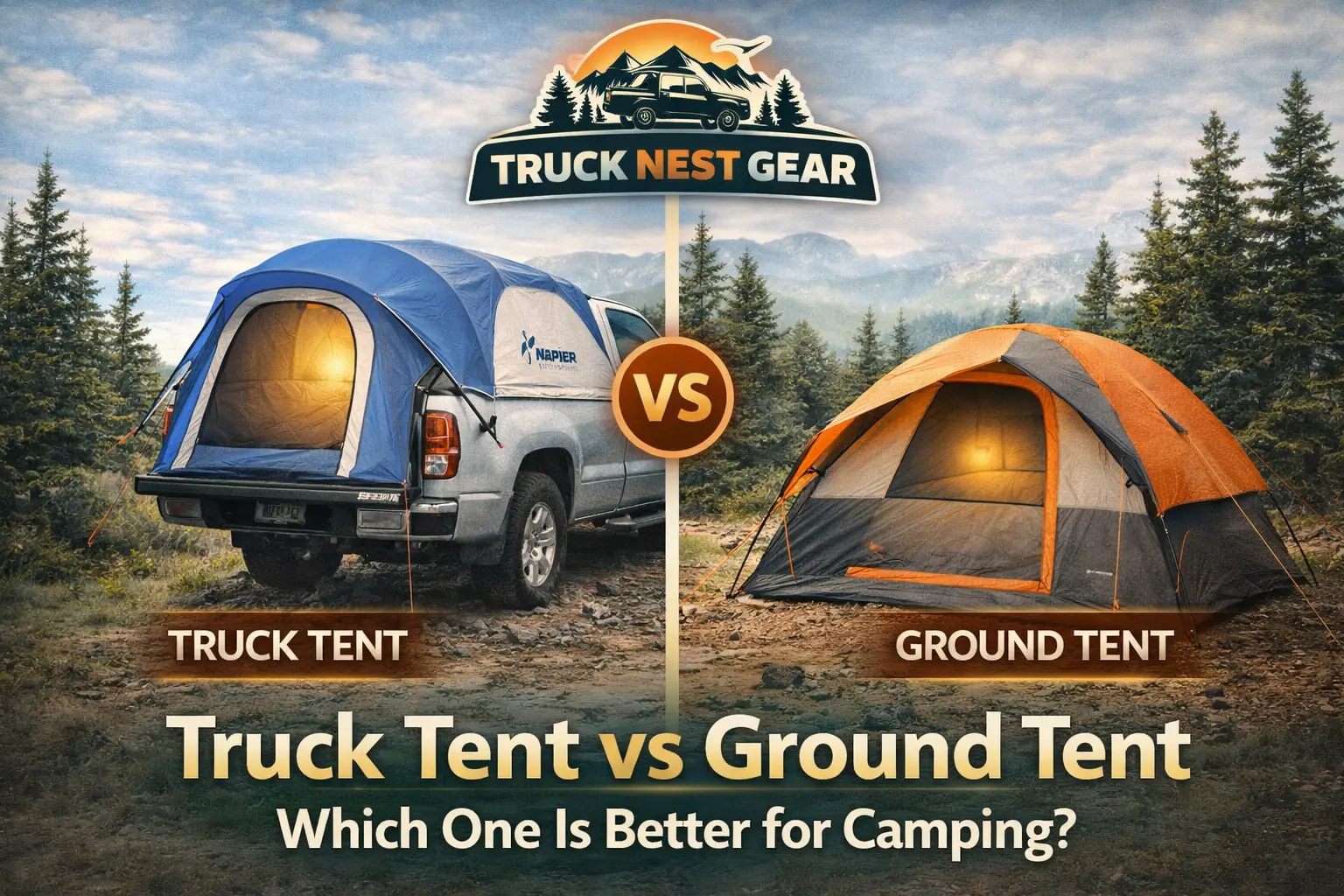
A ground tent is a freestanding or staked shelter pitched directly on the earth. It is entirely independent of your vehicle and can be set up virtually anywhere: a forest clearing, a beach, a grassy meadow, a rocky ridge. It has no relationship with your truck whatsoever.
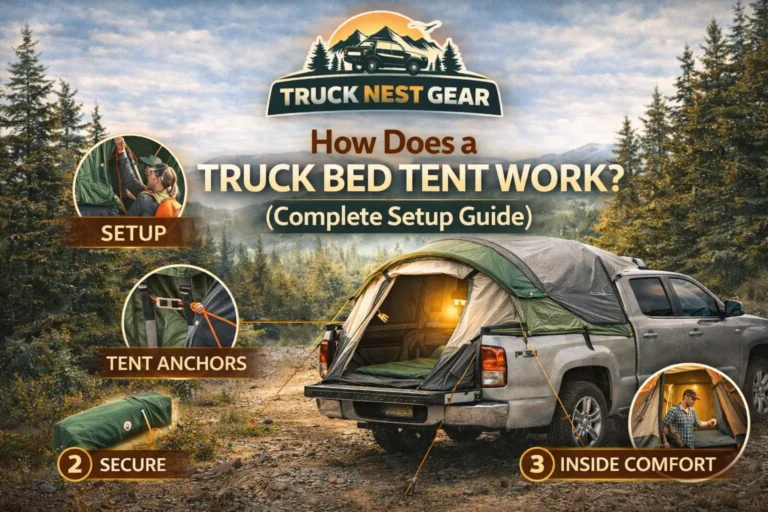
A truck bed tent is a vehicle-mounted shelter that uses your pickup truck bed as its foundation and floor. It attaches to the bed rails and tailgate using a pole system and strap anchors, creating an enclosed sleeping space elevated at truck-bed height, typically 24 to 36 inches off the ground. It cannot function without the truck.
The question is not which one is objectively better. The question is which one is better for you, specifically for the kind of camping you actually do.
Seven-Factor Head-to-Head Comparison
1. Comfort and Sleep Quality
A ground tent’s sleep quality depends entirely on the surface beneath you. Rocky terrain, tree roots, slopes, and wet soil all work against you regardless of how good your sleeping pad is. Finding a flat, debris-free spot is a campsite task every ground tent camper knows well, and one that isn’t always solvable depending on where you end up.
A truck bed tent gives you a flat, consistent, elevated surface every single time, regardless of the terrain around you. The truck bed doesn’t care whether you’re parked on gravel, sand, or a rocky dispersed campsite; the sleeping surface is always the same. Combined with a truck-specific air mattress or insulated sleeping pad, the sleep quality inside a truck tent genuinely rivals a budget hotel mattress. There are no rocks, no roots, and no ground moisture working against you.
Advantage: Truck bed tent. The elevated, consistent surface is a clear win for sleep comfort across varied terrain.
2. Weather Protection
Modern ground tents with full rainflies offer excellent weather protection; the best expedition-grade ground tents handle sustained rain and high wind as well as any shelter available. But ground-level camping introduces risks that elevation eliminates: pooling water flowing under the tent floor, mud splashing against the lower fabric, and cold ground conducting temperature directly through your sleeping pad regardless of its rating.
A truck bed tent solves the groundwater problem entirely. Rain runs off and away rather than pooling beneath your floor. The metal truck bed itself provides a completely windproof lower wall that ground tents cannot replicate. The vulnerability in a truck tent is the opposite: elevation exposes you to more wind than ground level, which is why proper strap tension, guy line deployment, and a quality full-coverage rainfly are non-negotiable for any serious camping use.
Seam construction matters significantly for both tent types. A taped seam, where the stitching is covered with a waterproof tape strip from the inside, outperforms a coated seam in sustained rain by preventing water from wicking through the needle holes. Whether you are evaluating a ground tent or a truck tent, checking for taped seams and a hydrostatic head rating of 2,000mm or above on the rainfly is the single most important weather protection specification to verify before buying.
Advantage: Draw. Both protect well when correctly specified. Truck tents win on ground moisture; ground tents can have a lower wind profile in exposed terrain.
3. Setup Time
A standard dome or cabin ground tent takes 15 to 30 minutes for most campers to pitch correctly, finding a flat spot, clearing debris, staking corners, assembling poles, and attaching the rainfly. In the dark or in bad weather, that process becomes significantly more difficult and frustrating. Site selection alone can add 10 to 20 minutes at an unfamiliar campsite.
A truck bed tent requires zero site preparation. Your truck bed is always flat, always ready, always the same. Once you are familiar with your tent’s pole sequence and attachment system, setup takes 10 to 15 minutes. Hub-style and automatic-mechanism designs deploy in under 5 minutes. There is no searching for level ground, no clearing rocks and roots, and no staking into whatever soil condition the campsite presents.
Advantage: Truck bed tent. Faster setup with no site preparation required.
4. Versatility and Portability
This is where ground tents hold their strongest advantage. A ground tent goes anywhere a person can carry it: national parks, beaches, backcountry trails, kayak trips, canoe camps, rooftop platforms, or anywhere vehicle access is impossible. It is completely independent of your vehicle and can be carried in a backpack if the design allows.
A truck bed tent is entirely dependent on your truck. No truck, no shelter. It cannot be deployed on the ground. If your camping plans change mid-trip, if you share camping duties with non-truck owners, or if you camp in locations without vehicle access, a truck bed tent offers zero flexibility.
Advantage: Ground tent. Vehicle independence and true portability are unmatched for campers who need a shelter that works everywhere.
5. Insect and Pest Protection
Ground-level camping places you directly in the path of crawling insects, ants, snakes, and small rodents. Even with a properly staked tent floor, gaps around the perimeter on uneven terrain can allow pests inside. A perfectly sealed ground tent floor on flat, smooth terrain is excellent. A tent floor on rocky or uneven ground is a different situation.
A truck bed tent’s elevation creates a natural barrier against ground-dwelling insects and animals. Crawling pests cannot reach you. Combined with quality mesh windows that block flying insects, a truck tent offers noticeably superior pest protection compared to most ground tents in environments where ground-dwelling insects and animals are active concerns, which includes most summer camping in wooded, marshy, and desert environments across North America.
Advantage: Truck bed tent. Elevation is one of the most effective and effortless defenses against ground-level pests.
6. Cost and Value
Quality ground tents range from $50 for entry-level options to $600-plus for expedition-grade shelters. The mid-range sweet spot for a reliable three-season ground tent sits around $150 to $250, a price that buys solid weather protection and reasonable durability for campground use.
Truck bed tents range from $100 for entry-level models to $400-plus for premium canvas designs. Because your truck bed provides the floor and the windproof lower walls, you are getting more structural shelter per dollar in many cases; the tent itself handles the roof, upper walls, and rainfly, while the truck handles everything else.
The relevant comparison is what each product delivers at a given price. A $200 truck bed tent and a $200 ground tent serve genuinely different use cases; comparing them on price alone misses the point. The right question is which one delivers better value for your specific camping life.
Advantage: Draw. Both categories offer solid value at comparable price points. The truck tent’s use of the vehicle as structural foundation shifts the value equation for truck owners specifically.
7. Family and Group Camping
For families of four or more, large cabin-style ground tents with multiple rooms offer sleeping space that no truck tent can match. A 10-person ground tent simply has no truck bed equivalent; the truck bed is a fixed physical space that limits sleeping capacity to one or two adults regardless of tent design.
Most truck bed tents comfortably sleep two adults. Some wider long-bed designs accommodate two adults and a small child, but truck tents are fundamentally a one or two-person solution. For group camping with three or more people, a ground tent is the only practical option regardless of what the truck tent offers in other categories.
Advantage: Ground tent. For group or family camping, a ground tent is the only viable choice.
Side-by-Side Summary
| Feature | Ground Tent | Truck Bed Tent |
|---|---|---|
| Sleep Comfort | Depends on terrain | Consistently flat and elevated |
| Weather Protection | Excellent | Excellent (better vs ground water) |
| Setup Time | 15 – 30 minutes | 5 – 15 minutes |
| Versatility | Very high | Limited to truck owners |
| Pest Protection | Moderate | Superior |
| Group Capacity | Up to 10+ people | 1 – 2 people typically |
| Price Range | $50 – $600+ | $100 – $400+ |
| Vehicle Dependency | None | Full |
Who Should Choose a Truck Bed Tent?
A truck bed tent is the stronger choice if you already own a pickup truck and want to maximize its utility, camp frequently on rough, rocky, or uneven terrain where finding a flat ground site is genuinely difficult, value faster setup and less site preparation at the end of a long driving day, camp solo or with one partner rather than as part of a larger group, want natural elevation from insects and ground moisture without relying on perfect tent floor sealing, or are interested in overlanding, dispersed camping, or backcountry truck camping where campsite conditions are unpredictable.
Before committing to a specific model, understanding how bed size compatibility, waterproofing ratings, pole material, and ventilation design separate a truck tent that performs for years from one that disappoints on its first rainy trip is worth the time, the complete buyer’s checklist for truck bed tents walks through every specification that actually matters and what to look for at each price point.
Who Should Choose a Ground Tent?
A ground tent remains the better option if you camp with a family or group of three or more where truck bed space is a hard physical limit, frequently hike or backpack to your campsite where carrying the shelter is part of the trip, do not own a pickup truck or camp in situations where vehicle access to the sleeping area is not guaranteed, need a single shelter that works across every type of outdoor trip you take rather than just truck-based camping, or prioritize maximum versatility over the comfort and convenience advantages that elevation provides.
Can You Own Both?
Many experienced campers do exactly this, and for good reason. A compact, lightweight ground tent handles backpacking trips, family camping, and any situation where vehicle access is not available. A truck bed tent handles solo overlanding, weekend dispersed camping, and any trip where the terrain and simplicity of setup matter more than maximum capacity.
The two shelter types serve genuinely different use cases and do not compete for the same camping nights. Owning both gives you complete flexibility across every kind of outdoor trip rather than forcing a single shelter to cover situations it was not designed for.
Final Verdict
Neither the truck tent nor the ground tent wins this comparison outright, because the right answer depends entirely on how you camp. But for pickup truck owners who camp on varied terrain, value fast setup, sleep in pairs, and want consistent comfort regardless of campsite conditions, a truck bed tent offers a level of convenience and sleep quality that a ground tent simply cannot replicate.
If you have decided that a truck bed tent is the direction you are heading, the specific models that deliver the strongest combination of weather protection, build quality, and value across every major truck platform and bed size, from short-bed Tacomas to long-box HD trucks, are evaluated in full in the complete guide to the best truck bed tents.