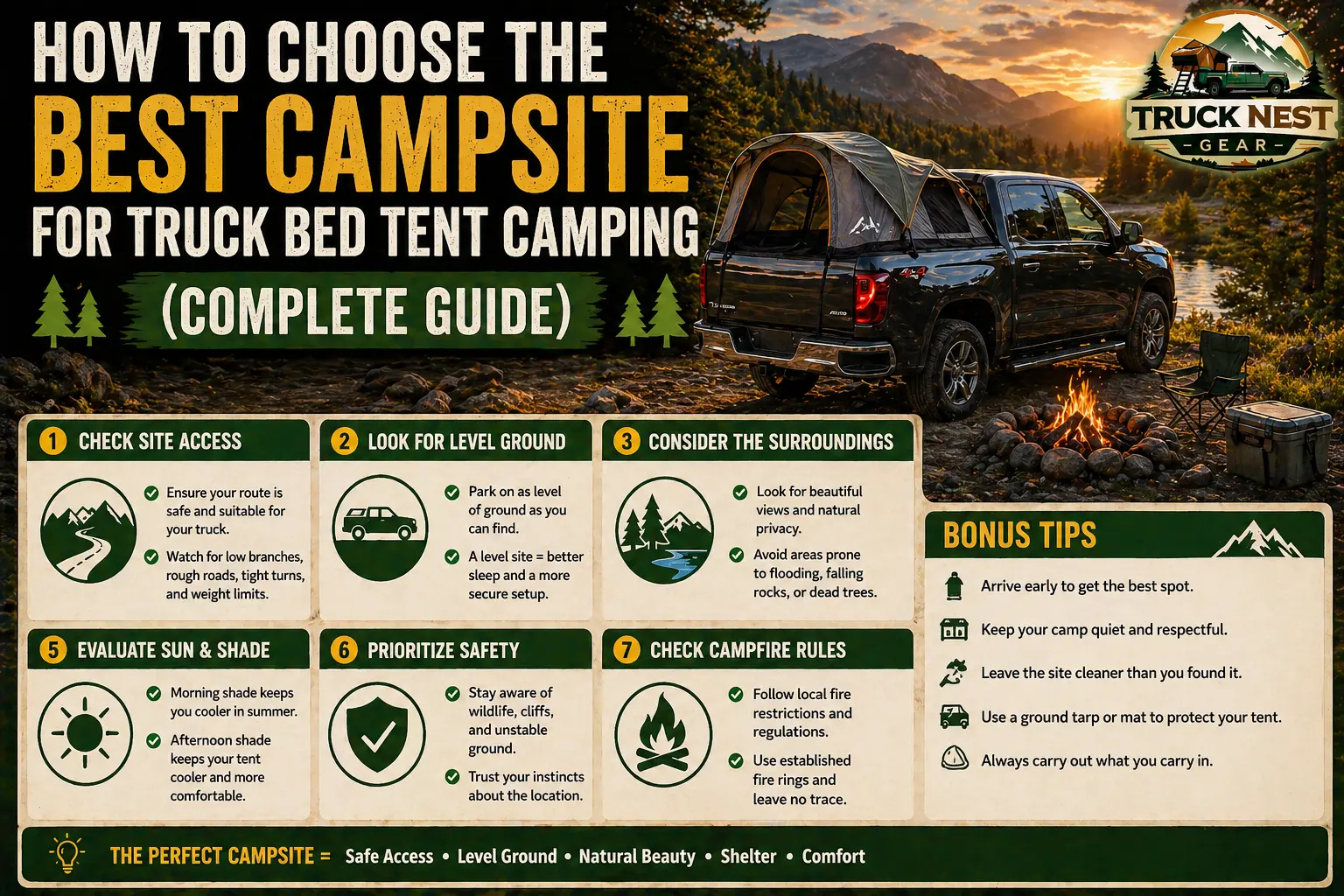
How to Choose the Best Campsite for Truck Bed Tent Camping (Complete Guide)
Choosing the best campsite for truck bed tent camping depends on 5 measurable factors: level ground below 2°, firm surface like gravel or packed dirt, 8–12 meters of space, safe clearance above 2.8–3.6 meters, and correct parking orientation.
Truck bed tents use a fixed platform. They cannot adjust to terrain like ground tents on grass, sand, and soil.
Slopes above 2–5 degrees cause body sliding and sleep disruption. Soft ground like mud, sand, and wet soil loses up to 50% load capacity.
Poor clearance leads to over 20% of campsite-related vehicle damage, according to the National Park Service.
Effective campsite selection requires evaluating surface type, slope angle, space dimensions, wind direction, and access routes like forest roads, campground loops, and dirt tracks.
Tools like The Dyrt, iOverlander, and Google Earth provide terrain data, user reviews, and satellite analysis.
A structured 5-point checklist confirms campsite safety in under 2 minutes and reduces setup failure, repositioning, and injury risk.
Designated campsites provide predictable surfaces and access. Dispersed camping offers flexibility but requires terrain and clearance evaluation skills.
Campsite selection determines stability, safety, access, and sleep quality in truck bed tent camping.
Why Campsite Selection Is Different for Truck Bed Tents
Campsite selection is different for truck bed tents because the truck bed is a fixed, rigid platform that cannot adjust to uneven terrain.
Ground tents adapt to surfaces like grass, sand, and soil, but truck beds depend entirely on site level. This creates 3 constraints: surface angle, weight distribution, and parking alignment.
A poor campsite creates 4 problems: sliding, uneven sleep posture, structural stress, and vehicle instability. Sloped areas like hillsides, riverbanks, and rocky trails shift body position during sleep.
Truck suspension systems in vehicles like the Toyota Tacoma, Ford F-150, and RAM 1500 follow ground angle instead of correcting it. This increases tilt and reduces balance.
A slope above 5 degrees affects sleep quality and increases rolling risk. Uneven load distribution stresses tires and suspension components.
According to the National Park Service, over 60% of camping injuries relate to unstable ground conditions. Elevated setups increase fall risk compared to ground-level tents.
Wind exposure increases in open areas like deserts, lakesides, and ridgelines. Elevated tents catch more airflow and create movement.
Water accumulates in low points like valleys, depressions, and flood zones.
The campsite controls stability, safety, and comfort in truck bed tent camping.
The Levelness Rule: How Flat Is Flat Enough?
A campsite is flat enough for truck bed tent camping when the slope stays below 2 degrees in all directions.
Slopes above 2 degrees create body movement. Slopes above 5 degrees create instability and safety risk. Truck suspension follows ground angle and increases tilt.
Why Even a Small Slope Ruins Sleep
A slope of 2–3 degrees causes continuous body sliding toward the tailgate during sleep.
Gravity pulls body weight downhill on smooth surfaces like plastic liners, air mattresses, and foam pads. Low-friction materials increase movement speed.
This creates 3 effects: muscle tension, sleep interruption, and spinal misalignment. For example, sleeping setups like foam pads, inflatable mattresses, and blankets shift position overnight.
Studies from the Sleep Foundation show that minor body misalignment increases sleep disturbance by over 25%. Elevated sleeping positions increase instability compared to ground tents.
How to Test Slope Before You Commit
Slope can be tested using 3 methods: object movement, digital measurement, and body feedback.
- Use rolling objects
Place items like water bottles, flashlights, and cans on the truck bed. Movement shows slope direction. - Use phone-level apps
Apps like Measure, Bubble Level, and Clinometer show slope angle in degrees. Visual estimation often fails below 5 degrees. - Lie down for 30 seconds
The body detects imbalance faster than the eyes. Subtle slopes are not visible but are physically noticeable.
What to Do When No Perfectly Level Spot Exists
Use 3 adjustments: reposition the truck, level the tires, and control sleeping direction.
- Adjust parking position
Move the truck forward or backward by 1–2 meters to reduce slope angle. - Use leveling tools
Use tools like leveling blocks, wood planks, and traction boards to raise low points under tires. - Control sleeping direction
Align the body head-to-toe with slope direction. Side-to-side slopes increase rolling risk more than forward incline.
Vehicle guidelines from Ford Motor Company and Toyota recommend parking on slopes below 5 degrees for stability. Parking brakes reduce movement risk on uneven terrain.
Flat ground controls stability, sleep quality, and safety in truck bed tent camping.
Campsite Size: How Much Space Does Your Truck Actually Need?
A truck bed tent campsite requires 8–12 meters of length and 3–5 meters of width for safe setup and movement.
This footprint includes 4 components: truck length, tailgate extension, walking clearance, and rear access space.
Compact trucks like the Toyota Tacoma, Ford Ranger, and Chevrolet Colorado need 8–9 meters of total length. Full-size trucks like the Ford F-150, RAM 1500, and Chevrolet Silverado need 10–12 meters of total length.
What Makes Up the Total Campsite Footprint?
The campsite footprint combines vehicle dimensions and required clearance for access and setup.
- Truck body length
Trucks measure 5.3–6.7 meters, depending on cab and bed configuration. - Tailgate and tent extension
Open tailgates add 0.6–1 meter. Truck tents extend total rear length to 1.5–2 meters. - Rear access space
A clearance of 1–1.5 meters allows safe entry and exit from the tailgate. - Side walking and door clearance
At least 1 meter per side is required for walking and opening doors like driver, passenger, and rear doors.
Pull-Through vs Back-In Campsites
Pull-through sites provide easier alignment, while back-in sites require precise positioning for truck bed tents.
Pull-through sites allow straight entry and exit. These sites suit long vehicles like pickup trucks, camper vans, and trailers.
Back-in sites require reversing into position. These sites restrict adjustments after parking and increase setup errors.
According to the National Park Service, over 70% of developed campgrounds use back-in layouts. This increases difficulty for larger vehicles.
Why Truck Size Changes Campsite Requirements
Truck size affects length, width, turning radius, and clearance requirements.
Compact trucks require smaller turning space. Full-size trucks require wider entry angles and larger parking zones.
Turning radius ranges from 5.5 to 7.5 meters for trucks like the Toyota Tacoma, Ford F-150, and RAM 1500.
Larger trucks require more vertical and horizontal clearance for rooftop gear like racks, storage boxes, and tents.
What Happens If the Campsite Is Too Small?
A campsite below required dimensions creates 3 problems: blocked access, unsafe setup, and restricted movement.
Blocked access limits entry points like tailgates, doors, and storage compartments. Unsafe setups occur when tents extend into obstacles like trees, rocks, and barriers.
Restricted movement increases risk during night activity. Limited space prevents safe walking and equipment adjustment.
Adequate campsite size ensures safe access, stable setup, and efficient movement for truck bed tent camping.
Ground Surface: What You Park On Matters More Than You Think
Ground surface determines tire grip, moisture exposure, and overnight vehicle stability in truck bed tent camping.
Surface type affects 3 factors: traction, drainage, and load-bearing strength. These factors control safety and comfort.
Gravel and Packed Dirt (Best Options)
Gravel and packed dirt provide stable, well-drained surfaces that maintain firmness under vehicle weight.
Gravel types like crushed stone, pea gravel, and limestone improve drainage and prevent water pooling.
Packed dirt resists compression and maintains levelness overnight. Compacted surfaces reduce tire sink and suspension shift.
According to the Federal Highway Administration, compacted gravel reduces surface displacement by over 40% compared to loose soil.
Airflow under the vehicle reduces moisture buildup. This lowers condensation inside sleeping setups.
Grass and Soft Dirt (Proceed With Caution)
Grass and soft dirt create unstable surfaces due to moisture retention and reduced load capacity.
Soft surfaces like wet soil, clay, and loam compress under weight and lose firmness overnight.
Rain increases saturation and reduces strength. The USDA reports that wet soil loses up to 50% of load-bearing capacity.
Moisture transfers through surfaces like grass, damp soil, and mud. This increases humidity in sleeping areas.
Asphalt and Concrete (Underrated Option)
Asphalt and concrete provide maximum stability with consistent flatness and zero ground deformation.
Hard surfaces like asphalt, concrete, and pavement support full vehicle weight without compression.
These surfaces increase heat retention by 5–10°C in summer conditions. This raises interior temperature.
They perform better in cooler seasons like autumn, winter, and early spring.
Sand and Mud (Avoid When Possible)
Sand and mud create unstable conditions due to low traction, ground shifting, and tire sinking.
Loose surfaces like sand, mud, and silt reduce grip and increase tire sink depth by several centimeters.
Mud creates suction that traps tires. Sand shifts under load and reduces stability.
Tie-down systems like stakes, straps, and anchors lose effectiveness in loose ground.According to the National Park Service, soft ground contributes to over 35% of vehicle recovery incidents.
Parking Orientation — Which Direction Should Your Truck Face?
Truck orientation should be back-in, slightly uphill or level, and aligned to block wind and limit sun exposure.
Orientation controls 4 factors: tailgate access, body position, wind exposure, and sunlight direction.
Back-In vs Head-In Position
Back-in parking improves tailgate access, increases privacy, and expands usable rear space.
Back-in positions place the tailgate away from roads. This reduces visibility from traffic and nearby campers.
Head-in positions block rear access and limit setup space. These positions restrict tent deployment.
Campsite types like back-in pads, pull-through lanes, and angled bays affect positioning. Vehicles like pickup trucks, camper vans, and SUVs require rear clearance.
According to the National Park Service, over 70% of campsites use back-in layouts.
Uphill vs Downhill Orientation
The truck should face slightly uphill or remain level to prevent body sliding during sleep.
A downhill slope of 2–5 degrees causes continuous sliding toward the tailgate. This increases pressure imbalance.
Uphill positioning keeps the head elevated above the feet. This reduces movement and improves alignment.
Sliding increases on surfaces like plastic liners, air mattresses, and foam pads.
Wind Direction and Protection
The truck cab should face incoming wind to reduce direct airflow on the tent surface.
Headwind positioning blocks airflow with the cab structure. Crosswinds increase lateral movement and tent instability.
Wind sources like coastal winds, mountain gusts, and open-field airflow increase pressure on tent fabric.
The National Weather Service states that wind speeds above 15 mph increase tent movement and structural stress.
Natural barriers like trees, rocks, and terrain reduce wind exposure.
Sun Direction and Heat Control
Tailgate direction should avoid east-facing exposure to reduce early morning heat and light.
East-facing setups allow direct sunrise into the tent. This increases internal temperature by 3–6°C within 30–60 minutes.
West-facing or shaded orientations reduce heat gain. Shade sources like trees, cliffs, and vehicles improve thermal comfort.
Key Orientation Rule
Correct orientation improves access, reduces sliding, blocks wind, and controls sunlight in truck bed tent camping.
Overhead and Road Clearance — What Most Campers Forget
Overhead and road clearance determine whether a truck can safely access and occupy a campsite without collision or blockage.
Truck bed tents increase total height by 0.9–1.5 meters (3–5 feet) above the bed floor. This changes clearance requirements.
Clearance affects 3 areas: vertical space, road width, and turning radius.
Why Overhead Clearance Becomes a Hidden Risk
Truck bed tents increase total vehicle height to 2.8–3.6 meters, creating new collision risks with low obstacles.
Low obstacles like tree branches, power lines, and structures such as signboards, entry arches, and shelters become hazards.
Safe overhead clearance requires at least 0.5 meters of extra space above total vehicle height.
Uneven ground increases effective height during suspension movement. This raises collision risk.
According to the National Park Service, low-clearance obstacles contribute to over 20% of campsite-related vehicle damage incidents.
Why Road Clearance Limits Campsite Access
Road clearance determines whether a truck can enter, turn, and exit without obstruction or contact.
Full-size trucks like the Ford F-150, RAM 1500, and Chevrolet Silverado 1500 measure 2–2.1 meters in width including mirrors.
Safe road width requires 3–3.5 meters to allow maneuvering space.
Compact trucks like the Toyota Tacoma, Ford Ranger, and Nissan Frontier require 2.5–3 meters of width clearance.
Turning radius ranges from 5.5–7.5 meters depending on vehicle size.
Common Clearance Obstacles to Check
Campsite access includes multiple obstacles that affect vertical and horizontal clearance.
Overhead obstacles like branches, cables, and beams reduce vertical space.
Road barriers like narrow gates, rocks, and sharp turns restrict width and movement.
Surface features like ruts, dips, and curbs affect undercarriage clearance and entry angle.The Federal Highway Administration reports that reduced road width increases maneuvering errors by over 30% on unpaved roads.
What Happens If Clearance Is Ignored
Ignoring clearance creates 3 risks: vehicle damage, access failure, and repositioning difficulty.
Vehicle damage includes roof tears, mirror impacts, and undercarriage scraping.
Access failure prevents reaching the campsite. Repositioning becomes difficult in narrow or blocked areas.
Limited visibility at night increases collision risk with obstacles.
Overhead and road clearance directly control campsite accessibility, vehicle safety, and setup success.
Designated Campsites vs. Dispersed BLM or Forest Land
Designated campsites offer structured, paid, and accessible setups, while dispersed BLM or forest land offers free, flexible camping with higher risk and skill requirements.
This difference affects 4 factors: surface quality, access conditions, legal rules, and cost.
What Are Designated Campsites?
Designated campsites are developed areas with prepared pads, defined spaces, and regulated usage.
These sites include 3 features: leveled pads, marked boundaries, and managed access systems. Pads use surfaces like gravel, compacted dirt, and pavement.
Facilities like water stations, toilets, and fire rings improve usability. Entry systems like reservations, permits, and check-in rules control occupancy.
Organizations like the National Park Service and California State Parks enforce regulations.
According to the National Park Service, over 80% of developed campgrounds provide leveled, vehicle-accessible sites.
Typical costs range from $10 to $40 per night, depending on location and amenities.
What Is Dispersed Camping on BLM or Forest Land?
Dispersed camping allows free camping on public land without designated pads or built infrastructure.
Public lands like Bureau of Land Management areas and United States Forest Service lands allow flexible site selection.
These sites lack facilities like toilets, water systems, and marked pads. Campers select locations independently.
Rules include 14-day stay limits within 28-day periods. Policies include restrictions like fire bans, vehicle limits, and designated camping zones.
According to the Bureau of Land Management, over 245 million acres of land allow dispersed camping in the United States.
Key Differences for Truck Bed Tent Camping
Designated sites reduce setup risk, while dispersed sites increase flexibility but require terrain and access evaluation skills.
- Surface and levelness
Designated sites provide stable surfaces like gravel, dirt, and pavement. Dispersed sites vary across terrain like sand, rock, and uneven soil. - Access and road conditions
Designated sites use maintained roads. Dispersed sites involve routes like forest trails, dirt roads, and remote paths. - Legal and usage rules
Designated sites require payment and reservations. Dispersed sites require compliance with policies like fire bans, stay limits, and vehicle restrictions. - Setup control
Designated sites limit positioning options. Dispersed sites allow flexible orientation based on slope, wind, and sunlight.
Which Option Works Better for Truck Bed Tents?
Designated campsites provide higher reliability, while dispersed camping provides higher flexibility with increased risk.
Designated sites suit beginners and full-size trucks due to easier access and predictable conditions.
Dispersed camping suits experienced users who can evaluate slope, clearance, and ground stability.
Limited services affect safety. Dispersed areas often lack cell signal, water access, and emergency support.
Campsite type determines cost, risk level, accessibility, and setup complexity in truck bed tent camping.
How to Scout a Campsite Before You Arrive
Scout a campsite before arrival using 5 tools to verify access, terrain, and safety conditions in advance.
Pre-scouting reduces 3 risks: blocked access, unstable ground, and unsafe setup conditions.
Which Apps Help Identify Good Campsites?
5 tools provide reviews, maps, and terrain data for campsite evaluation.
- The Dyrt
Shows user reviews, photos, and ratings. Reports include slope, access, and surface type. - iOverlander
Lists off-grid locations like dispersed sites, remote roads, and undeveloped areas. - FreeRoam
Maps public lands like BLM zones, national forests, and free camping areas. - Recreation.gov
Provides site dimensions, access rules, and reservation availability for designated campsites. - Google Earth
Displays satellite imagery to assess terrain, road width, and surrounding obstacles.
According to the Outdoor Industry Association, over 65% of campers use mobile apps for trip planning and campsite selection.
How to Filter Reviews for Truck-Specific Information
Filter reviews using 4 keywords: truck access, road width, clearance, and level ground.
Search terms like “truck,” “4×4,” and “full-size vehicle” reveal relevant feedback.
Focus on reviews mentioning conditions like narrow roads, steep slopes, and tight turns. These affect trucks differently than smaller vehicles.
Photos show obstacles like rocks, trees, and uneven terrain. Visual confirmation improves accuracy.
Prioritize reviews that mention vehicle types and exact conditions. Generic reviews provide limited value.
How to Use Satellite Tools to Evaluate Campsites
Satellite tools help analyze 3 factors: slope, access routes, and obstacle density.
Use Google Earth to inspect elevation changes and flat zones. Tree shadows and terrain patterns indicate slope direction.
Check road width and turning space. Narrow paths restrict access for vehicles like pickup trucks, camper vans, and SUVs.
Identify obstacles like tree cover, water bodies, and rock formations before arrival.
Satellite imagery may hide ground details under dense vegetation. Combine imagery with user photos.
What to Check Before Finalizing a Campsite
Confirm 4 conditions before arrival: route access, surface type, clearance limits, and legal rules.
- Route access
Verify road types like paved roads, dirt tracks, and forest trails. - Surface type
Identify materials like gravel, sand, and soil to assess firmness. - Clearance limits
Check overhead and width constraints from images and reviews. - Legal rules
Confirm policies like permits, stay limits, and fire restrictions.
Download maps for offline use in areas without signal. Conditions change with weather and season.
Pre-scouting improves access reliability, reduces setup risk, and increases campsite selection accuracy.
Quick 5-Point Campsite Checklist for Truck Bed Tent Campers
Use this 5-point checklist to verify levelness, firmness, space, clearance, and orientation in under 2 minutes before setup.
This checklist reduces 3 risks: unstable sleep, vehicle movement, and unsafe positioning.
1. Is the Surface Level Enough?
Confirm slope stays below 2 degrees using a 30-second body test or object roll test.
Lie down for 30 seconds to detect sliding. Use objects like water bottles, flashlights, and cans to confirm slope direction.
The Sleep Foundation reports that minor misalignment increases sleep disturbance by over 25%.
2. Is the Ground Firm?
Check firmness using 2 tests: foot pressure and drainage inspection.
Press the ground with one foot. Sinking more than 2–3 cm indicates weak support.
Look for drainage signs like puddles, wet patches, and runoff lines. Moist areas reduce stability.
Surfaces like gravel, packed dirt, and pavement provide stronger support than sand, mud, and wet soil.
3. Is There Enough Space for the Truck and Tailgate?
Ensure 8–12 meters length and 3–5 meters width for full setup and movement.
Estimate space using steps or visual markers. Confirm room for truck body, open tailgate, and walking clearance.
Check obstacles like trees, rocks, and barriers that restrict access.
Vehicles like pickup trucks, camper vans, and SUVs require rear and side clearance.
4. Are There Any Overhead Hazards?
Maintain at least 0.5 meters of clearance above total vehicle height, including the tent.
Truck bed tents add 0.9–1.5 meters. Total height reaches 2.8–3.6 meters.
Inspect obstacles like branches, power lines, and structures such as beams, signboards, and shelters.
The National Park Service states that low-clearance obstacles cause over 20% of campsite damage incidents.
5. Is the Orientation Set for Wind and Comfort?
Park back-in, face slightly uphill, and align the cab toward wind while avoiding direct sunrise exposure.
Position against wind sources like coastal winds, mountain gusts, and open-field airflow.
Avoid east-facing tailgate to reduce sunlight and heat.
The National Weather Service reports that wind speeds above 15 mph increase tent instability.
Complete this checklist before setup to ensure stability, safety, and sleep quality in truck bed tent camping.