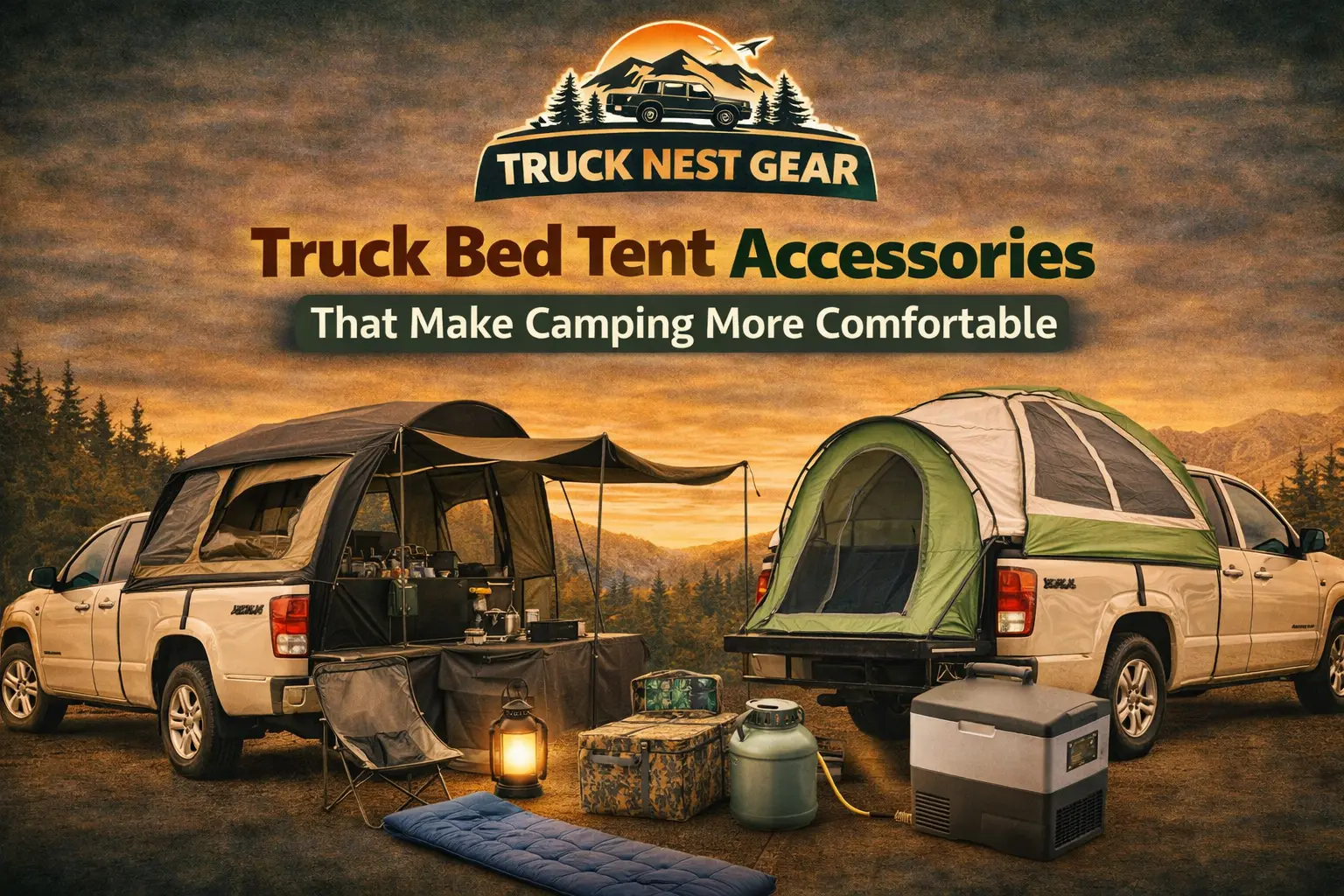
Truck Bed Tent Accessories That Make Camping More Comfortable in 2026
There is a specific kind of satisfaction that comes from a perfectly dialed truck camping setup. Not just a tent that stays up and keeps you dry, but a complete system where every piece of gear has its place, every comfort problem has already been solved before it becomes a problem, and every night in the field feels genuinely better than the one before it.
That level of setup does not happen by accident. It happens because experienced truck campers understand something that first-time buyers rarely do: the tent is just the beginning.
The truck bed tent you choose sets the foundation. The accessories you build around it determine whether that foundation becomes a genuinely comfortable, efficient, and weather-ready camping system — or just a fabric shelter that gets the job done and nothing more.
This guide covers the accessories that actually make a measurable difference. Not an exhaustive list of every truck camping gadget available in 2026, but a carefully selected collection of additions that experienced truck campers return to trip after trip because they solve real problems and deliver real comfort improvements.
Category 1: Sleep System Accessories
The quality of your sleep in a truck bed tent is determined by more than your sleeping bag rating. The surface beneath you, the temperature management around you, and the darkness and quiet of your sleeping environment all contribute to how rested you actually feel in the morning.
1. Truck Bed Air Mattress: The Single Biggest Comfort Upgrade
If there is one accessory that transforms the truck bed tent experience more dramatically than any other, it is a properly fitted truck bed air mattress.
A standard rectangular air mattress does not fit a truck bed correctly. It sits on top of the wheel well humps rather than conforming around them, creating an uneven sleeping surface and leaving cold air gaps between the mattress edges and the bed floor. A truck-specific air mattress is engineered to fit the exact contours of standard truck beds, with cutouts or contoured edges that wrap around the wheel wells and fill the full usable width of the bed at sleeping surface level.
What to look for in 2026: The best truck bed air mattresses offer dual-zone inflation, allowing you and your camping partner to independently adjust firmness on each side. Built-in electric pumps powered by your truck’s 12V outlet simplify inflation and deflation significantly. Flocked top surfaces prevent sleeping bags from sliding and add a layer of insulation between the air chamber and your sleeping surface.
Thickness matters more than most buyers realize. A mattress with less than 4 inches of inflated thickness places you close enough to the metal bed surface that conductive heat loss remains a meaningful factor — particularly in the cooler temperatures that truck campers encounter in spring, fall, and at elevation. An 8-inch mattress creates sufficient thermal separation to effectively eliminate conductive heat loss as a comfort concern in all but genuinely freezing conditions. Floor insulation is consistently the most critical thermal management factor in cold-weather truck tent camping, and the right air mattress addresses it before you ever unpack your sleeping bag.
Approximate cost: $80 – $200
2. Sleeping Bag Liner: Versatility and Warmth Extension
A sleeping bag liner is one of the most underrated accessories in truck camping. Small, light, inexpensive, and capable of extending the usable temperature range of your existing sleeping bag by 10 to 25°F, depending on liner material, it earns its place in the kit on the first cold night you use it.
Silk liners add approximately 5 to 10°F of warmth, weigh almost nothing, and provide a smooth, comfortable sleeping surface inside any bag. They are the preferred choice for warm-weather use where the primary benefit is comfort and hygiene rather than thermal extension.
Merino wool liners add 10 to 15°F of warmth, manage moisture actively, and provide natural odor resistance that makes them the superior choice for multi-night truck camping trips where washing between nights is not practical.
Synthetic insulated liners add 15 to 25°F of warmth and retain most of their insulating capacity when damp, making them the strongest choice for the condensation-heavy environment that cold-weather truck tent camping creates.
There is also a longevity benefit that extends beyond warmth. A liner used consistently between your body and the sleeping bag interior dramatically reduces the rate at which body oils, perspiration, and skin cells contaminate the bag’s fill material. According to REI’s sleeping bag care guidance, a sleeping bag used with a liner and washed after every trip requires full washing only two or three times per season rather than after every outing, a maintenance reduction that meaningfully extends the effective lifespan of a quality sleeping bag and preserves its loft and thermal performance for longer.
Approximate cost: $30 – $80
3. Earplugs and Sleep Mask: The Free Accessories Nobody Mentions
Wind noise against the tent rainfly, rain drumming on the fabric, early morning light filtering through mesh windows, these are the sensory conditions that truck bed tent camping introduces that a bedroom does not. None of them requires expensive gear solutions.
Foam earplugs rated at 33 NRR, the highest standard rating available, reduce wind and rain noise to a level that allows uninterrupted sleep in all but the most extreme conditions. A contoured sleep mask blocks early morning light completely without the pressure against the eyes that flat masks create.
These two items together weigh less than two ounces, cost less than ten dollars, and contribute more to actual sleep quality on windy or early-sunrise camping nights than accessories costing fifty times as much. They belong in every truck camping kit without exception.
Approximate cost: $5 – $15
Category 2: Climate and Weather Accessories
Comfort in a truck bed tent is fundamentally a climate management challenge. The accessories in this category address temperature, airflow, condensation, and weather protection, the four environmental variables that determine how comfortable your sleeping environment actually feels.
4. Portable Camping Fan: Essential for Three Seasons
A portable camping fan is not a luxury for warm-weather truck camping. It is a functional necessity that solves the ventilation problem responsible for more discomfort in truck bed tents than any other single factor.
Condensation inside a truck tent is primarily a ventilation failure, warm, humid body air accumulating against cooler tent surfaces until it reaches dew point and condenses into liquid on the inner walls. A portable fan circulating air through the tent interior prevents this accumulation by keeping air moving continuously, carrying moisture vapor toward the mesh ventilation points before it reaches condensation threshold.
What to look for in a 2026 truck camping fan:
USB-C rechargeable vs 12V powered: USB-C rechargeable fans offer cord-free placement flexibility, positioning the fan wherever airflow is needed most, rather than wherever a power cord reaches. A fan with a 10,000mAh or larger internal battery provides 8 to 12 hours of low-speed operation on a single charge, sufficient for a full night without recharging.
Noise level at low speed: A fan that provides adequate airflow at its lowest speed setting without creating sleep-disrupting noise is the correct balance for overnight use. Look for a maximum noise rating of 35 decibels or below at low speed, comparable to a quiet library environment.
Oscillation capability: An oscillating fan distributes airflow more evenly through the tent interior than a fixed-direction model, reducing warm spots and ensuring air reaches both occupants equally in a two-person setup.
The dual-season value is worth understanding. In summer, the fan provides cooling airflow that makes sleeping in a truck tent comfortable in temperatures into the mid-80s°F. In winter, counterintuitively, a fan set to its lowest speed on the opposite side of the tent from your sleeping position moves just enough air to prevent condensation buildup without creating a cold draft that disrupts sleep. This dual-season utility makes a quality camping fan one of the highest value-per-dollar accessories in the entire truck camping category.
Approximate cost: $30 – $80
5. 12V Portable Cooler: The Upgrade That Changes Multi-Night Camping
A standard ice cooler is adequate for a weekend trip. For the truck camper who spends multiple nights in the field, or who wants fresh food and cold beverages without managing melting ice and water accumulation, a 12V compressor cooler changes the fundamental capability of your camping setup.
Unlike passive ice coolers that gradually warm as ice melts, a 12V compressor cooler maintains a set temperature continuously, running off your truck’s electrical system or a portable power station, with no ice required and no meltwater management.
Quality 12V compressor coolers in 2026 maintain temperatures from -4°F to 50°F, cold enough to function as a freezer for meat and frozen items at the lower end, and precise enough for beverage cooling at the upper end. This range means fresh food on a five-day trip without resupply, a capability that fundamentally changes what meals are possible in the field.
Power consumption reality: a quality 12V compressor cooler draws approximately 3 to 5 amps when actively running, but the compressor cycles on and off rather than running continuously, resulting in an average draw of 1 to 2 amps over time. Connected to a healthy truck battery with the engine run for 30 to 45 minutes per day, a compressor cooler operates indefinitely without meaningful battery drain concern. For campers who prefer not to rely on engine runtime, pairing the cooler with a portable power station of 500Wh or above provides two to three days of continuous cooling without starting the truck.
Approximate cost: $150 – $400
6. Portable Power Station: The Hub of a Modern Truck Camping Setup
The portable power station has become the central hub of the modern truck camping electrical system. In 2026, increased battery capacity, faster charging speeds, and reduced prices have made quality units accessible at every budget level that truck camping requires.
A power station with 500Wh to 1,000Wh capacity covers the typical power needs of a two to three-night truck camping trip without requiring solar recharge in the field. Units in this range weigh between 12 and 30 pounds, manageable for truck camping, where weight is carried in the bed rather than worn on your back.
Every electrically powered accessory in this guide, the fan, the air mattress pump, the 12V cooler, the LED lighting, phone and device charging, connects to the power station as a central supply rather than competing for your truck’s single 12V outlet or drawing down the vehicle battery overnight.
Most quality portable power stations in 2026 support solar panel input through a dedicated MPPT charge controller. A 100W folding solar panel connected to a 500Wh unit under good sun conditions replenishes approximately 300 to 400Wh per day, enough to offset the daily consumption of a fan, cooler, and lighting system running simultaneously on a moderate duty cycle. This solar-plus-storage combination creates a genuinely self-sufficient truck camping electrical system that operates indefinitely in the field without shore power or vehicle engine runtime.
For truck campers moving toward multi-day overlanding trips where the truck bed becomes a complete mobile camp, not just a place to sleep but a full support system for extended time in the backcountry, the power station is the enabling piece that makes everything else possible.
Approximate cost: $200 – $500
Category 3: Lighting Accessories
Lighting inside and around a truck bed tent serves three distinct functions: task lighting for cooking and gear management, ambient lighting for comfort and relaxation, and safety lighting for nighttime navigation around the campsite.
7. LED Strip Lights: Interior Comfort After Dark
LED strip lights installed along the interior perimeter of your truck bed tent transform the inside from a dark fabric shell into a genuinely comfortable living space after dark. Installation requires nothing more permanent than adhesive-backed strips and a USB power connection.
Warm white vs cool white: Warm white strips in the 2700K to 3000K color temperature range create a relaxing interior atmosphere after a day outdoors. Cool white strips in the 5000K to 6500K range provide brighter task lighting but create a clinical feel that most campers find uncomfortable for evening relaxation.
Dimming capability: LED strips with dimmer control allow you to reduce light output to a low amber glow for middle-of-the-night navigation without fully waking yourself or your camping partner. This single feature makes a meaningful difference to sleep quality on multi-night trips.
The bug attraction consideration: Standard white LED light attracts flying insects, relevant when opening the tent entry at night. LED strips that offer a red or amber mode significantly reduce insect attraction while maintaining adequate interior visibility. Several truck camping-specific LED kits now offer app-controlled color modes that include an insect-deterrent amber setting specifically for this use case.
Approximate cost: $15 – $40
8. Headlamp: The Non-Negotiable Personal Lighting Tool
Every truck camper needs a quality headlamp, not as a substitute for camp lighting but as a personal, hands-free tool that serves functions no other light source can replicate.
A headlamp keeps both hands free during tent setup in fading light, a situation that arises on more camping trips than anyone plans for. It provides focused task lighting for cooking and gear organization. And it serves as your primary emergency lighting source if every other power system fails simultaneously.
What separates a quality headlamp from a basic one in 2026:
Regulated output: A regulated headlamp maintains consistent brightness throughout its battery life rather than gradually dimming as power depletes. The practical difference becomes apparent after the first hour of use on a multi-task night.
Red light mode: Red light preserves night vision, the eye’s dark adaptation that takes 20 to 30 minutes to develop and is destroyed instantly by white light exposure. Using red light for camp navigation after dark allows you to return to full night vision immediately when the light is off.
USB-C rechargeable: Eliminates the need to carry and manage spare batteries, a small convenience that compounds into meaningful simplification across a full camping season.
Approximate cost: $25 – $60
Category 4: Organization and Storage
A truck bed tent with two adults sleeping in it has very little floor space for gear storage. The accessories in this category solve the organization problem by moving gear off the floor and into purpose-built storage positions that keep the sleeping area clear and every item accessible.
9. Gear Loft: Overhead Storage That Reclaims Floor Space
A gear loft is a mesh hammock-style shelf that suspends from the tent’s interior peak, hanging above the sleeping area and providing overhead storage for items that need to stay accessible without occupying floor space.
In a truck bed tent where floor dimensions are fixed by the truck bed size, a gear loft effectively adds a second storage tier that dramatically improves interior livability. Phones, headlamps, eyeglasses, books, and small personal items that would otherwise occupy sleeping bag space or get lost in dark corners sit organized and accessible at arm’s reach overhead.
Most gear lofts attach to standard tent pole intersections using hook-and-loop or clip systems, making them compatible with a wide range of truck tent pole configurations without modification.
Approximate cost: $20 – $45
10. Organizer Pocket Panel: Wall-Mounted Gear Management
Organizer pocket panels, multi-pocket fabric panels that attach to the tent’s interior wall using hook-and-loop backing, provide organized, visible storage for the small items that create the most frustration when lost in the dark interior of a tent at night.
A well-designed panel holds: headlamp and backup flashlight, phone and charging cable, pocket knife and multitool, lip balm and personal care items, earplugs and sleep mask, trail map and compass, and snacks for middle-of-the-night hunger.
The organizational benefit is straightforward. The safety benefit is less obvious but equally important; knowing exactly where your headlamp and knife are at 2 AM is not a convenience, it is a preparedness baseline that every truck camper should maintain.
Approximate cost: $15 – $35
Category 5: Privacy and Security
A truck bed tent at a campsite is an inherently visible structure, elevated above ground level and positioned in an open parking area rather than tucked into natural vegetation. The accessories in this category address privacy and security without permanent modification.
11. Window Privacy Covers: Cab Security While You Sleep
While you sleep in your truck bed tent, your truck cab sits unoccupied and visible, with whatever gear is stored inside potentially visible through the windows to anyone walking through the campsite at night.
Custom-fit window covers, reflective on the outside, dark on the inside, attach to your truck’s interior window frames using suction cups or magnetic edges, blocking visibility into the cab from outside while simultaneously providing cab insulation on cold nights. The reflective exterior also reduces solar heat gain during afternoon rest periods when you may be inside the tent during hot weather.
Approximate cost: $30 – $70
12. Security Cable: Entry Deterrence and Zipper Protection
A lightweight security cable looped through the tent’s zipper pulls and locked to a bed rail anchor point does not make your truck tent impenetrable, but it meaningfully raises the effort required for opportunistic access to your sleeping space while you are inside.
The cable also serves a secondary function that most buyers don’t anticipate: it prevents zipper pull separation on the main entry zipper during high wind events, keeping the entry sealed against the wind-driven flutter that can work zipper pulls apart over a long, windy night.
Approximate cost: $15 – $30
The Complete Accessory Kit: Build Order by Impact
Not every truck camper needs every accessory immediately. This is the recommended build sequence based on impact per dollar, starting with the additions that deliver the greatest improvement to the core camping experience.
| Priority | Accessory | Primary Benefit | Approximate Cost |
|---|---|---|---|
| 1 | Truck Bed Air Mattress | Sleep comfort transformation | $80 – $200 |
| 2 | Portable Camping Fan | Ventilation and condensation control | $30 – $80 |
| 3 | LED Strip Lights | Interior livability after dark | $15 – $40 |
| 4 | Headlamp | Hands-free personal lighting | $25 – $60 |
| 5 | Sleeping Bag Liner | Warmth extension and bag longevity | $30 – $80 |
| 6 | Gear Loft | Floor space reclamation | $20 – $45 |
| 7 | Organizer Pocket Panel | Gear accessibility and safety | $15 – $35 |
| 8 | Portable Power Station | Electrical system hub | $200 – $500 |
| 9 | 12V Compressor Cooler | Fresh food capability | $150 – $400 |
| 10 | Window Privacy Covers | Cab security and insulation | $30 – $70 |
| 11 | Security Cable | Entry deterrence and zipper protection | $15 – $30 |
| 12 | Earplugs and Sleep Mask | Sleep quality in any conditions | $5 – $15 |
How the Accessories Connect to the Bigger Picture
Every accessory in this guide addresses a specific challenge that truck bed camping creates.
The air mattress and sleeping bag liner solve the thermal management and sleep comfort challenges at the core of cold-weather truck camping, providing the floor insulation and warmth extension that a sleeping bag alone cannot deliver when the metal truck bed is drawing heat away from below.
The portable fan and LED strips address ventilation and condensation management, keeping air moving and moisture from accumulating while maintaining a comfortable, livable interior environment on warm nights when closing the rainfly completely would make the tent unbearably humid.
The portable power station and 12V cooler expand the capability envelope of truck camping from overnight trips to genuine multi-day expeditions in the backcountry, where resupply is not an option, and self-sufficiency is the baseline requirement.
The organization and security accessories, gear loft, pocket panel, privacy covers, security cable address the livability and safety details that separate a setup that functions from a setup that actually feels good to live in across multiple consecutive nights.
All of it builds on the foundation of the tent itself. The specific tent you choose determines which accessories integrate most naturally. Short-bed Tacoma setups have different air mattress requirements than long-box HD truck configurations, and the ventilation design of your tent directly affects how much work the fan has to do. The full breakdown of which truck bed tents perform best across different truck platforms, bed sizes, and camping styles, evaluated against the same weather, comfort, and durability standards that every accessory in this guide is designed to complement, is covered in the complete guide to the best truck bed tents for 2026.
Final Thoughts
The difference between a truck camping setup that feels adequate and one that feels genuinely excellent is not a single expensive accessory. It is a thoughtfully assembled collection of purpose-built additions, each one solving a specific problem, each one contributing to a system that is more capable and more comfortable than the sum of its parts.
Start with the accessories that deliver the greatest immediate impact: the air mattress, the fan, the lighting. Build from there as your camping frequency and ambitions grow. And approach each addition not as a purchase but as a deliberate investment in the quality of every camping night that follows.
Because at the end of a long day on the trail, with the tailgate down and the tent up and the campfire burning low, the quality of what you have built around you is exactly what determines how well you sleep, how well you recover, and how ready you are for whatever the next day brings.