Campfire Safety for Truck Bed Tent Campers
A campfire at the end of a long trail day is one of the most satisfying parts of truck bed tent camping. It is also one of the most consequential decisions you make at a campsite, not because campfires are inherently dangerous, but because the consequences of a poorly managed one are severe and entirely preventable.
Nearly 85 percent of wildland fires in the United States are caused by humans. Human-caused fires result from campfires left unattended, the burning of debris, equipment use and malfunctions, negligently discarded cigarettes, and intentional acts of arson. In the Southwest, specifically Arizona, New Mexico, and West Texas, abandoned campfires have started 44 percent of human-ignited wildfires on average since 2001, making them the single most common source of human-ignited fire ignitions in that region.
These numbers are not cited to discourage campfires. They are cited because understanding where the risk actually comes from- not the fire itself but what happens after people stop paying attention to i, is what makes the difference between a camper who manages fire responsibly and one who does not.
The truck bed tent context adds one specific layer to standard campfire safety: the proximity of your sleeping space to the fire. A tent on a truck bed with an open tailgate positions the tent entry, the tent fabric, and your gear within the immediate campfire zone in a way that a ground tent pitched 20 feet from the fire does not. This guide covers both the universal campfire safety principles and the specific considerations that matter for truck tent camping.
Before the Fire: Checking Restrictions
The first campfire safety step happens before you arrive at the campsite, and it has nothing to do with fire-building technique.
Fire restrictions on BLM land, national forests, and state-managed public land change frequently, sometimes overnight, in response to drought conditions, wind forecasts, and fire danger ratings. A campsite that permitted fires when you booked it three weeks ago may be under a total fire ban by the time you arrive. The US Forest Service is clear on this: use alternatives to campfires during periods of high fire danger, even if there are no restrictions.
Check current fire restrictions for your specific land unit before departure and again on the day you leave. The two most reliable sources are the specific land management unit’s website, the ranger district or BLM field office managing the land you are camping on, and InciWeb, which tracks active fire and restriction information across federal public lands.
Do not rely on a camping app that may not have the latest restriction status. Do not rely on what was posted last week. Restrictions change fast during dry, windy conditions, and the fine for a campfire under active restrictions is significant regardless of how unaware you were of the change.
Campfire Placement: The Truck Tent-Specific Calculation
Standard campfire safety guidance says to build fires at least 10 to 15 feet from tent walls, trees, dry grass, and any combustible material. For truck bed tent camping, this requires one additional calculation: the tailgate.
When you are sleeping in a truck bed tent, the most natural and socially intuitive place to build a campfire is directly behind the open tailgate, the same space where you enter and exit the tent and where most of your camp activity is concentrated. This is also the worst possible placement for fire safety.
A fire directly behind the open tailgate places sparks and embers in direct line with the tent entry sleeve, the tent fabric at the tailgate end, and any gear stored near the entry. The tailgate sleeve, the fabric extension that drapes over and around the open tailgate, is the most exposed fabric surface on the entire tent. It is closest to the ground, it handles the most movement and contact, and it is in the most aerodynamically open position relative to wind-driven sparks.
Build your campfire at least 15 feet from the truck, not just the tent entry, but the truck itself, including any stored gear, fuel, and the truck’s own combustibles. Position the fire to the side of the truck rather than directly behind it. This keeps the fire at a social distance from the camp while removing the tent entry and tailgate zone from the ember risk area. It also means that if the wind direction changes overnight, the fire is not directly upwind of the tent entry regardless of which direction the shift comes from.
Building a Responsible Fire
Campfire escapes are caused by several factors: failure to properly extinguish, lack of attendance, improper clearance or construction, careless placement, improper discarding of coals and ash, improper use of accelerants, and careless discarding of matches. Every one of these is preventable, and the construction of the fire is where the prevention begins.
Use an established fire ring whenever one exists. Established fire rings on designated and dispersed campsites exist because previous campers built fires in that location, and the surface has already been cleared and used. Using an existing ring avoids creating a new scar on the landscape and contains the fire in a known, already-managed location.
Use a fire pan on any surface without an established ring. A fire pan, a metal pan with raised edges that contains the fire and its ash, is required on much BLM land and is the responsible default on any dispersed site without an established ring. Fire pans prevent ground scarring, make complete ash cleanup straightforward, and contain embers that would otherwise escape the fire perimeter.
For truck tent campers who regularly use dispersed BLM sites, a collapsible fire pan takes up minimal truck bed space and removes the uncertainty of whether a fire on bare ground is leaving a mark.
Use only dead and downed wood that can be broken by hand. Do not cut live vegetation. Do not bring firewood from more than 50 miles away; firewood transported across regions carries invasive insects and diseases that have caused significant ecological damage to North American forests. Most states with significant forest resources either restrict or strongly discourage firewood transport across county or state lines. Buy local firewood from the nearest source to your campsite or collect only dead and downed material from the immediate area.
Keep the fire small. A large fire is not warmer at a sitting distance than a small one; it is just less controllable. A small fire that burns cleanly is easier to extinguish completely than a large fire with partially burned logs and scattered embers. Small fires also produce fewer wind-caught embers during the period after you stop actively feeding them, which is when most escaped campfire events begin.
Never use accelerants. Gasoline, lighter fluid, and similar accelerants cause sudden flare-ups that are a common source of campfire-related burns and the primary cause of fire escaping a ring in the first seconds of ignition. Use fire starters, dry tinder, and small dry kindling to establish the fire.
While the Fire Burns: Attendance and Awareness
If you do use a campfire, make sure it is fully extinguished before leaving the area; be sure it is cold to the touch. That guidance seems obvious until you consider how often “leaving the area” means walking 20 feet to the truck or tent for a few minutes. An unattended fire of any size in any wind condition can spread beyond its ring faster than most people expect.
The practical rule is that a campfire should never be unattended by at least one person capable of managing it. This does not mean someone must stare at the fire continuously; it means someone is present at the campsite and aware of the fire’s condition. When everyone moves to the tent for the night, the fire needs to be out first. Not low, not smoldering, out.
Wind direction deserves specific attention during the period when the fire is burning. A wind shift that moves from a direction that blows embers away from the truck to one that blows them toward the tent entry can change the safety profile of a campfire placement that seemed fine at the start of the evening. Checking wind direction when you build the fire and monitoring it while the fire burns is not excessive caution; it is the same awareness that experienced outdoor fire users maintain automatically.
Extinguishing the Fire: The Step That Prevents Most Wildfires
The majority of campfire-caused wildfires are not caused by fires that burned out of control during the evening; they are caused by fires that were considered out but were not. Coals and ash retain enough heat to reignite for hours after the visible flame is gone, particularly when evening winds pick up, and oxygen reaches embers that have been smothered but not cooled.
The correct extinguishing process takes time and produces a specific physical result: cold ash that you can hold your hand against without discomfort.
Drown the fire with water. Pour water on the fire generously, more than you think is necessary. A fire that has been burning for two hours has heated the soil and rocks beneath the ring, and that stored heat continues to keep coals warm after the surface is wet. Pour water until no more steam rises.
Stir the ash and coals. Use a stick or a camp shovel to mix the wet ash and expose any remaining coals to the water. Coals that were insulated beneath ash retain heat even after the surface layer is wet. Stir thoroughly.
Pour more water and stir again. Repeat until no more steam rises when you pour water and stir.
Test with your hand — not your face. Hold your hand a few inches above the ash. If you feel heat, the fire is not out. If the ash is genuinely cold to the touch, the fire is out. Do not test by holding your hand over the ash at face level; rising heat is less detectable at that height than at hand level close to the ash.
Never bury hot coals. Burying coals in soil or sand to extinguish them does not work; it insulates them. Buried coals have reignited fires hours and even days later when wind or disturbance exposed them to oxygen. Bury nothing. Drown everything.
If water is not available, which should not happen on a planned camping trip but occasionally does, use dirt or sand to smother the coals completely, stir thoroughly, add more dirt, and stir again. Cold is the target result regardless of what you use to get there.
Fire Restrictions and Fire Bans: What They Mean and How to Check
Fire restrictions operate in levels across most western states and federal land management units, with Level 1 restrictions typically prohibiting campfires outside of established rings, and Level 2 or total fire bans prohibiting all open flames, including camp stoves in some jurisdictions.
The most reliable way to check the current fire restriction status for any public land area:
AirQuality.gov and your specific land unit’s website post current restriction status and are updated when restrictions change. The BLM and Forest Service both post restriction information prominently during fire season.
Campfire.org aggregates fire restriction data across western states and provides a map-based interface for checking restrictions by location.
The legal and practical reality: fire restrictions apply regardless of whether a physical sign is posted at the campsite. Dispersed camping sites on BLM and National Forest land do not always have posted signs, and the absence of a sign does not create a legal exception to an active restriction. Knowing the current restriction status before you arrive is your responsibility, not the land manager’s.
When a Truck Bed Tent Changes the Fire Risk Calculation
Two specific scenarios deserve explicit mention for truck tent campers.
Campfire smoke and tent ventilation. A campfire positioned too close to the tent entry, or positioned where the wind blows smoke toward the tailgate opening, fills the tent interior with smoke during the evening hours when the tailgate sleeve is open.
Beyond being unpleasant, smoke infiltration into the sleeping space represents a carbon monoxide risk that increases significantly in a partially enclosed environment. Position the fire where the prevailing wind blows smoke away from the tailgate opening and tent entry, not toward them.
Sparks and synthetic tent fabric. Polyester and nylon tent fabrics, the material in the majority of truck bed tents, are not fire-resistant. A single ember landing on a tent fly or tent body can melt and burn through the fabric before it self-extinguishes.
Canvas tent fabric, as found in the Kodiak Canvas line, is naturally more fire-resistant than synthetic fabrics, though no camping tent fabric should be considered fireproof. The 15-foot minimum distance between the fire and the truck protects against the ember-on-fabric scenario that ends a camping trip and starts a much larger problem.
The Simple Version
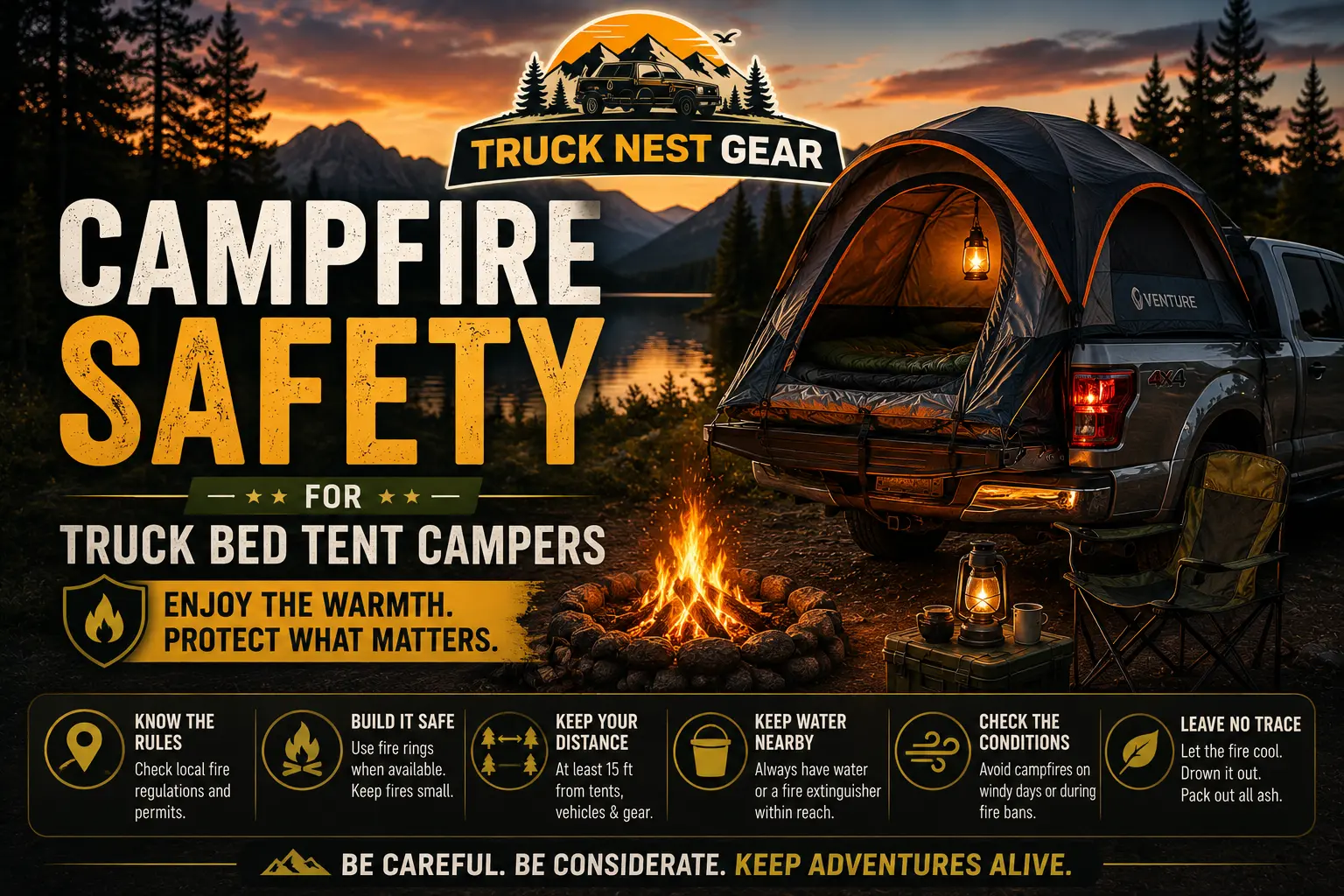
The campfire safety habits that matter most for truck bed tent camping are: check fire restrictions before you go and every day of a multi-night trip; build the fire at least 15 feet from the truck and to the side rather than directly behind the tailgate; never leave the fire unattended while it burns; extinguish completely with water until the ash is cold to the touch; and never bury hot coals.
Nine out of ten wildfires are caused by humans. The campfire that ends a perfect truck camping trip is the one that was out before you went to sleep.