
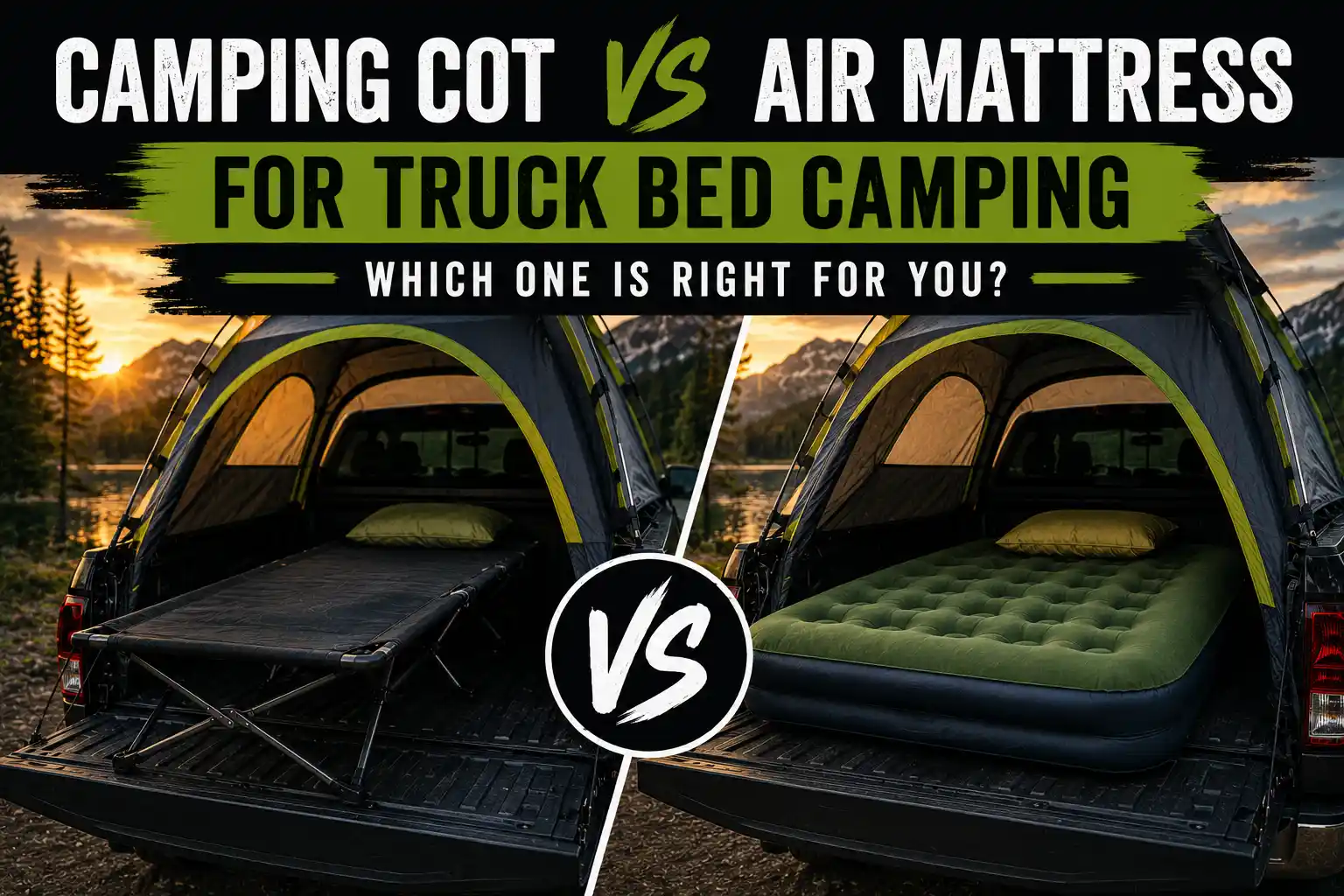
Camping Cot vs Air Mattress for Truck Bed Camping: Which One Is Right for You?
TruckNestGear is reader-supported. When you buy through links on our site, we may earn an affiliate commission at no extra cost to you. As an Amazon Associate we earn from qualifying purchases. Learn more
Every truck bed camper faces this decision eventually. You have the tent sorted, the sleeping bag rated for your expected temperatures, and the truck bed cleared and ready. The question is what goes between you and the metal bed surface for the night.
Two options dominate: a camping cot or an air mattress. Both solve the same core problem: the metal truck bed is hard, cold, and uneven at the wheel wells, but they solve it differently, and the right choice depends on how you actually camp rather than which one looks better in a product photo.
This guide breaks down the honest comparison across every factor that matters for the truck bed tent context specifically, not camping in general.
The Core Difference
A camping cot is a rigid elevated platform, a fabric sleeping surface stretched across a frame that holds you above the truck bed floor at a fixed height regardless of temperature, time of night, or how much you move during sleep.
An air mattress is an inflatable surface that sits on the truck bed floor and provides cushioning through pressurized air. Its firmness is determined at inflation and degrades gradually throughout the night as micro-leaks, temperature drops, and body weight compress the air volume.
Both are legitimate truck bed sleeping solutions. Neither is universally better. The difference is in the specific trade-offs each makes.
Factor 1: Consistency Through the Night
This is where cots win clearly, and the margin matters in real camping conditions.
A cot provides the same support at 2 AM that it provided at 10 PM. The frame holds your weight, the fabric maintains its tension, and the sleeping surface does not change regardless of temperature fluctuations or how many times you move during the night.
An air mattress starts the night firm and gradually loses firmness through a combination of three mechanisms. Micro-leaks, present in virtually every air mattress to some degree, release small amounts of air continuously. Temperature drops overnight cause the air inside the mattress to contract, reducing pressure and firmness. And body weight applied consistently to one area of the mattress compresses the air in that zone over several hours.
By 3 or 4 AM on a fall night, an air mattress that was adequately firm at bedtime may have softened enough to place you noticeably closer to the cold metal truck bed than you were when you fell asleep. For a summer weekend trip, this is a minor inconvenience. For a November hunting trip where floor insulation is a safety consideration, it matters more.
Factor 2: Cold Weather Performance
In cold-weather truck bed tent camping, the metal bed surface is the primary enemy of a warm night’s sleep. Conductive heat loss through metal is significantly faster than heat loss through the air or through tent fabric, which is why cold weather sleeping guides emphasize floor insulation as the highest-priority thermal management step.
A cot addresses this by creating an air gap between you and the metal surface. Even a cot at 6 inches of elevation creates a thermal buffer that dramatically slows conductive heat transfer. The insulating air column under the cot acts as an additional layer of protection beyond the cot’s own surface material.
An air mattress sits directly on the metal truck bed floor. The air inside the mattress is insulating, but as the mattress loses firmness overnight in cold temperatures, the insulating air column compresses, and your effective distance from the cold metal decreases. A properly insulated air mattress with a high R-value performs well early in the night. A mattress that has softened 30 percent by morning performs significantly worse.
The two-layer floor insulation approach, a closed-cell foam pad placed directly on the metal bed beneath the air mattress, addresses some of this, but adds gear complexity and cost that a cot handles structurally.
Factor 3: Setup and Reliability
An air mattress requires a pump, a power source, and inflation time. The pump can fail. The power source can drain your portable battery at an inopportune time. Inflation takes 3 to 10 minutes depending on the pump. And the risk of arriving at a remote dispersed site after dark and discovering the air mattress has a slow leak is a genuine scenario that ends with sleeping on a deflated mattress on a metal bed.
A cot unfolds and is ready in 10 seconds to 5 minutes depending on the design. No power required. No pump required. No leak risk. The only failure mode is a broken frame joint, which is both rare and visible before deployment.
For reliability-focused campers, hunters camping in remote locations, and anyone who has experienced a midnight air mattress deflation, the cot’s mechanical simplicity is a genuine argument in its favor.
Factor 4: Comfort and Sleeping Position
Here the comparison is less one-sided.
An air mattress contours slightly to your body. It provides cushioning across your entire contact surface, shoulders, hips, ankles, without the pressure points that a taut cot surface can create at contact areas with the cot frame or fabric crossbars.
A standard cot surface is taut fabric stretched across a frame. It provides excellent support for back sleepers but can feel hard at pressure points for side sleepers. Adding a 2-inch memory foam pad on top of the cot surface resolves this almost completely, but adds cost and pack size.
An air mattress: particularly a truck-specific model contoured around the wheel wells, provides a more immediately comfortable sleeping surface for side sleepers without additional accessories. The trade-off is the consistency problem described above.
Factor 5: Truck Bed Tent Headroom
This factor is exclusive to the truck bed tent context and rarely mentioned in general cot vs mattress comparisons.
A cot adds height to your sleeping position inside the tent. A cot at 18 inches elevation reduces your available sitting headroom inside a 52-inch truck bed tent from 52 inches to 34 inches, not enough for most adults to sit upright. A cot at 6 inches reduces headroom to 46 inches, which allows comfortable sitting for most campers.
An air mattress at 4 to 6 inches of inflation height reduces headroom by 4 to 6 inches, a negligible difference that allows full use of the tent’s interior space.
If you sleep in a deployed truck bed tent rather than an open truck bed, this factor favors the air mattress or a low-profile cot specifically. The decision matrix for tent users is: low-profile cot (6 to 8 inches) if you want cot benefits with acceptable headroom, or air mattress if you want maximum headroom and are not camping in conditions where cold-weather reliability matters.
Factor 6: Pack Size and Weight
An air mattress deflated and folded is compact, typically the size of a large sleeping bag stuff sack. Most weigh 3 to 8 pounds depending on size and construction. It stores easily alongside other gear in the truck bed and adds minimal bulk to the overall load.
A cot folded into its carry bag is larger, typically the size of a rolled sleeping pad, roughly 4 to 5 inches in diameter and 24 to 30 inches long. Lightweight cots weigh as little as 4.8 pounds. Heavy-duty steel-frame XXL models weigh 16 to 26 pounds. In a truck-camping context, where weight is carried in the truck bed rather than on your back, the weight difference matters less than the physical pack size.
The Decision Framework
Choose a cot if: You camp in variable or cold temperatures where floor insulation consistency through the night is important. You camp frequently enough that setup reliability and zero pump dependency matter. You are a back sleeper who does not need body contouring. You camp in an open truck bed or a high-headroom tent configuration. You value a sleeping system that requires zero maintenance and has no failure modes related to air retention.
Choose an air mattress if: You camp primarily in warm weather where cold-floor performance is not a concern. You are a side sleeper who needs body contouring to sleep comfortably. You camp inside a truck bed tent where headroom is at a premium and a low-profile inflated mattress preserves more sitting space. You are taking occasional one-night trips where setup convenience and pack size take priority. Budget is the primary consideration; a quality air mattress costs less than most quality cots.
Choose both if: You want the structural support and cold-air separation of a cot with the surface comfort of an inflated mattress, use a truck-specific cot at low profile with a 2-inch memory foam pad on top. This combination addresses every limitation of each solution and is what many experienced truck bed tent campers eventually settle on after trying each separately.
The full range of cot options for the truck bed tent context, from ultralight aluminum designs at 4.8 pounds through heavy-duty XXL options at 900-pound capacity, along with the specific truck bed compatibility factors that most cot guides overlook, are covered in the complete guide to the best cots for truck bed camping.