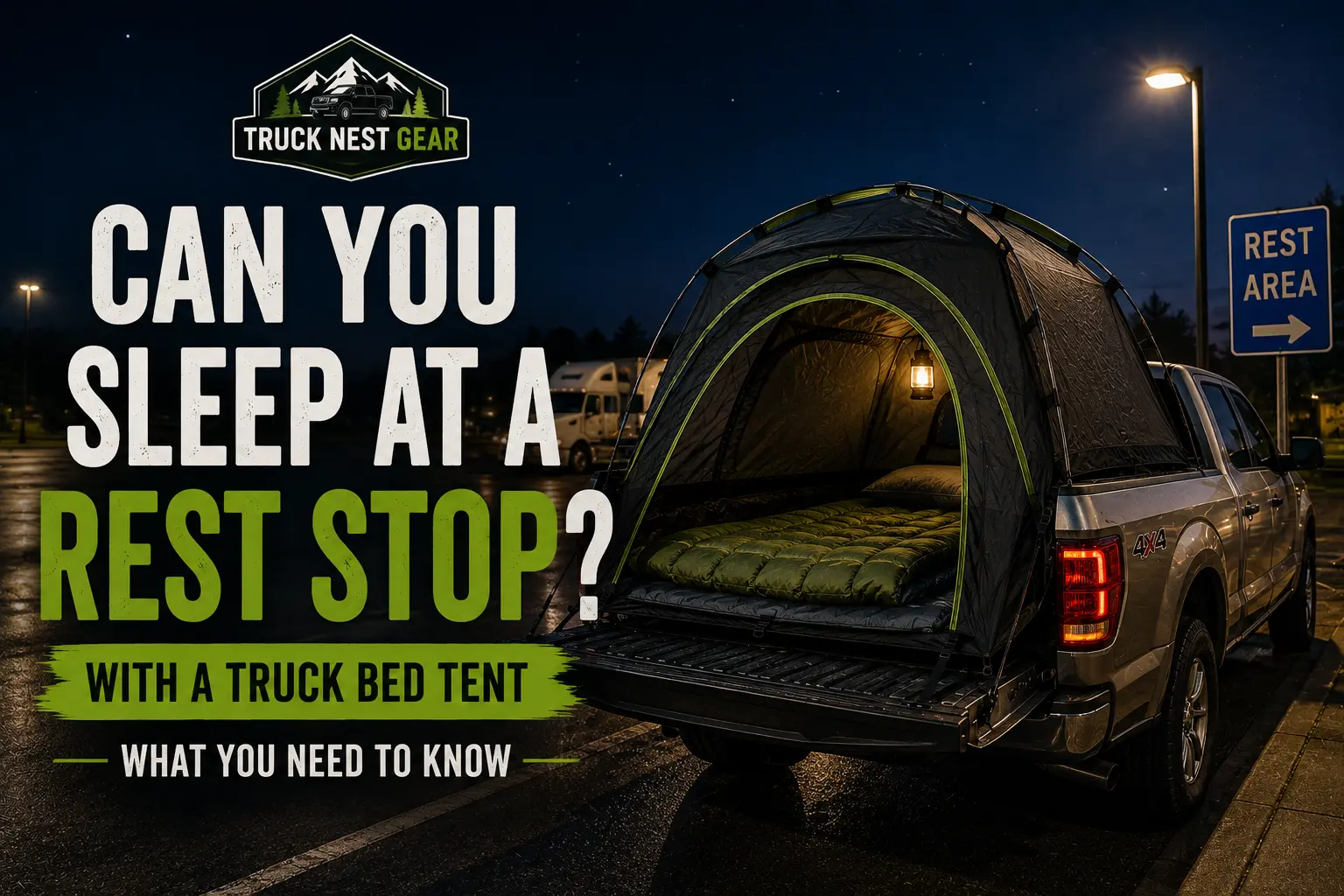
Can You Sleep at a Rest Stop With a Truck Bed Tent? What You Need to Know
It is 11 PM on a long road trip. You are two hours from your destination, tired enough that continuing feels like a bad idea, and there is a rest stop a quarter mile ahead. You have a truck bed tent in the back. The question that forms is reasonable and specific: can you pull in, set up the tent, and sleep until morning?
The answer is not simple, and it is different from the question of whether you can sleep in your truck at a rest stop, which has its own complicated answer across 50 different state rule sets. A truck bed tent introduces a specific additional variable that changes the calculus in almost every state: the tent itself is a structure deployed outside the vehicle, and that distinction is what most rest area rules address directly when they prohibit camping.
This guide covers what rest stop rules actually say about sleeping, what they specifically say about tents and external structures, which states allow overnight stays and which prohibit them entirely, and what the practical alternatives are for a truck bed tent camper who needs to sleep on the road.
The Core Distinction: Sleeping in a Vehicle vs Camping
Every state that has formalized rest stop overnight rules draws the same fundamental distinction: sleeping inside your vehicle is treated differently from camping, and camping is almost universally prohibited regardless of whether overnight vehicle parking is allowed.
Overnight parking means staying in the vehicle to rest, while camping means setting up gear and relaxing outside. Many states allow overnight parking with time limits, like California at eight hours, Texas at twenty-four, and Washington at eight hours.
Camping is not permitted in any rest area. Camping is generally defined as setting up a tent or sleeping outside of your vehicle. Sleeping in your RV is not considered camping.
A truck bed tent deployed over a truck bed is, under virtually every state’s definition, a tent, an external structure set up outside the enclosed vehicle cabin. Even though you are elevated in the truck bed rather than sleeping on the ground, the tent structure itself is outside the vehicle, which places it squarely in the camping category that rest area rules prohibit.
This distinction is not a technicality or a gray area. It is the explicit line that state transportation departments have drawn to differentiate a resting traveler from a camper using a rest stop as a free campground.
What This Means for a Truck Bed Tent Specifically
The truck bed tent situation is unique because it occupies genuine ambiguity in how rest stop rules are written.
The tent is attached to your vehicle. You are sleeping in the vehicle’s cargo bed, not on the ground. You are elevated above the pavement. You have not set up chairs, a camp stove, a fire, or any of the other visible markers of conventional camping.
But the tent structure is external to the enclosed cab. It is visible from a distance as a shelter structure. And in any state where a rest stop attendant or highway patrol officer applies the standard definition, camping means setting up a tent or sleeping outside of your vehicle; a deployed truck bed tent qualifies.
The practical reality is that enforcement varies significantly. In many states, the rule is on the books but lightly enforced for a parked vehicle with no visible campfire, no chairs, no cooking, and no extended stay. In others, particularly states that prohibit overnight stays entirely, like Virginia, Connecticut, and Illinois, enforcement is more consistent and citations are issued.
The safe and honest position is: do not deploy a truck bed tent at a rest stop in any state, regardless of whether overnight parking is technically permitted. The tent structure triggers the camping prohibition that exists independently of the overnight parking rule.
State-by-State Overnight Parking Rules
These rules cover vehicle sleeping, not tent deployment. All states below prohibit tent setup regardless of vehicle parking status.
- States where overnight vehicle parking is permitted:
California: You are permitted to stay overnight for a maximum of 8 hours at California rest stops that are open 24 hours daily. There is no camping, and you must be inside your vehicle during your stay.
Arizona: Arizona rest stops allow travelers to park overnight. They do not, however, allow camping or campfires. Keep all gear inside.
Arkansas: You must sleep within the confines of your vehicle, and no camping is allowed.
Texas: Texas allows overnight parking at many interstate rest stops. Most stops permit vehicles to stay 8 to 12 hours.
Kansas: You may park overnight in a Kansas rest area for one night. No camping allowed.
Colorado: Colorado permits overnight stays at select interstate rest stops, mainly along I-70 and I-25. Time limits typically hover around 8 hours.
New Mexico: Rest stops on interstate highways in New Mexico have signage indicating you cannot exceed a 24-hour stay.
Florida: Certain rest areas in Florida allow travelers to sleep in vehicles overnight for limited periods, usually around 8 hours.
Idaho: Rest stops in Idaho, particularly along I-84 and I-90, allow overnight parking for limited periods, typically 8 hours.
Delaware: Delaware allows overnight parking at its two rest areas. Generally, camping is not allowed, and there are posted time limits.
- States where overnight vehicle parking is NOT permitted (no exceptions for any vehicle type):
Connecticut: No overnight parking or camping. There is a 3-hour stay limit.
Virginia: Virginia rest areas do not allow sleeping.
Illinois: No overnight parking or camping.
New Jersey: No overnight parking or camping.
Important caveat: Rules vary by state and by facility. Most states fall into one of three categories: overnight stays allowed, short rest breaks only, or limited to specific locations. Check posted signs. Parking regulations are subject to change by state DOTs, local agencies, and individual facility management.
Always check the posted signs at the specific rest area you plan to use, not just the general state rule. Individual rest areas within the same state can have different postings.
Why You Should Not Deploy a Truck Bed Tent at a Rest Stop
Even in states where overnight vehicle parking is permitted, deploying a truck bed tent at a rest stop creates specific problems that go beyond the legal question.
- The practical enforcement risk.
A truck with a deployed tent is immediately visible as a camping setup. Highway patrol officers and rest area attendants who might otherwise allow a parked vehicle with a reclining driver will almost certainly address a deployed truck tent as a camping violation. The tent structure is a visual flag that invites enforcement attention that sleeping reclined in the cab does not.
- Rest area design conflicts with tent deployment.
Rest area parking spaces are sized for vehicle parking, not for a truck with an open tailgate and a tent extending behind it. The standard parking space provides roughly 20 feet of length; a truck with a deployed truck bed tent and an open tailgate may extend 26 to 30 feet. This creates conflict with adjacent parked vehicles, particularly at busy rest areas where spaces fill overnight.
- Safety considerations are real.
Rest areas are public parking facilities with significant overnight foot traffic from long-haul truckers, other travelers, and in some locations, transient populations. Sleeping inside a locked vehicle cab provides meaningful security that sleeping in a truck bed tent at a public rest area parking lot does not. The elevated position of a truck bed tent does not compensate for the proximity to foot traffic and other vehicles that a rest area environment involves.
- The time limit undermines the camping benefit.
Even where overnight parking is permitted, the 8-hour limit in most permitting states means that arriving at midnight requires departure by 8 AM. For the effort of deploying and packing a truck bed tent, 15 to 30 minutes each way, the net sleeping window is shorter than simply reclining in the cab would provide.
What to Do Instead: Better Alternatives for Truck Bed Tent Campers on Long Drives
The truck bed tent is not the right tool for a rest stop overnight. These alternatives are.
- Sleep in the cab without the tent.
The most practical rest stop option for a truck bed tent camper is the same as any other vehicle traveler: recline the seat, use a travel pillow, and sleep in the enclosed cab. In states where overnight parking is permitted, this is fully legal and involves no tent deployment. In states with shorter time limits, it provides a rest break within the allowed window.
- Find a Walmart, Cracker Barrel, or truck stop instead.
These are the standard free overnight parking solutions for road trippers. Walmart stores allow overnight parking in most locations by general policy, though individual stores can opt out. Cracker Barrel actively welcomes overnight RV and truck camper parking in their lots.
Truck stop chains, Flying J, Pilot, Love’s, provide dedicated overnight truck parking with bathroom access, fuel, and 24-hour food service. None of these have the camping prohibition that rest areas enforce, and none require the truck bed tent to be deployed for a comfortable overnight stay in the cab.
- Use iOverlander or Freecampsites.net to find overnight parking near the route.
Both platforms aggregate user-reported free overnight parking locations, including industrial areas, fairgrounds, and other spots that legally allow overnight vehicle parking without camping restrictions. A 15-minute route search before departure identifies these options in advance rather than relying on rest area availability after dark.
- Plan for a campsite if truck tent camping is the goal.
If the specific experience of sleeping in a truck bed tent is the point, which is a legitimate preference, plan the overnight stop to be at an actual campsite. BLM dispersed sites, national forest land, and many state parks accommodate truck bed tent camping legally and with far better sleeping conditions than a rest stop parking lot.
The drive time from a highway to a suitable dispersed site in the western United States is often 15 to 30 minutes, a marginal addition to a long drive for a significantly better sleeping environment.
The Cab Sleep Setup: How to Rest Comfortably Without the Tent
For the truck bed tent camper who needs to stop at a rest area or an overnight parking lot without deploying the tent, the truck cab sleeping setup is worth optimizing rather than treating as a compromise.
A reclining front seat in most modern trucks, particularly the RAM 1500 with its multi-contour seat and the F-150 with the available Max Recline seats, provides a reasonable sleeping position for a full-size adult. The seat reclines to near-flat in some configurations. A travel pillow and a compact packable blanket stored in the cab, separate from the sleeping bag in the truck bed, make the cab sleep setup usable without accessing the truck bed gear.
Cracking a window prevents the carbon dioxide buildup that makes sleeping in a sealed vehicle uncomfortable. Parking with the cab facing away from direct light sources, other vehicles’ headlights, and overhead parking lot lighting reduces sleep disruption. A sun shade placed in the windshield from inside provides both light blocking and temperature moderation in warm weather.
The cab is not as comfortable as a truck bed tent on a proper campsite. But for a 6- to 8-hour rest stop midway through a long drive, it is the legally appropriate tool for the situation.