Snake Safety for Truck Bed Tent Campers: Why Elevation Changes Everything
Most campers who think about snake safety think about it in terms of where they walk and what they reach into. That is the right instinct, but it tells only part of the story for truck bed tent campers, because the sleeping situation is fundamentally different from a ground tent, and that difference matters more than most guides acknowledge.
The honest starting point: each year, 7,000 to 8,000 people are bitten by venomous snakes in the United States, and about five of those people die. That low fatality rate reflects the availability of antivenom and emergency medical care, not a low level of actual encounters. For campers in snake-active regions of the South, Southwest, and West, snakes are a realistic consideration, not an exotic worst-case scenario.
What truck bed tent camping changes, and what it does not change, is the subject of this guide.
The Elevation Advantage: What a Truck Bed Tent Actually Does for You
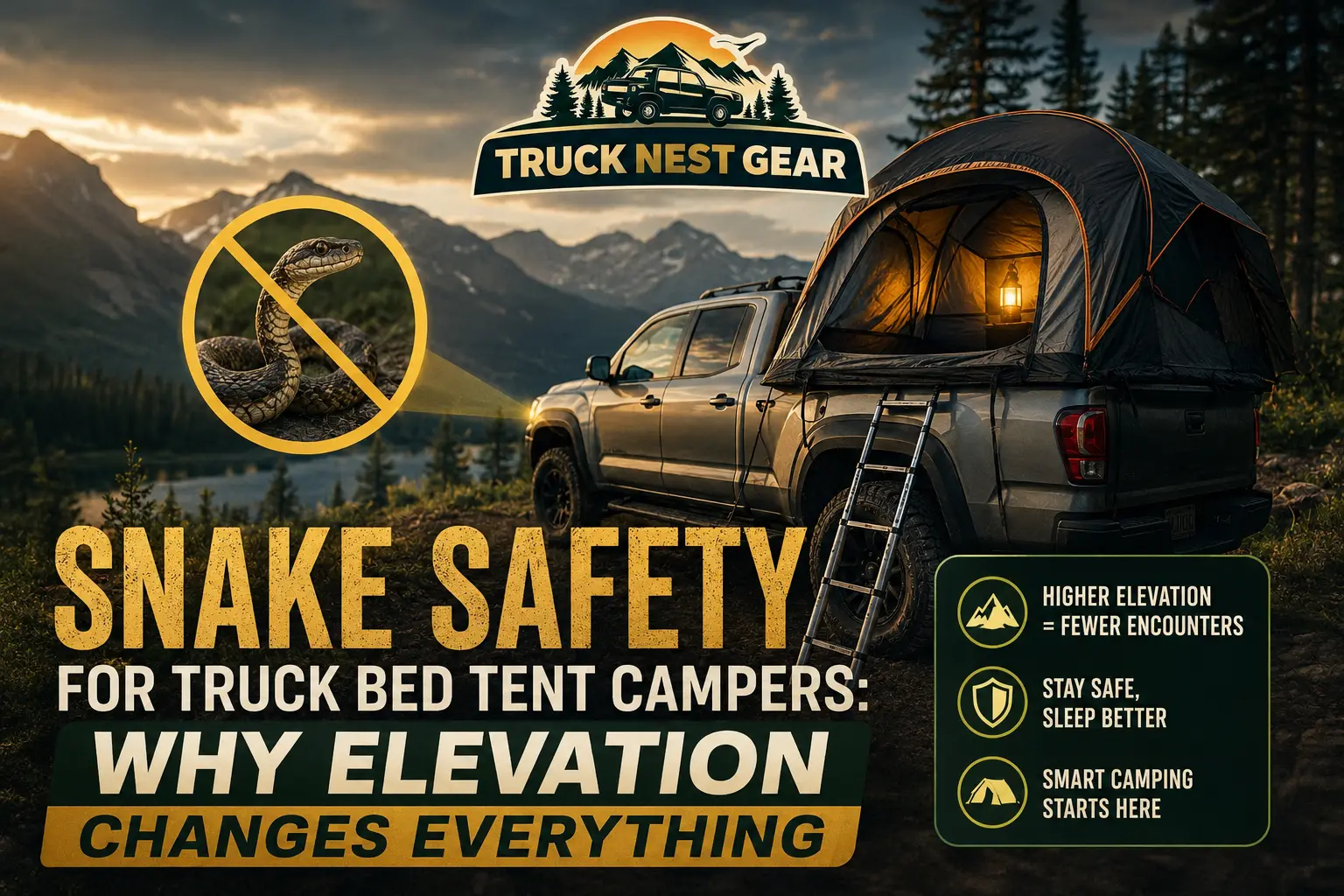
A truck bed tent positions your sleeping surface 24 to 36 inches off the ground. That single fact is the most significant snake safety distinction between truck bed tent camping and ground tent camping, and it deserves an honest explanation rather than either dismissal or exaggeration.
Snakes are ground-dwelling animals. They hunt, rest, thermoregulate, and move at ground level. The warm, dark environment beneath a ground tent, where the tent floor meets soil, leaves, or grass, is exactly the kind of microenvironment that snakes are attracted to during the night. A ground tent camper sleeps directly above this environment, separated from it by a few millimeters of tent floor fabric.
A truck bed tent removes you from that environment entirely. Your sleeping surface is a metal truck bed, elevated above the ground, enclosed on all sides, with no direct contact with the soil, leaf litter, or vegetation where snakes hunt and rest. There is no warm, dark gap between your floor and the earth for a snake to investigate.
This does not make a truck bed tent snake-proof. Snakes can climb, and determined individuals can access a truck bed via the tires, wheel wells, and any object touching the truck. But it meaningfully reduces the passive overnight encounter risk that ground tent campers face, the scenario where a snake finds warmth near a sleeping camper without anyone deliberately attracting it.
Where the Risk Remains: The Moments That Matter
Elevation protects you while you sleep. It does not protect you during the parts of camping where you are actively interacting with the environment, and those are the moments that account for the majority of campsite snake encounters.
Setup and Breakdown
The highest-risk periods for truck tent campers are setup and breakdown, when you are moving through the campsite, handling gear, and spending time close to the ground. Reaching under the truck to access gear, picking up the carry bag from the ground, pulling stakes, and moving around the site in fading light all involve the kind of ground-level interaction that creates snake encounter opportunities.
The practical response is to bring a headlamp, not a phone flashlight held in one hand, to every twilight or after-dark task around the campsite. Snakes are most active at dawn and dusk, and these are the periods when encounter risk is highest. A headlamp keeps both hands free and illuminates the ground in front of every step.
Gear Left on the Ground
Anything left on the ground overnight is a potential snake shelter by morning. Gear bags, boots, tarps, folded chairs, and any item that creates a dark, covered space at ground level can attract a snake seeking warmth or shelter. This is not a theoretical concern, boot and gear checks are standard safety practice in snake-active regions for exactly this reason.
The habit to develop: anything that will be retrieved or worn after being left on the ground should be checked before use. Shake boots upside down before putting them on. Check the opening of any gear bag left on the ground. Lift tarps and ground cloths from the far side, away from your body, so that anything underneath moves away from you rather than toward you.
The Area Around the Tailgate
The tailgate zone, the ground directly behind the open tailgate where you enter and exit the tent, receives the most foot traffic of any part of your campsite. It is also where gear bags, coolers, and equipment tend to accumulate during setup and at the end of a trip. Illuminating this area before stepping into it at night is a habit that costs nothing and matters in snake country.
Vegetation and Natural Features Near the Campsite
Snakes use specific types of cover: rock piles, fallen logs, tall grass, brush piles, and the edges where open ground meets dense vegetation. Parking close to any of these features increases the likelihood of a nearby snake simply because those features are part of active snake habitat.
Choosing a campsite that keeps the truck and the tailgate entry zone away from these features is a practical risk reduction, not always possible, but worth factoring into campsite selection when options exist.
North American Venomous Snakes: The Geographic Reality
Not all camping environments carry the same snake risk. Understanding which snakes are present in the regions where truck tent campers are most active helps calibrate the level of precaution that is genuinely warranted.
The United States has approximately 30 species of venomous snakes, including 23 species of rattlesnakes, three species of coral snakes, and four species of American moccasins. At least one species of venomous snake is found in every state except Hawaii, Maine, and Alaska.
Snakebites in the US are highly regional. An analysis of 2016 data found that 82 percent of snakebites occurred in the South, 11 percent in the West, 7 percent in the Midwest, and 1 percent in the Northeast. For truck tent campers, the highest-risk regions map directly onto the most popular dispersed camping destinations:
The Southwest (Arizona, New Mexico, Nevada, Utah, California), home to multiple rattlesnake species including the western diamondback, Mojave rattlesnake, and sidewinder. Desert and scrubland camping terrain is prime rattlesnake habitat. Rock features, desert washes, and brush are all active snake zones.
The Southeast (Texas, Florida, Georgia, Louisiana, Mississippi), highest overall snakebite rates in the country. Home to copperheads, cottonmouths, eastern diamondback rattlesnakes, and coral snakes. Cottonmouths are water-associated and particularly relevant for campers near rivers, lakes, and marshes.
The Pacific Northwest and Rocky Mountain region, western rattlesnakes are present throughout, though at lower density than the Southwest. Encounter risk increases in rocky terrain and at lower elevations.
The Midwest and Great Plains, prairie rattlesnakes and timber rattlesnakes are present in specific habitat types, including rocky hillsides and wooded river corridors.
Practical Habits for Snake Country Camping
These are not rules that require memorization, they are habits that become automatic after one or two trips in snake-active terrain.
Walk with a headlamp after dark, always. Snakes on a warm dirt road or campsite path are genuinely difficult to see without direct illumination. This is the single habit with the highest return on snake encounter prevention in camp.
Never reach into a space you cannot see. Under the truck, into a bag that has been sitting on the ground, behind a rock, under a log, any enclosed space at ground level is a potential snake shelter. Look before reaching. In the Southwest specifically, check under and around the truck itself before crouching to access the tire, frame, or undercarriage area.
Keep the campsite clear of food and rodent attractants. Snakes follow prey. A campsite that attracts rodents, through improperly stored food, open trash, or spilled food, attracts the snakes that hunt them. Sealed coolers, hard-sided food containers, and clean campsites reduce rodent activity and, in turn, reduce the snakes that follow.
Store gear off the ground when possible. The truck bed is your best ally here, gear stored in the locked truck bed or cab overnight is gear that does not become snake habitat by morning. This is one of the specific advantages of truck bed tent camping that the comparison between truck tents and ground tents rarely mentions directly.
Check everything before putting it on or picking it up. Boots, gloves, hats, and any clothing or gear left on the ground. Shake, check visually, and then use. This one habit eliminates the most common type of campsite snakebite encounter, reaching into or stepping into something without looking.
Snake Gaiters: When They Are Worth It
For campers doing significant ground-level activity in high-density rattlesnake terrain, the Sonoran Desert, the Texas Hill Country, the Great Basin, snake gaiters are a legitimate addition to the camping kit. They are protective wrappings for the lower leg that resist the penetration of most snake fangs.
They are not necessary for the majority of truck tent camping, where most time is spent in or near the vehicle rather than moving through dense brush. But for campers who plan to do significant hiking through rocky scrubland from a truck tent base camp, particularly in Arizona, New Mexico, and Nevada, gaiters are worth considering alongside quality high-top leather boots.
If a Bite Occurs: The Evidence-Based Response
The correct first aid steps, aligned with current CDC guidance, are straightforward: move at least 20 feet away from the snake, call 911 or activate your emergency communication device, keep the victim calm and still, remove jewelry and constrictive clothing before swelling begins, wash the bite with soap and water, cover with a clean dry dressing, immobilize the affected limb, and arrange the fastest possible transport to a hospital with antivenom.
What not to do is equally important and often more consequential than what to do. Do not apply a tourniquet, do not cut the wound, do not attempt to suck out the venom, and do not apply ice. These interventions are all based on outdated advice that has been definitively shown to cause additional harm without reducing venom absorption. According to the CDC, a significant percentage of snakebites occur when people deliberately interact with snakes, do not attempt to capture or handle the snake, and be aware that even a recently decapitated snake can deliver an envenomating bite through residual reflexes.
Take a photograph from a safe distance to identify the snake if possible, this aids in faster treatment at the hospital.
The most important action in a wilderness or dispersed camping setting is speed of evacuation. Antivenom is the definitive treatment, and it is only available at a hospital. In areas without cell service, designate a runner to reach help while the victim is kept calm and still. A satellite communicator, a PLB or a device like a Garmin inReach, is the most reliable emergency communication tool for dispersed camping in areas without cell coverage, and snakebite is exactly the scenario where having one matters.
Keeping Perspective on the Risk
Snake encounters in a campsite are genuinely uncommon, even in high-density regions. People in the United States are nine times more likely to die from a lightning strike than from a venomous snakebite, and the availability of antivenom means that the vast majority of bites that do occur are treated successfully without permanent injury.
The goal of snake safety awareness is not to make camping in snake country feel dangerous, it is to remove the specific behaviors and situations that turn a low-probability encounter into a preventable one. Sleeping elevated in a truck bed tent rather than on the ground, keeping gear off the ground overnight, using a headlamp after dark, and checking boots and bags before use are habits that reduce encounter risk without requiring any significant change to how you camp.
The elevation advantage of a truck bed tent is real. The residual risks during setup, breakdown, and ground-level activity are manageable with basic awareness. Together, they make a truck tent camper meaningfully better prepared for snake country than a ground tent camper operating on the assumption that snakes are someone else’s problem.