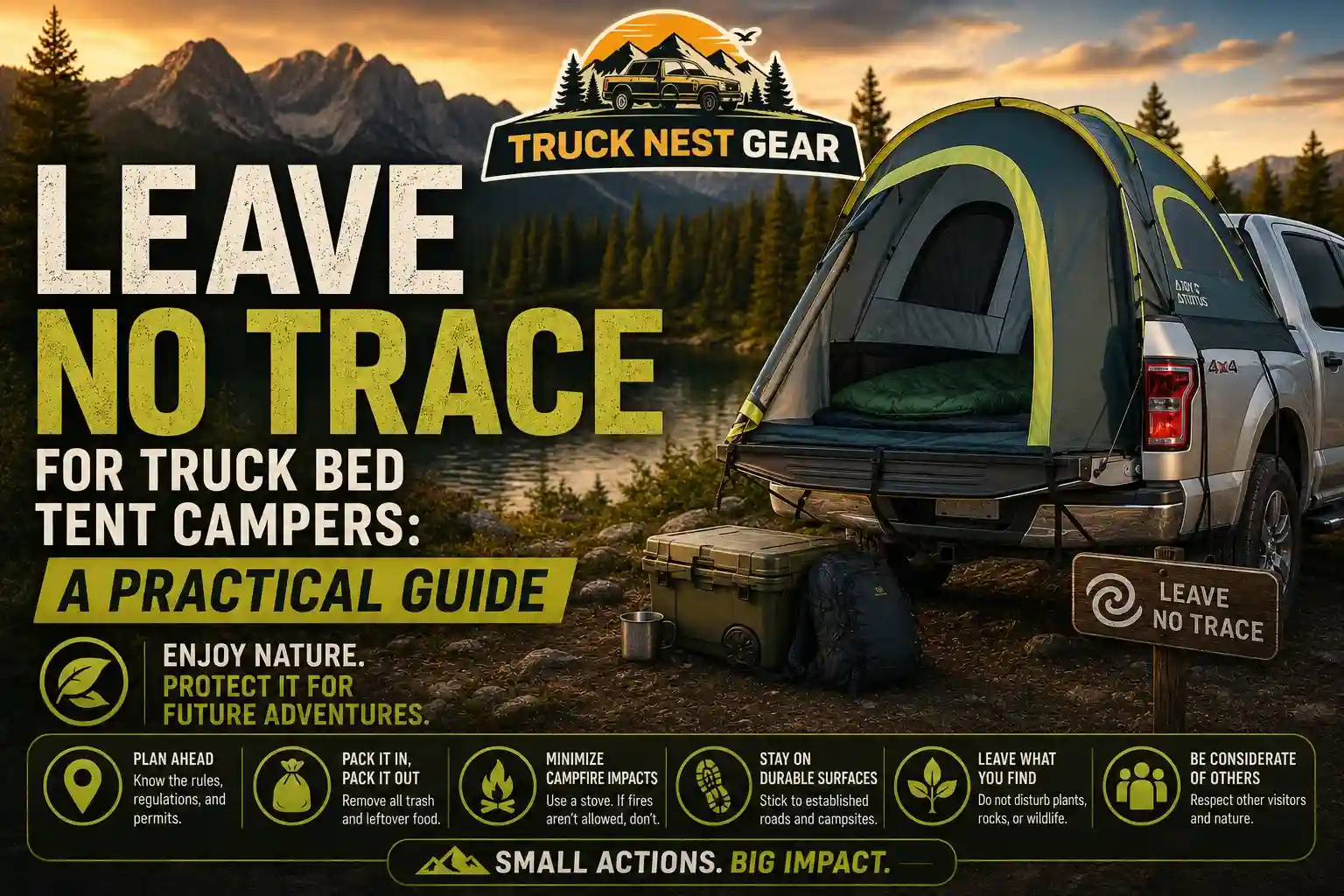
Leave No Trace for Truck Bed Tent Campers: A Practical Guide
Truck bed tent camping and Leave No Trace principles are more naturally aligned than most people realize, and in some specific ways, truck tent camping is genuinely lower impact than the ground tent alternative it often replaces.
But that alignment is not automatic. A pickup truck on public land carries its own set of impact vectors that backpackers and ground tent campers do not deal with: vehicle weight on soil, tire tracks on fragile surfaces, gray water from a larger cooking operation, and the assumption by some truck campers that vehicle access makes the land more forgiving of casual impact.
That assumption is wrong, and it is increasingly being corrected by land managers who see more vehicle-based camping on BLM and Forest Service land every year.
The seven principles of Leave No Trace, developed by the Leave No Trace Center for Outdoor Ethics and built on work by the US Forest Service, National Park Service, and Bureau of Land Management, are the framework that guides responsible outdoor recreation for everyone in the field.
This guide applies each one specifically to the truck bed tent camping context, with the practical details that generic LNT guides skip over.
Principle 1: Plan and Prepare
For truck bed tent campers on dispersed public land, planning has a specific meaning beyond checking the weather forecast.
Know the regulations for the specific land unit you are camping on. BLM and National Forest regulations vary significantly by field office and ranger district. Stay limits on dispersed sites are typically 14 days within 28 days, but some areas have shorter limits or designated camping zones.
Fire restrictions change seasonally and are often implemented with little advance notice. Checking the specific land management unit’s website, not just a general camping app, before departure is the preparation step that prevents unintentional violations.
Know your truck’s clearance and turning radius before committing to a road. Getting a full-size truck stuck on a narrow forest road or high-centered on a washed-out two-track is an impact event. Recovery involves tire spinning, vegetation damage, and sometimes the involvement of other vehicles that compound the damage.
Satellite imagery and user-submitted road condition reports on platforms like iOverlander give a reasonably accurate picture of access routes before you drive them. Walking an unfamiliar access road for the last quarter mile before driving on it is the most effective way to avoid a recovery situation.
Repackage food to minimize waste. The larger cooking operation that a truck camp typically supports, coolers, stoves, and full meal preparation, generates more packaging than a backpacking trip. Removing excess packaging before departure reduces what needs to be managed and packed out.
Principle 2: Travel and Camp on Durable Surfaces
This is the principle where truck bed tent camping has both a genuine advantage and a genuine responsibility.
The truck bed tent advantage. Durable surfaces include maintained trails and designated campsites, rock, gravel, sand, dry grasses, or snow. A truck bed tent occupies a single parking-sized footprint on these durable surfaces. Unlike a ground tent that requires a cleared sleeping area plus a kitchen area plus a path between them, a truck tent consolidates the sleeping footprint to the vehicle. You sleep in the truck bed, you cook near the truck, and the total disturbed area is the vehicle’s parking footprint plus a small perimeter.
The responsibility that comes with vehicle access. That parking footprint is significantly heavier than a backpacker’s footprint. A loaded pickup truck weighs 4,000 to 7,000 pounds, concentrated on four tire contact patches. Driving or parking on vegetated, wet, or loose soil causes compaction and surface damage that a hiker’s boot never does. The LNT standard is to park on existing disturbed surfaces, existing two-tracks, gravel pullouts, rock, hardpan, and not to create new parking areas on vegetated or fragile soil.
Never drive off existing tracks to reach a campsite. This is the truck camping behavior that land managers point to most consistently as a source of damage on dispersed land. A tire track through desert cryptobiotic soil crust- the living biological layer of the desert surface, takes decades to recover. A tire track through alpine meadow grass is visible for years. The campsite that requires driving off an existing track to reach is a campsite that should not be used.
Camp at least 200 feet from water. This applies as completely to a truck campsite as to a backpacker’s tent. The riparian zone within 200 feet of water is the most ecologically sensitive corridor in any natural area. A truck parked at the edge of a creek or lake shore concentrates vehicle weight, fuel drips, cooking waste, and human activity in exactly the area most vulnerable to it.
Principle 3: Dispose of Waste Properly
This principle generates the most truck-camping-specific considerations of any of the seven.
Pack it in, pack it out — completely. Inspect your campsite, food preparation areas, and rest areas for trash or spilled food. Pack out all trash, leftover food, and litter. For truck campers, this includes the full volume of packaging, food waste, gray water from cooking and cleaning, and any consumable materials used at the site. The truck is the pack-out vehicle; use it fully. A dedicated trash bag in the truck cab from day one of the trip makes this habit automatic.
Gray water management. To wash yourself or your dishes, carry water 200 feet away from streams or lakes and use small amounts of biodegradable soap. Scatter strained dishwater. Straining food particles from dishwater before scattering it, keeping the solids for the trash bag, prevents food odor from attracting wildlife and avoids concentrating soap residue in a single location.
Human waste at dispersed sites. Most dispersed camping sites have no toilet facilities. Deposit solid human waste in catholes dug 6 to 8 inches deep, at least 200 feet from water, camp, and trails. Cover and disguise the cathole when finished. Pack out toilet paper and hygiene products. The 200-foot distance from water, camp, and trails applies as strictly to a truck campsite as to a backpacker’s site; the vehicle does not change the biology of how waste breaks down or contaminates water sources.
Do not dump gray water at the campsite or on the ground near the truck. This is the most common LNT violation specific to vehicle-based camping. Dumping cooking water, dish rinse water, or cooler melt water on the ground near the vehicle concentrates food odor, attracts wildlife, and degrades soil and vegetation. Pack it out in a sealed container or scatter it widely, strained, at least 200 feet from water.
Principle 4: Leave What You Find
Leave rocks, plants, and other natural objects as you find them. Do not build structures, furniture, or dig trenches.
For truck bed tent campers, this principle has one specific application that ground tent campers rarely face: the temptation to modify a campsite to improve vehicle access or campsite functionality. Clearing brush to widen a pullout, stacking rocks to level a parking area, or cutting branches to improve overhead clearance all fall under this principle. The site should be left looking as if it were never used.
The truck bed tent is relevant here in a positive way: because it elevates your sleeping surface above the ground, you do not need to clear, rake, or modify the ground surface to create a comfortable sleeping area. The tent goes on the truck, and the truck goes on whatever durable surface is available. No site preparation is required for the sleeping area itself; this is a genuine LNT advantage of the format.
Principle 5: Minimize Campfire Impacts
Use a lightweight stove for cooking where possible. Where fires are permitted, use established fire rings, fire pans, or mound fires. Keep fires small. Only use down and dead wood from the ground that can be broken by hand. Burn all wood and coals to ash, put out campfires completely, then scatter cool ashes.
The truck bed tent context adds one specific consideration: the proximity of a campfire to the truck and tent. A truck bed tent positions the sleeping space 24 to 36 inches off the ground at the open tailgate end of the truck. A campfire built directly behind the open tailgate, the most intuitive location for social fire-sitting at a truck camp, placing sparks and embers in direct line with the tent entry and tent fabric.
Build fires at least 15 feet from the tent, vehicle, and any gear. Use a fire pan on any surface without an established fire ring; this is required on much BLM land and leaves no permanent scar on the surface. Never burn trash, food waste, or packaging. Check current fire restrictions before departure, and every day of a multi-night trip, restrictions can be implemented between your departure and your third night at a site.
Principle 6: Respect Wildlife
Observe wildlife from a distance. Do not follow or approach them. Never feed animals. Protect wildlife and your food by storing rations and trash securely.
For truck bed tent campers, food storage in wildlife country is the primary application. A truck bed, even with the tent deployed, is not a wildlife-proof food storage environment. A bear can access a truck bed and damage both the tent and the vehicle in the process. In bear-active areas, store food in the truck cab with all windows fully closed, or in a certified bear canister or bear box. Never store food in the truck bed overnight in bear country.
The same applies to attractants beyond food: scented toiletries, sunscreen, insect repellent, cooking oil, and anything with food odor should be stored with food. Most wildlife incidents at vehicle campsites involve food attractants that are not food itself.
Principle 7: Be Considerate of Others
Take breaks and camp away from trails and other visitors. Let nature’s sounds prevail. Avoid loud voices and noises.
A truck bed tent camping setup is more visible and audible than a backpacker’s camp. A full-size pickup with a tent on the bed is a significant visual presence in a dispersed camping landscape. Camp out of sightlines from other campsites and from trails where terrain allows. Keep generator use to morning and evening hours rather than through the night.
Leave enough buffer between your camp and the next site that other campers have the experience of dispersed solitude rather than a parking lot. On popular BLM land, particularly in the Southwest desert, the cumulative impact of many truck campers each choosing to park within view of each other is the visual equivalent of a developed campground, even when everyone is technically on legal dispersed sites.
The Truck Tent LNT Advantage Worth Acknowledging
It is worth stating directly what truck bed tent camping gets right from an LNT perspective.
The sleeping footprint is the vehicle footprint. No cleared sleeping area, no staked tent, no disturbed ground surface beneath the sleeping space. The tent goes on a platform that was going to be there regardless.
The self-contained pack-out capacity is significant. A pickup truck can carry out everything it brought in, plus more, without any weight penalty. There is no LNT-relevant excuse for a truck tent camper to leave anything behind.
The format is most common on dispersed camping land, BLM, and National Forest, where LNT practice has the most direct conservation impact. Truck tent campers are disproportionately present in the landscapes where responsible practice matters most.
The Leave No Trace Center for Outdoor Ethics at lnt.org maintains current educational resources and region-specific guidance for exactly these environments. The principles are not burdensome; they are the baseline that keeps dispersed camping accessible and keeps the land worth returning to.