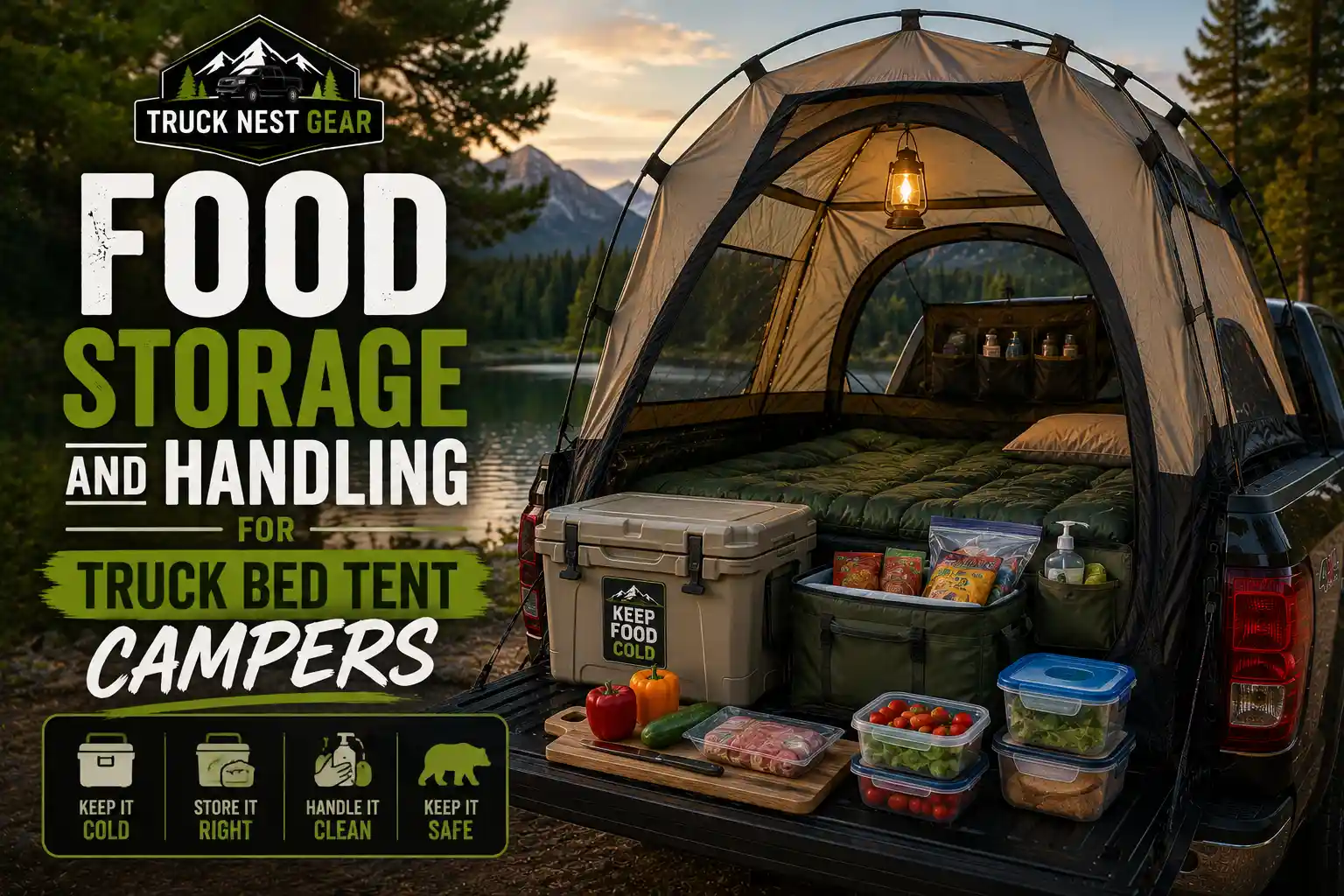
Food Storage and Handling for Truck Bed Tent Campers
Most truck bed tent campers think about food storage the way they think about everything else on a camping trip: adequately. A soft-sided cooler with ice, food bags in the truck bed, snacks in the tent pocket. It works fine until the morning the cooler has been visited overnight, or the bag of trail mix has a hole chewed through it, or the campsite ranger explains exactly why the citation is being issued for improper food storage in a bear management zone.
Proper food storage and handling is not a bureaucratic requirement. It is the practice that keeps wildlife from becoming conditioned to human food, a conditioning that almost always ends with the animal being destroyed, and keeps your campsite free of the rodent and wildlife activity that improper storage reliably attracts.
The truck bed tent format has specific food storage considerations that generic camping food guides do not address. The truck is simultaneously your sleeping space, your food transport vehicle, and your primary storage container, and how you use each of these roles affects the others in ways worth understanding before your first dispersed camping trip.
The Core Problem: Why Food Storage Matters More on Dispersed Sites
At a developed campground with bear boxes, dumpsters, and camp hosts, the food storage infrastructure exists, and the rules are clearly posted. On a dispersed BLM or National Forest site where you have chosen your own location, you are entirely responsible for managing every attractant in the campsite, and the wildlife in those environments have learned, over many camping seasons, exactly what a truck parked on a two-track means.
Food odors in the air are detectable by bears at distances up to 20 miles. Black bears have been documented opening latched soft-sided coolers and zipped duffel bags without damaging the containers, simply popping the latches with their claws. Mice and squirrels can enter a standard nylon gear bag through a gap the width of a pencil. The smell of a food wrapper, cooking grease on a stove, or sunscreen left in the truck bed is sufficient to draw wildlife investigation to a campsite overnight.
The truck bed tent configuration creates a specific vulnerability: many truck bed tent campers use the truck bed as a combined sleeping and storage area, with food gear and camping supplies stored alongside the tent setup. When food attracts wildlife to the truck bed area, that is also where you are sleeping, a situation that no amount of tent fabric between you and the outside changes meaningfully.
The solution is not paranoia. It is a set of specific storage practices that take less than ten minutes to implement correctly and eliminate the vast majority of wildlife attraction to the campsite.
What Counts as a Food Attractant
The definition of food attractant for wildlife management purposes is broader than most campers expect. Understanding what qualifies prevents the most common storage mistakes.
Obvious food attractants:
- All human food regardless of packaging
- Pet food and pet treats
- Cooking oils and spices
- Used cooking utensils and pots with food residue
- Food wrappers and packaging, even empty ones
- Garbage and food waste
- Used paper towels and napkins with food residue
Less obvious attractants that most campers miss:
- Scented toiletries, toothpaste, lip balm, sunscreen, insect repellent, lotion, and soap all carry scents that attract bears and rodents
- Empty beverage cans and bottles; the residue of fruit juice, soda, and alcohol is sufficient to attract insects and small mammals
- Chewing gum and candy wrappers
- Cooking stoves with grease residue on the burner
- Cutting boards with food residue
- The interior of a soft-sided cooler after ice has melted; the water absorbs food odors and remains attractive even after food is removed
All of these require the same storage treatment as food itself. Treating toiletries and empty containers as low-priority is the oversight that produces the most camping food storage incidents.
The Truck Bed Tent Storage System
For truck bed tent campers, the food storage system divides into three physical zones with specific rules for each.
Zone 1: The Truck Cab (Primary Food Storage)
The truck cab with all windows fully closed is the most wildlife-resistant storage location available to a truck bed tent camper without a dedicated bear canister. A vehicle with closed windows and locked doors is rated as resistant, not impenetrable, to bear investigation, but it eliminates the passive wildlife access that soft-sided containers in the truck bed allow.
All food, all scented toiletries, all food waste, and all cooking equipment with food residue go in the truck cab overnight. Not in the truck bed under the tent, in the cab, with the windows closed.
This rule has a practical implication for campsite planning: if you need to access the truck cab during the night, for bathroom trips, for temperature management, or for any other reason, the cab must still be kept closed when not in active use. A truck cab window left cracked “just a little” for ventilation is not closed for wildlife management purposes.
Zone 2: The Truck Bed With Tent Deployed (Sleeping Space Only)
When the truck bed tent is deployed and occupied for sleeping, the truck bed interior is your sleeping space, not a secondary storage area. Food, food-scented gear, and any wildlife attractant should not be in the truck bed tent overnight.
This means planning the truck bed space before tent deployment. Sleeping system components go into the bed before the tent goes up. Food and cooking gear go into the truck cab before the tent goes up. Gear that will not attract wildlife, clothing, camera equipment, and personal gear without food odor can remain in the truck bed alongside the sleeping system.
The temptation to keep snacks accessible in a tent pocket or a small bag near the sleeping area is understandable. In a developed campground with low bear pressure, it is a minor risk. On dispersed BLM land in Colorado, Utah, California, or anywhere in the Northeast where black bear populations are active, it is the practice that produces tent damage and wildlife conditioning.
Zone 3: The Campsite Perimeter (Cooking Area)
The cooking area, stove, prep surface, and dishwashing area should be positioned at least 200 feet from the sleeping area and from any water source. This standard is established by the Leave No Trace Center for Outdoor Ethics and is based on wildlife behavior patterns that associate human campsites with food.
For a truck bed tent camper, the 200-foot separation between cooking and sleeping can be challenging when the truck itself is the center of both activities. The practical approach: cook and eat beside the truck, then move all cooking equipment and food waste to the truck cab before sleeping. The 200-foot principle applies to the location of cooking odors lingering overnight; once all food gear is secured in the cab, the residual odor at the cooking area is manageable.
Bear-Specific Storage: When a Canister or Box Is Required
In designated bear management areas, specific zones within national parks, national forests, and state parks where bear activity has been documented at levels requiring additional food storage measures, a certified bear canister or bear box is required by regulation, not just recommended.
A bear canister is a rigid, certified-hard-sided container with a top closure that bears cannot open without tools. The Interagency Bear Canister Program has established a certification standard; only containers on the certified list are acceptable in areas requiring canisters.
The Garcia Backpacker Cache, BearVault BV500, and Ursack AllWhite are the three most commonly used options, though the full certified list is available at interagencybearcommittee.org.
In areas where bear canisters are required, the truck cab alone is not a compliant substitute. The canister must be used, placed at least 200 feet from the sleeping area, not in a depression or near a cliff edge, and away from water.
Many designated wilderness areas and high-use national park dispersed zones now require year-round canister use. Check the specific land management unit’s regulations before departure; the BLM field office or national forest ranger district managing the land you plan to camp on posts current food storage requirements on their websites.
Cooler Selection and Management
The cooler is the most common food storage failure point in truck bed tent camping, and the failure mode is almost always the same: a soft-sided cooler, a latched but not bear-resistant hard-sided cooler, or an IGBC-certified cooler left in the truck bed overnight rather than in the truck cab.
Soft-sided coolers are not wildlife-resistant by any standard. They are convenient and lightweight, and they are appropriate for day-use trips where the cooler is always attended. For overnight truck bed tent camping, a soft-sided cooler is not a food storage solution; it is a wildlife attractant with a carrying handle.
Standard hard-sided coolers YETI, Coleman, Igloo, and most common camping cooler brands, are not IGBC-certified bear-resistant. A motivated bear can open a standard latched hard-sided cooler without significant difficulty. In the truck cab with windows closed, a standard hard-sided cooler is adequately protected because the cab provides the wildlife resistance that the cooler itself does not. In the truck bed overnight, a standard hard-sided cooler is accessible.
The Interagency Grizzly Bear Committee (IGBC) list includes several hard-sided coolers tested and certified for bear resistance. In areas that require IGBC-certified containers rather than specifically requiring canisters, a certified cooler stored outside the vehicle is the compliant option. Check the specific area’s requirements before relying on this.
The cooler meltwater problem is a food storage issue most campers do not consider. As ice melts, the water it produces absorbs food odors from the contents and becomes a food attractant itself. Dumping cooler meltwater on the ground near the campsite or truck is improper food storage under Leave No Trace principles. Dump melt water at least 200 feet from camp, strained of any food particles, or pack it out in a sealed container.
Ice management extends the cooler’s temperature effectiveness and reduces wildlife attractant meltwater. Pre-chill food before loading; food loaded at refrigerator temperature maintains safe temperature significantly longer than food loaded at room temperature. Block ice lasts longer than cubed ice in equivalent quantities. Keep the cooler in shade rather than the truck bed in direct sun.
Safe Food Handling at the Camp Stove
Food handling practices at the camp stove determine how much residual odor remains at the cooking area after cleanup,, which directly affects how attractive the campsite is to nocturnal wildlife visitors.
Measure before you leave home. Pre-portioning ingredients at home into sealed bags reduces food waste, eliminates the need to handle bulk containers at the campsite, and reduces the volume of food residue in cooking containers that requires cleanup.
Cook what you will eat. Leftover cooked food at a campsite requires storage treatment identical to raw food; it cannot remain in an open pot on the camp stove overnight. Planning meals to minimize leftovers reduces the amount of cooked food that needs to be managed. If leftovers occur, they go into the truck cab in a sealed container with the rest of the food.
Clean cooking equipment completely before sleeping. Residual grease on a camp stove burner, food bits in a pot, cooking oil on a spatula, all of these carry odors that attract wildlife investigation overnight. Clean all cooking equipment with biodegradable camp soap, rinse thoroughly, and dry before storing in the truck cab. A stove that smells like dinner when you cook on it is a stove that smells like dinner when a bear investigates your truck at 2 AM.
Gray water from cooking cleanup. Dishwater containing food particles and soap should be strained and scattered at least 200 feet from the sleeping area rather than dumped near the truck. A small mesh strainer for dishwater allows the particles to be captured, dried, and packed out with other food waste while the water is scattered in small amounts over a wide area.
Rodent-Specific Prevention: The Underrated Wildlife Problem
Bear food storage gets the attention, but rodents, mice, squirrels, chipmunks, and pack rats are a more frequent and more consistent food storage problem for truck bed tent campers across North America than bears.
A mouse can enter a truck bed, a gear bag, or a tent through a gap the size of a pencil eraser. They chew through nylon bags, fabric cooler sides, and cardboard food packaging without significant effort. And unlike a bear, which announces its presence audibly, a mouse investigating your camp supplies operates silently and is often undetected until morning.
The prevention measures for rodents are the same as for bears, all food and scented items in the truck cab, no food residue on cooking surfaces, no food packaging left in the truck bed, with one additional consideration specific to rodent behavior.
Rodents do not only respond to strong food odors. They are attracted to any soft material that could serve as nesting material, including tent fabric. A truck bed tent stored in the carry bag in an outdoor environment with rodent activity is a potential nesting target. Store the packed tent in a hard-sided plastic bin with a latching lid between trips, not in the soft carry bag on a garage floor or truck bed.
Food Waste Pack-Out
All food waste, including packaging, food scraps, cooking residue collected from cleanup, and cooler melt water that has absorbed food odors, must be packed out from dispersed camping sites.
The Leave No Trace principle of “pack it in, pack it out” applies to food waste as completely as to gear and garbage. On dispersed BLM and National Forest land, there is no waste disposal infrastructure. The food waste you generate at the campsite leaves the campsite in your truck.
A dedicated waste bag system makes this routine rather than an afterthought. Keep a sealed dry bag or a rigid container specifically for food waste collection throughout the trip. As cooking residue, food scraps, packaging, and cleanup materials accumulate, they go into the waste bag rather than being left near the campsite. The sealed waste bag goes into the truck cab overnight alongside the food, and the entire contents go to a proper disposal facility when you return to civilization.
A truck camping trip produces significantly more food waste volume than a backpacking trip, and the truck’s cargo capacity makes full pack-out straightforward; no weight or volume constraint prevents complete food waste removal from a dispersed truck camping site. Using that capacity fully is both the responsible practice and the practice that keeps dispersed camping accessible by preventing the wildlife conditioning that consistently triggers land management restrictions.