
What Is the Lifespan of a Truck Bed Tent? (Honest Answer by Price Tier)
The honest answer to this question depends on three variables that most tent lifespan guides treat as secondary: what you paid for the tent, how many times per year you use it, and whether you have been doing the maintenance that most people skip.
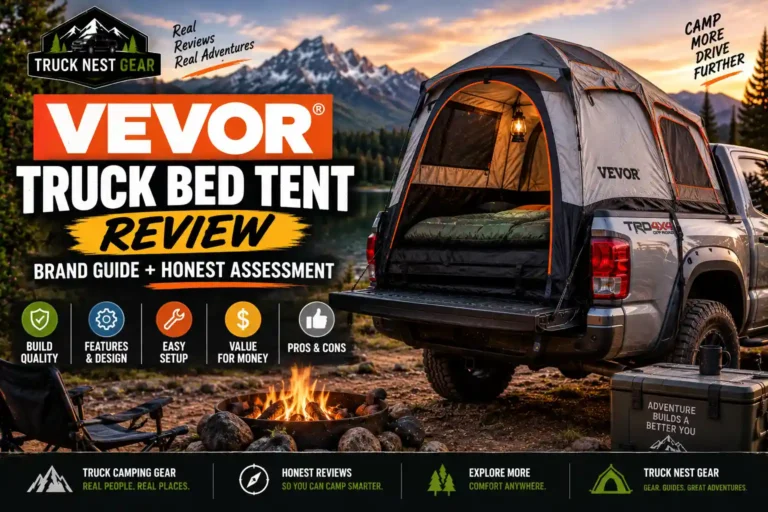
A budget truck bed tent at $80 to $100 realistically lasts 2 to 3 camping seasons with regular use. A quality mid-range tent at $150 to $270 lasts 5 to 8 seasons. A Kodiak Canvas at $400 to $500 can last 15 to 20 years with proper care. These are not manufacturer claims, they are the ranges that owner communities on ClubFrontier, Tacomaworld, and overlanding forums report consistently across hundreds of documented setups.
The second honest point: a truck bed tent faces specific wear conditions that a ground tent does not. The metal truck bed, the bed rail attachment system, and the tailgate sleeve all introduce failure modes that generic tent lifespan guides never address. Understanding these truck-specific factors is what allows you to accurately predict and extend the life of your specific tent.
Lifespan by Price Tier: The Realistic Ranges
Budget Tier ($80 to $130): 2 to 4 Seasons
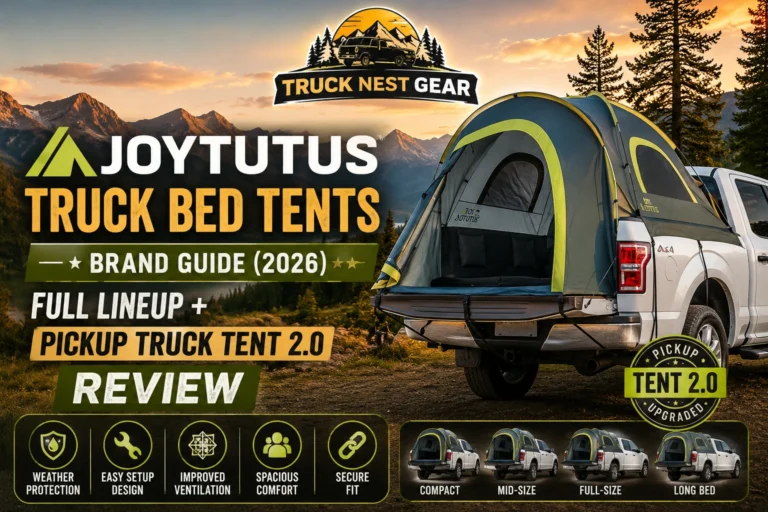
Entry-level truck bed tents, JOYTUTUS, WildFinder, Guide Gear, and similar brands, use 150D to 190D polyester with single-pass PU coating, fiberglass poles, and basic plastic buckle hardware. These materials deliver adequate performance when new and degrade at a predictable pace.
Light camping tents made from lightweight polyester typically last around 80 to 200 days of use. At two camping weekends per month across a five-month camping season, that translates to approximately 2 to 3 seasons of regular use before waterproofing failure, zipper degradation, or pole breakage becomes a recurring problem rather than an occasional one.
The components that fail first in budget tents: zippers seize or lose their seal after 20 to 40 use cycles; fiberglass poles crack or shatter after cold-weather use or rough handling during breakdown; the PU waterproof coating delaminates from the tent floor where it contacts the truck bed surface repeatedly.
The financial case for budget tents is legitimate for occasional campers, one or two trips per year, where the 2 to 4-season lifespan translates to 6 to 12 total camping trips before replacement. At that frequency, a $90 tent replaced every 3 years costs approximately $30 per year. A $270 mid-range tent that lasts 7 years at the same frequency costs approximately $38 per year. The total cost of ownership is similar; the experience is not.
Mid-Range Tier ($150 to $270): 5 to 8 Seasons
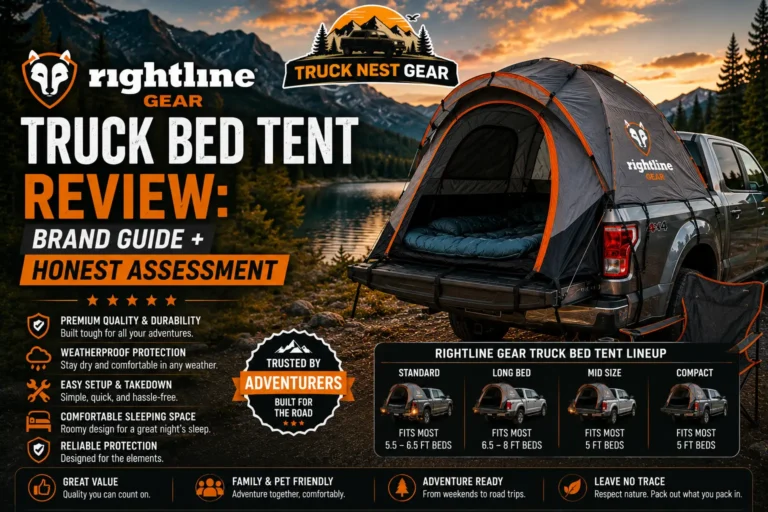
The Napier Backroadz, Napier Sportz 57 Series, and Rightline Gear 110730 represent the mid-range category. These tents use 190D to 210D polyester with 1,500mm to 2,000mm PU waterproofing, aluminum or quality fiberglass poles, and metal or reinforced buckle hardware.
Carefully maintained tents can last much longer than the average 3 to 7 years, even up to a decade or beyond. How long a tent lasts heavily depends on the frequency of use, conditions, and maintenance.
At the mid-range tier, the lifespan is primarily maintenance-determined rather than material-determined. A Napier Sportz 57 Series that is stored dry, reapplied with DWR annually, and kept in a sealed hard-sided bin between trips will outlast the same tent stored wet in a garage on a cement floor by a factor of three or more. The tent’s construction is capable of 5 to 8 seasons; whether it achieves that range depends on how it is treated between trips.
The components that determine whether mid-range tents reach their upper lifespan limit are: shock cord integrity in the pole system (typically needs replacement at year 4 to 5 with regular use), DWR coating on the rainfly (needs reapplication every 1 to 2 seasons), and the tailgate sleeve junction seam sealant (needs annual inspection and resealing).
Premium Canvas Tier ($400 to $500+): 10 to 20+ Years
The Kodiak Canvas will outlast five Napier tents. That comparison is directionally accurate and worth taking seriously. The Kodiak Canvas Truck Bed Tent uses 100% cotton duck canvas, the same material as military field tents and canvas wall tents that survive decades of expedition use.
Canvas does not delaminate like PU-coated polyester. It does not become brittle like fiberglass. It does not develop the distinctive crinkle of degraded nylon. Cotton canvas breathes naturally, which means condensation manages itself rather than accumulating inside the tent, which in turn means the interior fabric does not face the repeated wet-dry cycling that destroys synthetic tent fabrics from the inside.
A key to longevity is making sure the tent is dry when put into storage. With proper storage prep, you can expect the tent to last for many years to come.
The Kodiak Canvas requires seasoning before first use: wetting the canvas completely and allowing it to dry, which swells the cotton fibers and creates a naturally waterproof seal between threads. This one-time process, which polyester tents never require, is what activates the canvas’s full weatherproofing capability and begins the long service life the material is capable of.
At $400 to $500 and a 15 to 20-year realistic lifespan with proper care, the Kodiak Canvas is the lowest total cost-of-ownership option for any truck tent camper who camps 6 or more times per year. The math: a $450 canvas tent over 15 years of 8-trip seasons costs $3.75 per camping trip in tent depreciation. A $90 budget tent replaced every 2 years for the same 15-year period costs $675 total, $1.87 per trip at the same frequency, but with the recurring replacement cost, installation learning curve, and performance gap that synthetic tents carry.
The Truck-Bed-Specific Failure Modes No Generic Guide Covers
Every generic tent lifespan guide covers UV degradation, water damage, and poor storage. What they do not cover are the failure modes specific to truck bed tents, the ones that end the life of a tent before material degradation would have.
1. Bed Liner Abrasion on the Tent Floor
The truck bed floor is an abrasive surface. A spray-in bedliner has a textured surface designed to grip cargo, which means it is also a surface that gradually abrades the tent floor fabric with every setup, every repositioning, and every surface contact during the night.
The tent floor fabric of a budget or mid-range tent develops accelerated wear at the contact points with the bed liner texture, particularly at the wheel well edges where the tent floor stretches over the raised wheel well humps. This abrasion is invisible in the first season and visible as thinned, weakened fabric by season three or four.
The fix: a truck bed mat, a fitted rubber or foam pad that creates a smooth, non-abrasive surface between the bed liner and the tent floor, extends tent floor lifespan significantly. At $30 to $60, a quality truck bed mat is the highest-return lifespan investment available for a truck bed tent.
2. Bed Rail Strap Over-Tensioning
The bed rail attachment straps that secure a truck tent to the truck apply concentrated stress at the strap-to-fabric attachment point on the tent body. Over-tensioned straps, tighter than the firm-but-not-forced tension that the design specifies, create progressive stress fractures in the fabric at the attachment-point grommet.
This failure mode presents as a small tear originating at the grommet and propagating outward into the tent body fabric. It is visible only on close inspection of the tent interior at the grommet positions. It is preventable by tensioning straps to firm contact without over-forcing, and by inspecting grommet attachment points at the start of each camping season.
3. Tailgate Sleeve Junction Failure
The junction between the tailgate sleeve and the main tent body is the single highest-stress seam on any truck bed tent. Every entry and exit flexes this junction. Every wind event loads it laterally. Every tailgate opening and closing shifts it across the tailgate surface.
This is the seam that fails first on mid-range tents that have not received annual seam sealant maintenance. The failure presents as a small separation at the junction point that allows cold air infiltration initially and water ingress in rain. By the time the separation is large enough to be noticed as a draft, the seam has been failing for at least one season.
Annual inspection of the tailgate sleeve junction, looking for lifting tape, cracked sealant, or fabric separation, and proactive resealing with Gear Aid Seam Grip prevents this failure mode from determining the tent’s lifespan.
4. Shock Cord Degradation in Pole Systems
The elastic shock cord that runs through the pole sections of a truck bed tent and holds them connected stretches gradually with every use cycle. By year three to four of regular use, the cord has typically stretched past the threshold where it provides meaningful tension; the pole sections separate easily during setup and during use rather than snapping together and holding position.
This failure is gradual and often goes unnoticed until it is advanced enough to make setup frustrating. The fix, shock cord replacement, costs under $10 and takes 20 minutes of time. Checking shock cord tension annually (the cord should provide noticeable resistance when sections are pulled apart) and replacing it proactively rather than reactively keeps the pole system functional across the tent’s full potential lifespan.
5. Fiberglass Pole Cold-Weather Shattering
Budget tents often fall on the shorter end because the fabrics and zippers simply aren’t built to take repeated stress. Fiberglass poles are less durable; they may splinter or shatter more easily than aluminum poles.
Fiberglass poles, the standard in budget and mid-range truck bed tents, become brittle below freezing. A pole that is assembled quickly in sub-freezing temperatures, or that absorbs a sudden lateral load from wind during cold-weather setup, can shatter rather than bend. Shattered fiberglass inside a pole sleeve damages the sleeve fabric and often renders that pole assembly unusable.
This failure mode is entirely preventable: bring poles into the truck cab to warm before cold-weather setup. A pole that has been at cab temperature for 15 to 20 minutes before assembly in freezing conditions behaves very differently than one assembled directly from a cold carry bag.
The Factors That Determine Where Your Tent Falls in Its Lifespan Range
UV Exposure: The Silent Lifespan Killer
If tents had a natural enemy, it wouldn’t be wind, rain, or raccoons; it would be sunlight. UV rays break down the nylon or polyester fibers, causing the fabric to weaken, fade, and eventually tear. Even the toughest tent fabric can fail after too much UV exposure.
Truck bed tent campers who leave the tent deployed through afternoon sun, particularly in the Southwest desert, high-altitude Rocky Mountain terrain, and coastal environments, are accelerating UV degradation significantly. A tent that spends 6 hours per deployment day in direct sun accumulates UV damage that a tent deployed at dusk and packed at dawn does not.
A UV-resistant DWR spray applied annually provides some UV protection in addition to its primary waterproofing function. A reflective tarp positioned above the tent during afternoon sun hours, which also serves as a shade and temperature management tool, dramatically reduces UV exposure during the highest-intensity hours.
Wet Storage: The Single Most Damaging Habit
Proper storage is a key practice that extends the life of a tent significantly. Storing it dry and free from debris to avoid mold and mildew is essential.
Packing a wet truck bed tent into its carry bag and storing it for more than 24 hours is the single most effective way to shorten its lifespan. Mildew establishes in damp, dark fabric within hours under the right conditions. Once mildew infiltrates the polyurethane coating on the inner tent fabric, it degrades the coating permanently; the coating delaminates, the waterproofing fails, and no amount of DWR spray restores the inner fabric’s performance.
The protocol: never store a wet tent. If you must pack wet due to a morning departure in rain, unpack and set up the tent within 24 hours of returning home, in the garage, in the yard, in the driveway, and allow it to dry completely before returning it to the carry bag.
Compressed Storage: The Long-Term DWR Degrader
Extended storage of the tent tightly compressed in its carry bag, the way most campers store it between seasons, maintains the tent fabric under continuous compression that degrades the DWR coating at the fold lines. A tent stored loosely in a large mesh bag or breathable storage container between trips maintains its DWR performance significantly longer than one stored under maximum compression in a sealed stuff sack for months at a time.
Cleaning Frequency
Dirt, sunscreen residue, insect repellent, and food particles all degrade waterproof coatings on contact. Cleaning the tent body and rainfly with a technical fabric cleaner, Nikwax Tech Wash or Gear Aid Revivex, after the first dirty trip of each season and at the end of the season before storage removes the chemical and biological contaminants that accelerate coating degradation between uses.
The Annual Maintenance Routine That Doubles Tent Lifespan
Completing this routine at the start of each camping season adds approximately two hours of maintenance time and extends tent lifespan by a factor of 1.5 to 2 compared to tents that receive no maintenance.
Step 1: Set up and inspect. Deploy the full tent in your driveway or garage. Inspect every seam, every zipper, every grommet attachment point, and every pole joint. Identify any issues before the first trip reveals them at a campsite.
Step 2: Waterproof hose test. Run a garden hose on medium pressure over the fully deployed tent for five minutes, including concentrated passes over every seam, the tailgate sleeve junction, the pole sleeve seams, and the lower tent walls. Any drip on the inner surface indicates a repair point.
Step 3: Clean with technical fabric cleaner. Wash the tent body and rainfly with Nikwax Tech Wash or equivalent. Rinse completely. Allow to dry fully before proceeding.
Step 4: Reapply DWR. Apply a spray-on DWR treatment to the outer surfaces of the tent body and rainfly. Nikwax TX. Direct Spray-On or Gear Aid Revivex Durable Water Repellent applied to a clean, dry tent restores the water-beading performance that UV exposure and washing have degraded.
Step 5: Reseal problem seams. Apply Gear Aid Seam Grip to the tailgate sleeve junction, any pole sleeve seams showing lifting tape or cracked sealant, and any seam that showed moisture during the hose test. Allow 12 hours to cure before repacking.
Step 6: Check shock cords. Pull pole sections apart and feel for tension. Replace shock cord in any pole that provides no resistance when sections are separated.
Step 7: Store correctly. Pack the tent loosely, rolled rather than compressed, in a large mesh bag or breathable storage container. Store in a cool, dry location away from direct sunlight and away from exterior walls that may introduce moisture.
When to Replace Your Truck Bed Tent
Even with perfect maintenance, every truck bed tent eventually reaches end-of-life. These are the signs:
Replace immediately:
- Water entering through the tent floor despite DWR reapplication and seam sealing; the PU coating has fully delaminated and cannot be restored
- Zipper failure that cannot be repaired; a failed zipper on the main entry or a critical window renders the tent non-functional
- Multiple pole failures in the same season; the fiberglass has become uniformly brittle and will continue to fail
Replace this season:
- Visible fabric thinning or pilling on the tent floor at wheel well contact points
- DWR no longer beading even immediately after fresh application; the coating has degraded below the threshold that reapplication can address
- Zipper that requires significant force to operate; zippers under stress fail suddenly rather than gradually
Consider upgrading:
- If you are camping more than 6 times per year on a budget tent, the maintenance cost and replacement frequency make a mid-range or premium tent the more economical choice
- If you are camping in cold weather or shoulder seasons on a polyester tent, canvas construction addresses the condensation and warmth limitations that polyester cannot overcome regardless of maintenance
Bottom Line: What Lifespan to Expect From Your Tent
Instead of thinking in years, it’s better to think in use cycles. A well-built tent that only comes out for one family trip per year can last ages. A bargain tent exposed to conditions week after week ages quickly.
For truck bed tents specifically, the realistic expectations:
Budget tent ($80 to $130), 2 to 4 trips per year, basic maintenance: 3 to 4 seasons before meaningful performance decline.
Mid-range tent ($150 to $270), 4 to 8 trips per year, annual maintenance routine: 5 to 8 seasons before any significant issues.
Premium canvas tent ($400+), any frequency, dry storage: 15 to 20+ seasons. The Kodiak Canvas is the only truck bed tent that realistically outlasts the truck it was purchased for.
The variables you control, dry storage, annual DWR reapplication, seam sealing, shock cord replacement, and a truck bed mat to prevent floor abrasion, have more impact on your tent’s lifespan than the tent’s price tier. A well-maintained budget tent outlasts a neglected mid-range tent. A well-maintained mid-range tent outlasts a neglected premium canvas tent, though that scenario requires genuinely exceptional neglect to produce.
Maintain the tent correctly, store it dry, and it will last as long as the materials are capable of lasting. Neglect it, and it will tell you exactly how long it was designed to survive without care, usually sooner than you would like.