
Are Truck Bed Tents Waterproof? (What Campers Need to Know)
Everything is perfect. Your truck tent is set up, your sleeping pad is laid flat, and the campfire is burning low. Then, at 2 am, you feel it, a cold drip on your face. Then another on your sleeping bag. Then the unmistakable sound of rain drumming harder on the rainfly above you.
In that moment, one question matters more than any spec sheet, any product review, or any star rating on a retail website: Is this tent actually keeping me dry?
Waterproofing is the single most discussed and most misunderstood feature in the entire truck tent category. Manufacturers use numbers, ratings, and technical language that sound impressive but rarely come with a plain explanation of what they actually mean in real camping conditions.
This article fixes that. By the time you finish reading, you will understand exactly how truck tent waterproofing works, what the ratings mean, where tents actually leak and why, and what you can do to maintain and restore waterproofing over the life of your shelter.
Before we go further, it is worth connecting this topic to the broader picture. Understanding waterproofing in isolation is useful, but understanding it alongside what to look for when buying a truck bed tent, including fabric quality, seam construction, and rainfly design, gives you the complete framework for evaluating any tent on the market with genuine confidence.
The Short Answer
Yes, truck bed tents are waterproof. But with an important qualification.
A truck bed tent is only as waterproof as its weakest component. A tent body with an excellent hydrostatic head rating can still leak through poorly sealed seams. A well-sealed tent can still let moisture in through a rainfly that does not extend far enough past the walls. A perfect rainfly becomes useless if condensation is mistaken for a leak and the wrong problem is being solved.
Waterproofing is not a single feature. It is a system, and every part of that system needs to work together for the tent to stay genuinely dry in real rain.
How Truck Tent Waterproofing Actually Works
A properly designed truck bed tent manages water through three distinct layers of defense. Understanding each layer helps you evaluate any tent accurately and diagnose any moisture problem correctly.
Layer 1: The Tent Body Fabric
The outermost layer of your tent body is coated with a water-resistant treatment that causes rain to bead and roll off rather than soaking through. This treatment is called DWR, Durable Water Repellent, and it is applied to virtually all camping tent fabrics at the factory.
DWR is not a permanent treatment. It degrades over time through UV exposure, washing, compression, and general use. A tent that performs excellently when new may begin to wet out, meaning the fabric absorbs water rather than repelling it, after two or three seasons of regular use without maintenance.
The good news is that DWR can be restored relatively easily, which we cover in the maintenance section later in this article.
Layer 2: The Rainfly
The rainfly is your primary active defense against rain. It is a separate waterproof cover that drapes over the tent body and creates a protected air gap between itself and the inner tent walls.
This air gap serves two critical functions simultaneously:
First, it prevents rain from driving directly against the tent body fabric. Even on a tent with excellent DWR, sustained heavy rain at an angle will eventually find its way through the outer fabric if there is no secondary barrier. The rainfly intercepts that rain before it ever reaches the tent body.
Second, the air gap allows moisture vapor, the warm, humid air your body produces while sleeping, to escape outward through the tent walls and dissipate rather than condensing on the inner surface. This is why a sagging rainfly that contacts the tent walls causes interior wetness even when it is not raining. The condensation management system breaks down the moment that air gap disappears.
A quality rainfly should extend at least 6 to 8 inches past the tent walls on all sides. A rainfly that sits too close to the tent edges allows wind-driven rain to reach the lower tent walls directly.
Layer 3: Seam Construction
Seams are where two pieces of fabric are stitched together, and every stitch hole is a potential entry point for water. In heavy or sustained rain, water finds seams before it finds anywhere else.
There are three levels of seam protection you will encounter across different tent price points:
Unprotected Seams: Raw stitched seams with no additional treatment. Found almost exclusively in the cheapest entry-level tents. Unprotected seams will leak in moderate rain; this is not a matter of if but when.
Seam Taped: A waterproof tape is applied over the stitched seam from the inside of the fabric. Taped seams are significantly more water-resistant than unprotected seams and are the standard in mid-range and quality truck tents.
Fully Taped and Sealed: Every seam, including secondary and internal seams, is taped and additionally treated with a liquid sealant. This is the highest level of seam protection available and is found in premium expedition-grade tents. Fully taped and sealed seams remain watertight in sustained heavy rain and are the benchmark to look for if you camp regularly in wet climates.
Understanding Hydrostatic Head Ratings
The hydrostatic head rating, expressed in millimeters, is the number you will see most frequently when comparing truck tent waterproofing specifications. It is the most objective measure of a fabric’s water resistance, and knowing how to read it correctly separates informed buyers from everyone else.
What the Number Actually Means
The hydrostatic head test works by placing a fabric sample beneath a column of water and measuring how high the column can rise, in millimeters, before water begins to pass through the fabric. The higher the number, the more water pressure the fabric resists before leaking.
Here is how to translate those numbers into real camping conditions:
| HH Rating | Water Resistance | Real-World Conditions |
| Under 800mm | None to minimal | Will leak in light drizzle |
| 800mm – 1,200mm | Basic | Light rain only, no sustained exposure |
| 1,200mm – 1,500mm | Moderate | Moderate rain for short periods |
| 1,500mm – 2,000mm | Good | Heavy rain with limited wind |
| 2,000mm – 3,000mm | Very Good | Sustained heavy rain and wind |
| 3,000mm+ | Excellent | Storm conditions, extended wet weather |
What Rating Do You Actually Need?
For three-season truck camping in typical North American or European conditions, a tent body rated at 1,500mm minimum and a rainfly rated at 2,000mm minimum provides reliable protection across the vast majority of weather situations you will encounter.
If you camp regularly in the Pacific Northwest, mountain environments, or any region with frequent heavy rainfall, push those numbers up to 2,000mm on the tent body and 3,000mm on the rainfly for genuine peace of mind.
If you are comparing tents and a manufacturer only lists one waterproofing rating without specifying whether it applies to the tent body or the rainfly separately, treat that as a red flag. Quality manufacturers are transparent about both numbers because they know serious buyers will ask.
Where Truck Bed Tents Actually Leak, And Why
Knowing the ratings is important. But knowing where leaks actually occur in real-world conditions is what allows you to prevent them before they happen and diagnose them correctly when they do.
Leak Point 1: The Tailgate Sleeve Junction
The junction where the tailgate sleeve meets the main tent body is the most common leak point in the entire truck tent system. This area experiences the most movement; every time you enter or exit the tent, the sleeve flexes, and the fabric-to-fabric seam at this junction is under constant stress.
Over time, the seam sealant at this junction breaks down faster than anywhere else on the tent. Inspect this area at the start of every camping season and reseal it proactively rather than waiting for a leak to appear.
Leak Point 2: The Rainfly Edges in Wind-Driven Rain
A rainfly that performs perfectly in vertical rain can fail in wind-driven rain if the edges do not extend far enough past the tent walls. Wind pushes rain horizontally, and horizontal rain finds the gap between the rainfly edge and the tent wall with alarming efficiency.
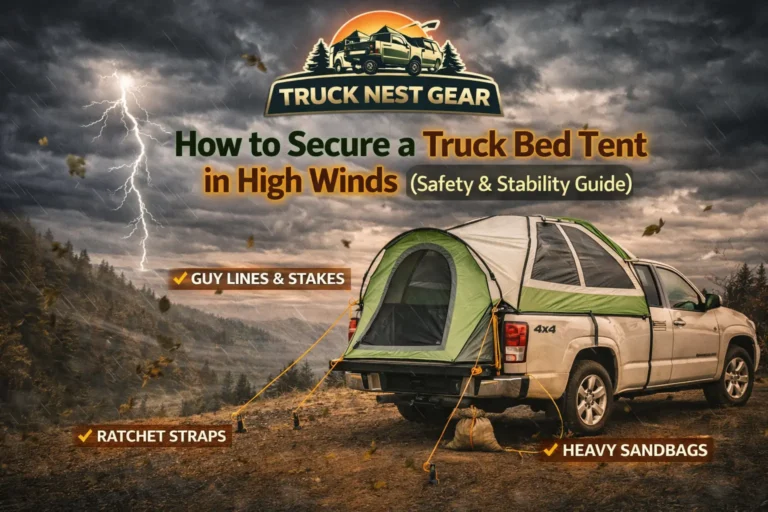
The solution is proper guy line staking. Staking your rainfly guy lines pulls the fly edges outward and downward, extending the effective coverage area and closing the gap that wind-driven rain exploits. This is one of the most impactful and most frequently skipped steps in the setup process we outlined in our complete step-by-step truck bed tent setup guide.
Leak Point 3: The Pole Sleeve Seams
The fabric sleeves through which your poles are threaded create long seams running the length of your tent roof, exactly where the most rain falls. These seams are under tension whenever the tent is erected, which gradually stresses the seam sealant.
Check pole sleeve seams annually and apply seam sealer along their full length as a preventive measure at the start of each camping season.
Leak Point 4: The Truck Bed Gap
This leak point is unique to truck tents and has nothing to do with the tent fabric itself. The gap between the tent floor fabric and your actual truck bed, particularly around the wheel well humps, can allow water to pool and wick upward into your sleeping space during heavy rain.
The most effective solution is a fitted truck bed mat or a custom truck bed liner that eliminates these gaps. A close-fitting mat also provides the additional benefit of insulation against the cold metal bed surface on cool nights.
Leak Point 5: Condensation Mistaken for a Leak
This is the most common source of confusion among first-time truck campers. On cool nights, the warm, humid air inside the tent contacts the cooler tent walls and condenses into liquid water droplets, creating the appearance of a leak from the inside.
Condensation and genuine rain leakage feel identical to the touch. The way to tell them apart is to check where the moisture appears:
- Moisture concentrated near ventilation points, on inner walls, or on your sleeping bag → Condensation
- Moisture dripping from a specific seam, corner, or pole sleeve → Genuine leak
Treating condensation as a leak and applying seam sealer everywhere solves nothing. The correct solution for condensation is always improved ventilation, more open mesh windows, better rainfly air gap, or a small camping fan to increase airflow.
How to Test Your Truck Tent’s Waterproofing Before a Trip
Never trust a brand-new tent’s waterproofing claims without a personal verification test, and never take an older tent on a camping trip without confirming its waterproofing is still performing.
The test is simple:
Set up your tent fully in your driveway, including the rainfly with all attachment points connected and guy lines staked. Use a garden hose on a medium-pressure setting to simulate rain over the entire tent surface for a minimum of five to ten minutes.
Start with the rainfly, then direct water specifically at every seam, the tailgate sleeve junction, the pole sleeve seams, and the lower tent walls. After the test, climb inside and inspect the inner tent surfaces and sleeping area for any moisture.
Any moisture found during this test represents a leak that needs addressing before your camping trip. Finding it in your driveway takes five minutes to fix. Finding it at a remote campsite in the middle of the night takes considerably more than five minutes and considerably more frustration.
How to Maintain and Restore Truck Tent Waterproofing
Waterproofing degrades with use, but it is entirely restorable with the right products and a simple annual maintenance routine.
Step 1: Clean the Tent Thoroughly
Dirt, sunscreen residue, insect repellent, and body oils all degrade DWR treatments faster than normal weathering. Before any waterproofing maintenance, clean the tent body and rainfly with a technical fabric cleaner specifically formulated for camping gear — standard household detergents strip DWR rather than preserving it.
Step 2: Reapply DWR Treatment
Once the tent is clean and completely dry, apply a spray-on DWR treatment to the tent body and rainfly outer surfaces. Products like Nikwax TX. Direct or Gear Aid Revivex are widely available and restore the water-beading performance of degraded DWR coatings effectively.
Apply the DWR spray evenly across the entire outer surface, allow it to absorb for the manufacturer’s recommended time, then wipe off any excess and allow the tent to dry completely before storage.
Step 3: Inspect and Reseal All Seams
With the tent still set up after DWR reapplication, inspect every seam carefully for cracking, peeling tape, or areas where the original sealant has worn through. Pay particular attention to the tailgate sleeve junction, the pole sleeve seams, and all corner seams.
Apply seam sealer, available in brush-on or squeeze-tube form, to any areas showing wear. Work from the inside of the tent for maximum effectiveness, as inside application allows the sealant to be pushed outward through the seam by rain pressure rather than away from it.
Allow the seam sealer to cure for a minimum of 12 hours before the waterproof hose test.
Step 4: Check the Rainfly Coverage and Guy Lines
Inspect the rainfly attachment hardware, clips, hooks, and Velcro for wear or damage. Replace any attachment points that no longer hold firmly. Check your guy lines for fraying and replace them if needed. A broken guy line in wind is what turns a properly designed rainfly into an ineffective one.
Maintenance Schedule
| Maintenance Task | Frequency |
| Full tent cleaning | Every 3–5 trips or start of season |
| DWR reapplication | Once per season or when fabric wets out |
| Seam inspection and resealing | Start of every camping season |
| Rainfly attachment hardware check | Start of every camping season |
| Full waterproof hose test | Before first trip of every season |
The Best Waterproofing Practices in the Field
Maintenance at home sets the baseline, but good habits in the field maintain your waterproofing performance trip after trip.
Always stake your rainfly guy lines, even when the forecast looks clear. Mountain and coastal weather changes faster than any forecast predicts, and a properly staked rainfly costs you two minutes at setup.
Never touch the inner tent walls during rain. The pressure of a hand against the inner fabric during rainfall creates a direct water transfer path through the tent wall, a phenomenon called wicking. Keep contact with the inner walls minimal when it is actively raining outside.
Dry your tent completely before packing. Packing a damp tent degrades DWR, promotes mildew, and weakens seam sealant. If you must pack wet, unpack and dry the tent within 24 hours of returning home.
Store your tent loosely, not compressed. Long-term compression of the tent fabric in its carry bag degrades the DWR coating and stresses the seam tape. Store your tent in a large mesh bag or loosely folded in a cool, dry location between trips.
What to Do When Your Tent Leaks Mid-Trip
Despite the best preparation, sometimes a leak appears in the field. Here is how to manage it without ending your camping trip:
Identify the source first. Use a headlamp to trace the moisture back to its entry point before doing anything else. Acting on the wrong assumption wastes time and materials.
For seam leaks: Apply a strip of duct tape over the leaking seam from the inside as an emergency fix. It is not elegant, but it is waterproof and will hold for the remainder of a trip.
For rainfly coverage failures: Reposition and re-tension the rainfly, ensuring all attachment points are connected, and guy lines are staked and taut.
For condensation: Open additional mesh windows and create airflow through the tent. If temperatures allow, leave the tailgate sleeve partially open to increase ventilation dramatically.
For truck bed gap water intrusion: Elevate your sleeping pad on additional layers, folded blankets, or a second pad to lift your sleeping surface above the water line.
Final Thoughts
A well-designed truck bed tent, properly maintained and correctly set up, will keep you completely dry in heavy rain, sustained overnight storms, and the kind of weather that sends ground tent campers scrambling. The technology exists, hydrostatic head ratings, taped seams, and full-coverage rainflies, to make truck tent waterproofing genuinely reliable.
But reliable waterproofing does not happen by accident. It happens because you chose a tent with the right ratings, understood where the vulnerable points are, tested it before your trip, and maintained the DWR and seam sealant through your annual routine.
You now have the complete knowledge base to do all of that with confidence.
And if you are ready to put all of this research into action, the waterproofing knowledge, the setup technique, the buying checklist, and the full understanding of how these shelters work, our complete guide to the best truck tents for camping brings everything together in one place, ranking and reviewing the top models on the market against every standard we have covered across this entire article series.