What Is Truck Tent Camping? Complete Beginner’s Guide
Truck tent camping is one of the simplest upgrades a pickup truck owner can make to their camping setup and one of the most misunderstood. If you have heard the term but are not quite sure what it means, how it works, or whether it is worth trying, this guide answers all of it from the beginning.
By the time you finish reading, you will know exactly what truck tent camping is, what you need to get started, who it works best for, and how it compares to the other camping options you are probably already familiar with.
What Is Truck Tent Camping?
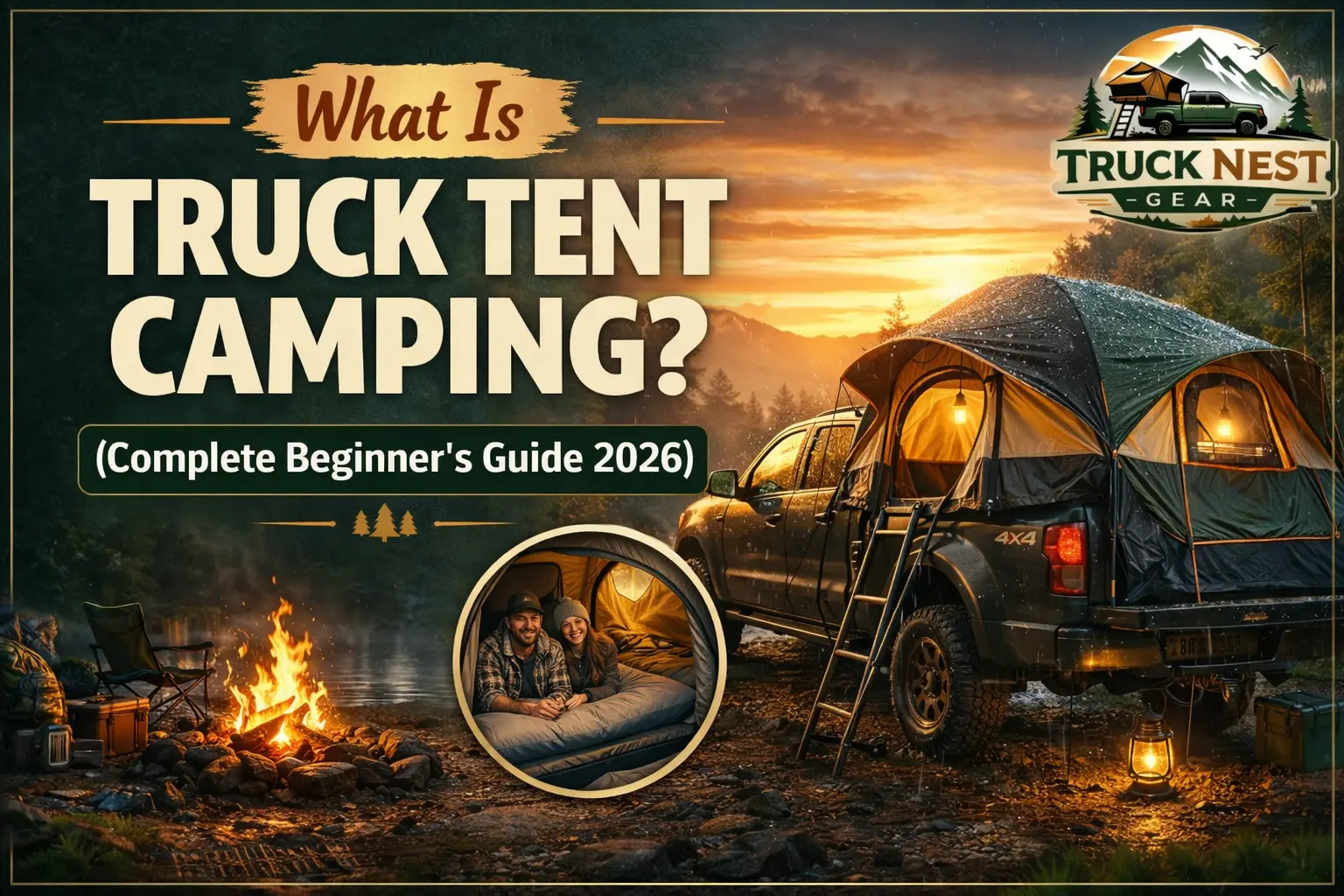
Truck tent camping is sleeping in a purpose-built tent that attaches to the bed of a pickup truck. Instead of pitching a tent on the ground, you set up inside and above your truck bed, sleeping elevated off the ground on a stable, flat, weatherproof platform that your truck provides.
The tent attaches to your truck’s bed rails using adjustable straps or clamps, covers the tailgate opening with a sealed fabric sleeve, and uses a fiberglass or aluminum pole system to stand upright above the bed. The result is a fully enclosed sleeping space with mesh windows for ventilation, a rainfly for weather protection, and an entry point through the tailgate sleeve or a side door.
Truck tent camping has grown steadily since Napier Outdoors launched the first commercial truck bed tent in 1994. Today, it is a mainstream camping option for pickup truck owners across North America, particularly for hunters, road trippers, overlanders, and anyone who wants to sleep elevated off the ground without the cost or complexity of a rooftop tent or slide-in truck camper.
- Entry cost: approximately $80 to $100 for a budget tent, $200 to $270 for the most popular mid-range model
- Setup time: 10 to 20 minutes on first use, 5 to 10 minutes with practice
- Truck requirement: any standard pickup with a 5-foot to 8-foot bed
- Sleeping capacity: two adults comfortably in most configurations
What Is a Truck Bed Tent?
A truck bed tent is the shelter itself, the product that makes truck tent camping possible. It is a purpose-built tent designed to fit inside and over a pickup truck’s bed, using the truck’s physical structure as its foundation.
The tent body sits inside the truck bed, supported by fiberglass or aluminum poles that run through internal fabric sleeves, the same basic pole structure as a freestanding ground tent, adapted to truck bed dimensions. Adjustable straps or clamps grip the bed rails on both sides to anchor the tent firmly in position. A fabric tailgate sleeve drapes over the lowered tailgate to seal the rear entry point.
Most truck bed tents include a full rainfly for weather protection, mesh windows on the side walls for cross-ventilation, and a main entry through the tailgate sleeve. Premium models add features like a built-in awning that extends over the tailgate entry, a cab access panel that connects the tent interior to the truck’s rear window for running a power cord, and additional ceiling vents for improved airflow.
Interior dimensions vary by tent model and truck bed size. Width at the sleeping surface is approximately 48 to 54 inches; the usable space between the wheel wells determines this, not the bed’s outer width. Height ranges from about 4.5 feet in entry-level tents to approximately 5 feet 10 inches in premium models. Most truck bed tents sleep two adults comfortably, and three is possible in longer beds when one is a child.
How Does a Truck Bed Tent Work?
The setup process follows the same sequence across most truck bed tent brands.
Lower your tailgate fully and park on reasonably level ground. Clear the truck bed of any gear, tools, or debris that could damage the tent floor. Place a sleeping pad or truck bed mat flat across the bed surface before the tent goes on.
Unpack the tent and lay out all components, poles, rainfly, straps, and stakes, and identify each piece before assembling anything. Thread the assembled poles through the corresponding fabric sleeves in the tent body. Connect each pole end to its grommet or pin at the base corners of the tent, which tensions the poles into their curved arc and raises the tent upright.
Attach the bed rail straps from front to back on both sides, tightening to firm tension. Drape the tailgate sleeve over the lowered tailgate and secure its bottom closures. Drape the rainfly over the assembled tent body and connect all attachment points. Stake out the rainfly guy lines for wind stability and rainfly coverage.
The full setup process, including pro tips for faster deployment, how to seat pole joints correctly, how to avoid the most common first-time mistakes, and a realistic timeline for how quickly setup improves with practice, is covered step by step in the complete guide to setting up a truck bed tent, which walks through every stage from truck bed preparation to final pre-sleep checks.
Teardown is the reverse of setup and takes 10 to 15 minutes. The complete tent packs into a carry bag roughly the size of a large duffel, which stores in the truck cab or under a tonneau cover when not in use.
Who Is Truck Tent Camping Best For?
Truck tent camping hits a specific sweet spot. It is not for everyone, but for the right camper, it is the most practical sleeping setup available.
Hunters find truck tents particularly well suited to the way they camp. Sleeping at the trailhead eliminates the walk from a distant campground. Camo tent models blend into woodland environments. The cab access panel on premium models like the Napier Sportz 57 Series lets you run a power cord from the truck for a heated blanket or small heater, a meaningful advantage in November and December pre-dawn conditions.
Road trippers value the flexibility of not needing to book a campground. Pull off at a scenic spot, set up in 15 minutes, sleep, and drive on in the morning. No check-in, no reservation, no hotel bill.
Overlanders find that a truck bed tent integrates naturally with their setups at a fraction of the cost of a rooftop tent. Lower financial commitment, faster deployment than a conventional ground tent, and no permanent roof rack installation required.
Weekend campers who already drive a pickup to established campgrounds find that the tent lives in the truck bed and deploys without complex site preparation. Floorless designs like the Rightline Gear 110730 eliminate even the requirement to unload the bed before setup.
First-time truck campers benefit from the lowest barrier to entry in the elevated sleeping category. An entry-level truck bed tent at $80 to $100 is 10 to 15 times cheaper than a rooftop tent and delivers the same core benefit of sleeping off the ground, without roof rack installation, without permanent vehicle modification, and without a four-figure financial commitment before you know whether the style of camping suits you.
Truck tent camping is not the right choice if you need sleeping space for three or more adults, camp in locations without vehicle access, or frequently need the truck bed for hauling during the same trip where you plan to camp.
How Truck Tent Camping Compares to Other Options
The most useful comparison for first-timers is how a truck bed tent stacks up against a ground tent and a rooftop tent.
| Factor | Truck Bed Tent | Ground Tent | Rooftop Tent |
|---|---|---|---|
| Cost to start | $80 – $500 | $30 – $500+ | $1,100 – $4,500+ (with rack) |
| Setup time | 10 – 20 minutes | 15 – 30 minutes | 2 – 5 minutes (deployment) |
| Ground moisture | Not a factor — elevated | Requires groundsheet | Not a factor — elevated |
| Site flexibility | Needs a flat parking spot | Any flat ground works | Needs a flat parking spot |
| Sleeping capacity | 2 adults | 2 to 10+ | 2 adults |
| Vehicle modification | None required | None required | Roof rack required |
| Fuel economy impact | None | None | 10 – 25% reduction |
| Storage when packed | Compact duffel bag | Compact carry bag | Stays mounted on vehicle |
The honest summary: a truck bed tent delivers most of the rooftop tent experience at a fraction of the cost and none of the permanent vehicle modification. A ground tent is more versatile for campers without truck access or those camping with larger groups. A rooftop tent is the right choice for serious overlanders who camp on technical terrain and want the fastest possible deployment with the truck bed kept free for gear.
The complete breakdown of all four truck camping shelter types, truck bed tents, rooftop tents, camper shells, and slide-in campers, including specific buyer profiles and honest assessments of where each one works and where it fails, is worth reading before committing to any direction.
What You Need to Get Started
The barrier to entry for truck tent camping is genuinely low.
- Essential — required:
A pickup truck with a 5-foot to 8-foot bed. Any standard pickup qualifies. Confirm your exact interior bed measurement before buying a tent.
A truck bed tent matched to your specific bed size, covered in the sizing section below.
A sleeping surface, an air mattress, a self-inflating sleeping pad, or a foam pad. A queen-sized air mattress fits a 6.5-foot or longer bed. For a 5.5-foot bed, use a full-size mattress or two twin pads side by side.
A sleeping bag or bedding rated for your expected overnight low temperature.
- Strongly recommended:
A closed-cell foam base layer under your air mattress. The metal truck bed conducts cold upward even through a sleeping pad, and a foam base layer eliminates most of that conductive heat loss.
A headlamp for hands-free lighting during setup in low light and nighttime tent navigation.
Leveling blocks for sloped campsites. Even a slight incline affects sleep quality noticeably. Camco leveling blocks at $15 to $20 are compact and reusable.
- Optional upgrades:
A truck-specific air mattress. Standard rectangular air mattresses leave gaps at the wheel wells. Truck-specific designs from AirBedz and Rightline Gear are contoured to fit around the wheel wells and use the full bed width.
A 12V portable fan or small heater. The cab access panel on the Napier Sportz 57 Series lets you run a power cord from your truck’s outlet for electric climate management in shoulder seasons.
How to Choose the Right Size Truck Tent
Sizing is the most important factor when buying a truck bed tent, and the most frequently overlooked. A tent designed for one bed size will not anchor properly on a different bed; the attachment geometry will be wrong, and the tailgate sleeve will not seal correctly.
- Step 1: Measure your truck bed interior.
Find the inside length of your truck bed, from the inside face of the tailgate to the inside wall of the cab. Do not use your truck’s advertised bed length, which is typically the exterior measurement and runs 3 to 6 inches longer than the interior.
- Step 2: Match to your bed size category.
Short bed (5 to 5.75 feet): Ford F-150 SuperCrew, RAM 1500 Crew Cab, Chevy Silverado Crew Cab, Toyota Tacoma Double Cab; use tents specifically listed for short beds or 5-foot configurations.
Standard bed (6 to 6.5 feet): Ford F-150 SuperCab, RAM 1500 Quad Cab, Chevy Silverado Double Cab, GMC Sierra; use tents listed for standard 6.5-foot beds.
Long bed (7 to 8 feet): Ford F-250, RAM 2500, Toyota Tundra long bed, Chevy Silverado work trucks, use tents specifically rated for 8-foot beds, such as the Rightline Gear 110730 or the Kodiak Canvas 7206 8-foot variant.
- Step 3: Verify with the manufacturer’s compatibility tool.
Napier maintains a publicly available truck fitment database at napieroutdoors.com that covers verified fits by make, model, year, and cab configuration. Using it before ordering takes two minutes and eliminates the most expensive mistake in this category.
Is Truck Tent Camping Worth It?
For pickup truck owners who camp two or more times per year, the answer is consistently yes.
You already own the platform. The only incremental cost is the tent itself. There is no roof rack installation, no vehicle modification, and no additional hardware.
The cost-to-benefit ratio is the best in the elevated sleeping category. An $80 entry-level tent delivers the core benefit of sleeping elevated, off the ground, away from moisture and insects, on a stable, flat surface that a $1,500 rooftop tent also delivers. The rooftop tent adds height, speed, and permanent roof mounting. For most weekend campers, those additions do not justify a 15-to-1 price difference.
Setup and breakdown are faster than a full ground camp. Ten to twenty minutes to be sleeping versus 45 to 90 minutes to pitch a tent, set up a kitchen, and organize a campsite from scratch.
The honest limitations: budget tents have real durability limits; expect two to three seasons of regular use before material quality becomes a factor. The two-adult sleeping capacity is a hard constraint that no tent design can change. And the experience is vehicle-dependent; if your camping life includes trips without truck access, you will need a ground tent alongside it.
Frequently Asked Questions
Do I need a special truck for a truck tent?
No special modifications are required. Any standard pickup truck with a functioning tailgate and intact bed rails accommodates a truck bed tent. The tent attaches via adjustable straps over the bed rails- no drilling, no permanent hardware, no rack required.
Can two people sleep in a truck tent?
Yes, two adults is the standard comfortable capacity. A queen-sized air mattress fits a 6.5-foot or longer bed. For a 5.5-foot bed, use a full-size mattress or two sleeping pads side by side. Three people can fit in a longer bed, but the practical maximum is one adult and two children or three slim adults in an 8-foot configuration.
Can you use a truck tent with a tonneau cover?
It depends on the cover type. Retractable covers and roll-up soft covers under 6 inches high when rolled are compatible with most truck tents. Hard folding tri-fold covers and hard one-piece covers typically need to be removed before setup. The Rightline Gear 110730 has the broadest compatibility across cover types. Always verify with your specific tent model’s documentation.
Is a truck tent waterproof?
Quality truck tents from established brands are weatherproof under normal rain conditions. Mid-range tents use PU-coated fabric with a 1,500 mm to 2,000mm hydrostatic head rating and taped seams, reliable in heavy sustained rain. Canvas tents like the Kodiak Canvas handle all-weather conditions better than any polyester alternative. Budget entry-level tents perform adequately in light to moderate rain; seam weakness can appear in sustained heavy downpours. Applying seam sealer at the start of each season improves performance at every price point.
How much does truck tent camping cost to get started?
The minimum entry cost is approximately $80 to $100 for a budget truck bed tent plus $20 to $40 for an air mattress. A solid mid-range setup, a Napier Backroadz 19 Series at $140, a truck-specific air mattress at $60, and leveling blocks at $20- runs approximately $220 total. A rooftop tent setup starts at $1,100 to $1,500 with a rack. A truck camper starts at $5,000 and up.
What is the difference between a truck bed tent and a rooftop tent?
A truck bed tent sits inside, and over the truck’s bed, you sleep in the bed itself at 24 to 36 inches off the ground. A rooftop tent mounts on a roof rack above the vehicle; you sleep 6 to 8 feet off the ground, accessed by a built-in ladder. Rooftop tents cost $1,100 to $4,500 or more, including the required rack, stay mounted on the vehicle between trips, and reduce fuel economy by 10 to 25 percent from aerodynamic drag. Truck bed tents cost $80 to $500, require no installation, and store in a duffel bag.
Final Thoughts
Truck tent camping is the most accessible and cost-effective way for a pickup truck owner to sleep elevated, off the ground, and in a weatherproof shelter, without the complexity, cost, or permanent modification that a rooftop tent requires.
The concept is simple: your truck provides the foundation, the tent provides the shelter, and together they create a camping setup that is faster to deploy, more comfortable on rough terrain, and more affordable than almost any alternative.
If you own a pickup truck and camp at least a few times a year, a truck bed tent is very likely the best camping upgrade you have not tried yet.