Dispersed Camping Rules for Truck Bed Tent Campers (2026 Guide)
Dispersed camping is one of the core reasons truck bed tent camping is so appealing. The Bureau of Land Management manages over 245 million acres of public land in the United States where dispersed camping is permitted without a reservation, without a fee in most cases, and without the campground infrastructure that constrains how and where you sleep.
Pull off a two-track road on BLM land in southern Utah, drop your tailgate, and you can have a campsite with a view that no developed campground can match, for free.
That freedom comes with rules. Not suggestions, actual federal regulations with citations, enforcement presence, and fines for non-compliance. The rules exist because dispersed camping without them would degrade the land rapidly, and in some areas, lax enforcement has already produced visible damage that is closing access for everyone.
This guide covers every major rule that applies to truck bed tent camping on dispersed public land — BLM land, National Forest land, and the distinctions between them, so you know what you are operating under before you leave pavement.
The Two Primary Land Types for Dispersed Truck Tent Camping
Most dispersed camping in the United States happens on one of two types of federal public land, and they operate under different regulatory frameworks.
Bureau of Land Management land is managed under Title 43 of the Code of Federal Regulations, specifically 43 CFR Part 8365, which governs rules of conduct on BLM-administered public land. BLM land is concentrated in the western states; Nevada, Wyoming, Colorado, Utah, Idaho, Montana, New Mexico, Arizona, Oregon, and California contain the vast majority of BLM acreage open to dispersed camping.
The BLM’s management philosophy has historically been permissive: activities not specifically prohibited are generally allowed, though this principle varies by field office and has become more restrictive in areas experiencing high use.
National Forest land is managed by the US Forest Service under Title 36 of the Code of Federal Regulations, particularly 36 CFR Part 261, which governs prohibited acts on National Forest System land. National Forests cover roughly 193 million acres across 44 states, with the heaviest concentration in the western states, Pacific Northwest, and upper Midwest. Forest Service rules differ from BLM rules in several specific ways covered below.
Understanding which type of land you are on before you camp is the starting point. Not all undeveloped public land is BLM or National Forest. State trust lands, state parks, Army Corps of Engineers land, Bureau of Reclamation land, and National Wildlife Refuge land all have their own regulations, and assuming dispersed camping is permitted because land is publicly owned is an error that results in trespass citations.
Stay Limits: The 14-Day Rule
Dispersed camping is generally limited to 14 days within any 28-day period on BLM land, though specific stay limits vary by state and field office. After reaching the stay limit, visitors must move to a new location, often at least 25 to 30 miles away.
The 14-day stay limit on BLM land is codified in federal regulation 43 CFR 8364.1, which authorizes BLM field offices to manage public land use. The default BLM policy, absent a specific field office order, is a 14-day stay limit within a 28-day period in a given area. After 14 days, you must move and not return to the same area for the remainder of that 28-day window.
The relocation requirement is specific and enforced more consistently than many campers expect. Rangers track license plates and revisit known spots, so this rule gets enforced more consistently than people expect. Failure to relocate can result in citations, and personal property left unattended for more than 10 days on BLM land without authorization is subject to impoundment.
On National Forest land, stay limits fall under 36 CFR 261.58, which authorizes forest supervisors to set specific rules. The standard limit is 14 days within a 28-day period, the same as BLM, but individual ranger districts can set shorter limits.
The Shasta-Trinity National Forest in California, for example, has a 7-day stay limit on three of its ranger districts. The Mount Hood National Forest near Portland applies different stay limits to different zones of the same forest.
The practical takeaway: 14 days is the default and the most common limit, but it is not universal. Check the specific field office or ranger district rules for the land you are camping on before assuming the standard 14-day limit applies.
For truck bed tent campers specifically: the 14-day rule is easy to comply with because you are already mobile by definition. The truck is your shelter. Moving camp means starting the truck and driving, not breaking down a semi-permanent structure. This is a genuine practical advantage of the truck tent format over more permanent vehicle dwelling setups, compliance is effortless.
Vehicle Travel: Stay on Designated Roads
Vehicles must stay on designated roads and trails unless the area is specifically designated for off-road vehicle use.
This is the rule most commonly violated by vehicle campers and the one with the most visible environmental consequences. Driving off existing tracks on BLM and National Forest land to reach a preferred campsite, crossing vegetated soil, creating new two-tracks, or widening existing roads, is a federal regulation violation regardless of how remote or uninhabited the area appears.
The practical implication for truck bed tent campers: your campsite is where you can park on an existing road or two-track. If reaching a campsite requires driving across undisturbed ground, you cannot camp there. The truck bed tent camping format does not change this; a pickup truck off existing roads causes the same regulatory violation and the same ecological damage as any other vehicle.
The ecological damage is not abstract. A tire track through desert cryptobiotic soil crust, the biological layer of bacteria, algae, and fungi that holds desert soil together, can take 50 to 250 years to recover.
Vehicle tracks through alpine meadow grass leave marks visible for a decade or more. The “dispersed” in dispersed camping refers to the spread of camping impact across many locations rather than concentrating it in one, not to the freedom to drive anywhere.
Campsite Setback Requirements
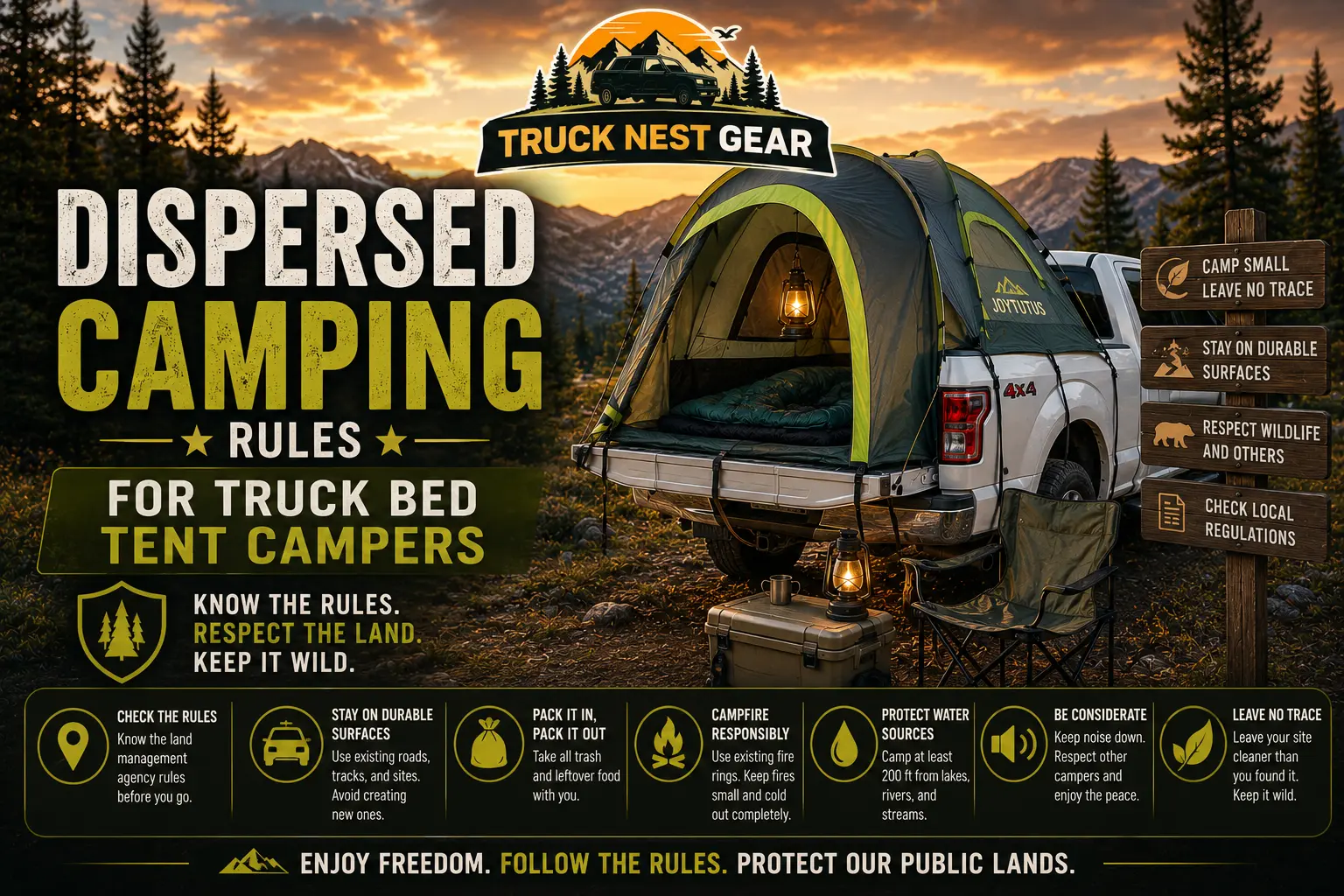
Federal agencies require campers to stay at least 200 feet from lakes, rivers, and streams to protect water quality.
The 200-foot setback from water sources applies on both BLM and National Forest land and is one of the most consistently enforced dispersed camping regulations. It applies to camping, fire building, and human waste disposal equally. On some land units, particularly in areas with sensitive riparian habitat or heavy recreational use, the setback requirement is greater than 200 feet and posted at access points.
For truck bed tent campers: a pickup truck parked at the edge of a creek or river bank occupies a significantly larger and heavier footprint than a backpacker’s tent. Vehicle weight on riparian soil causes compaction that affects water infiltration and bank stability.
The 200-foot rule is the minimum; choosing a campsite farther from water when terrain allows is both better practice and reduces the visual impact on water access points that other users want to experience without a parked truck.
Setback requirements also apply to trails in most land units. Camping within sight or sound of a trail is not prohibited in most dispersed areas, but parking a truck adjacent to a hiking trail creates a significantly different experience for trail users than a small tent visible at a distance. The general principle of camping out of sightline and earshot of trails applies even where no specific setback is codified.
Fire Restrictions
Fire regulations on dispersed camping land are the most variable and time-sensitive rules in this guide. They change based on drought conditions, fire danger ratings, wind forecasts, and active fire situations, sometimes overnight.
The baseline rules on BLM and National Forest land when no specific restriction is in effect: fires are permitted in established fire rings where they exist, or in a fire pan or mound fire construction on undisturbed surfaces where established rings do not exist.
In California, a free campfire permit is required year-round for dispersed camping; the permit is obtained online through the CalFire website and takes a few minutes. Some other states have similar permit requirements during specific periods.
When fire restrictions are active, Level 1, Level 2, or total fire bans, the restrictions override the baseline rules entirely. A Level 1 restriction typically prohibits campfires outside of established fire rings. A Level 2 restriction typically prohibits all open flame, including charcoal fires and in some jurisdictions, propane stoves without a spark-arresting device. A total fire ban prohibits all ignition sources.
The most reliable way to check current fire restriction status before departure:
The specific land management unit’s website, the BLM field office, or National Forest ranger district managing the area you plan to camp on, posts current restriction status and updates it when conditions change. The AirQuality.gov website aggregates fire restriction information across western states. Campfire.org provides a map-based fire restriction status tool updated by agency data.
The legal reality: fire restrictions apply whether or not a physical sign is posted at your dispersed campsite. Most dispersed sites have no posted signs. The absence of a sign does not create a legal exception. Checking restriction status is your responsibility, and the fine for a campfire under active restrictions is significant.
Waste Disposal Requirements
Dispersed camping sites have no trash service, no toilet facilities in most cases, and no gray water disposal infrastructure. The requirements for waste management are identical to what Leave No Trace principles recommend, because those principles were developed in collaboration with federal land management agencies.
All trash must be packed out. There is no dispersed camping land where leaving trash is permitted. A pickup truck’s cargo capacity makes full pack-out straightforward; there is no weight or volume reason that a truck tent camper cannot carry out everything they brought in.
Human waste must be deposited in catholes dug 6 to 8 inches deep, at least 200 feet from water, trails, and camp. Toilet paper and hygiene products must be packed out in most dispersed camping areas, particularly in arid environments where decomposition is slow.
Some BLM field offices specify pack-out requirements for solid human waste as well, particularly in highly impacted desert areas; the Moab area of Utah and the Alabama Hills in California have both implemented pack-out requirements due to sanitation impacts from high camping volume.
Gray water, cooking water, dishwater, and any water with food particles or soap must be dispersed at least 200 feet from water sources, strained of food particles before dispersal, and never dumped in concentrated quantities near the campsite.
This rule is frequently ignored at vehicle camps because the volume of gray water from a full cooking operation is larger than what a backpacker generates, and the temptation to dump it on the ground near the truck is high. It is still a violation regardless of convenience.
Permit Requirements
Most dispersed camping on BLM and National Forest land does not require a permit or fee. This is one of the defining advantages of the public land system. However, exceptions exist and are becoming more common as land managers respond to increased recreational pressure.
Some specific land units require a permit for dispersed camping, particularly in high-demand areas. The Mount Whitney Zone in the Inyo National Forest requires a permit for overnight camping. The Enchantments area in the Okanogan-Wenatchee National Forest requires a permit. Several popular BLM areas in the Southwest have implemented permit systems for specific zones.
The BLM operates a handful of Long-Term Visitor Areas, mostly in the desert Southwest, where extended stays are permitted for a fee. A seasonal permit covering September 15 through April 15 costs $180, or you can buy a 14-day short-visit permit for $40. These are the exception to the standard 14-day rule and exist specifically to accommodate snowbirds and long-term travelers.
The practical check before any dispersed camping trip: search the specific land unit’s Recreation.gov page and the land management agency’s website for your destination area to determine whether a permit is required. This is a five-minute search that prevents arriving at a permit-required area without one.
Knowing Which Rules Apply to Your Specific Location
The single most important practical step in dispersed camping compliance is not memorizing the default rules; it is checking the specific rules for the specific field office or ranger district managing the land you plan to camp on.
BLM field offices and National Forest ranger districts have the authority to implement supplemental rules that are more restrictive than the federal baseline. These supplemental rules cover stay limits, camping setbacks, fire restrictions, vehicle access, camping zones, and in some areas, the specific roads on which camping is permitted. They are published as Special Recreation Management Area orders, temporary closure orders, or supplemental rules on the field office or ranger district website.
The BLM field office finder at blm.gov allows you to identify the field office managing any specific area. The USFS ranger district finder at fs.usda.gov serves the same function for National Forest land. Both sites publish current orders and restrictions for each unit.
This is the research step that separates compliant dispersed camping from unknowingly violating rules that are specific to a location. The default 14-day rule, the 200-foot water setback, and the vehicle-on-roads requirement are reliable baselines. Everything else requires unit-specific verification.
The Truck Bed Tent Advantage in Dispersed Camping
It is worth stating explicitly what the truck bed tent format offers in the dispersed camping context, because it is directly relevant to compliance and impact.
The truck is the shelter, and the shelter moves when the truck moves. Compliance with stay limits requires nothing more than driving. Unlike RVs, truck campers, or any semi-permanent camping setup, there is no logistical barrier to relocating when the stay limit is reached.
The impact of a truck bed tent on a dispersed site is also structurally lower than a ground tent setup that requires site preparation; the sleeping footprint is the vehicle footprint, with no cleared ground, no staked perimeter, and no alteration to the campsite surface.
These advantages are meaningful on land that is increasingly pressured by the growth of dispersed camping as a recreational activity. Using them responsibly, moving when the limit is reached, staying on existing roads, and leaving sites as they were found is what keeps dispersed land open and accessible for everyone who values it.