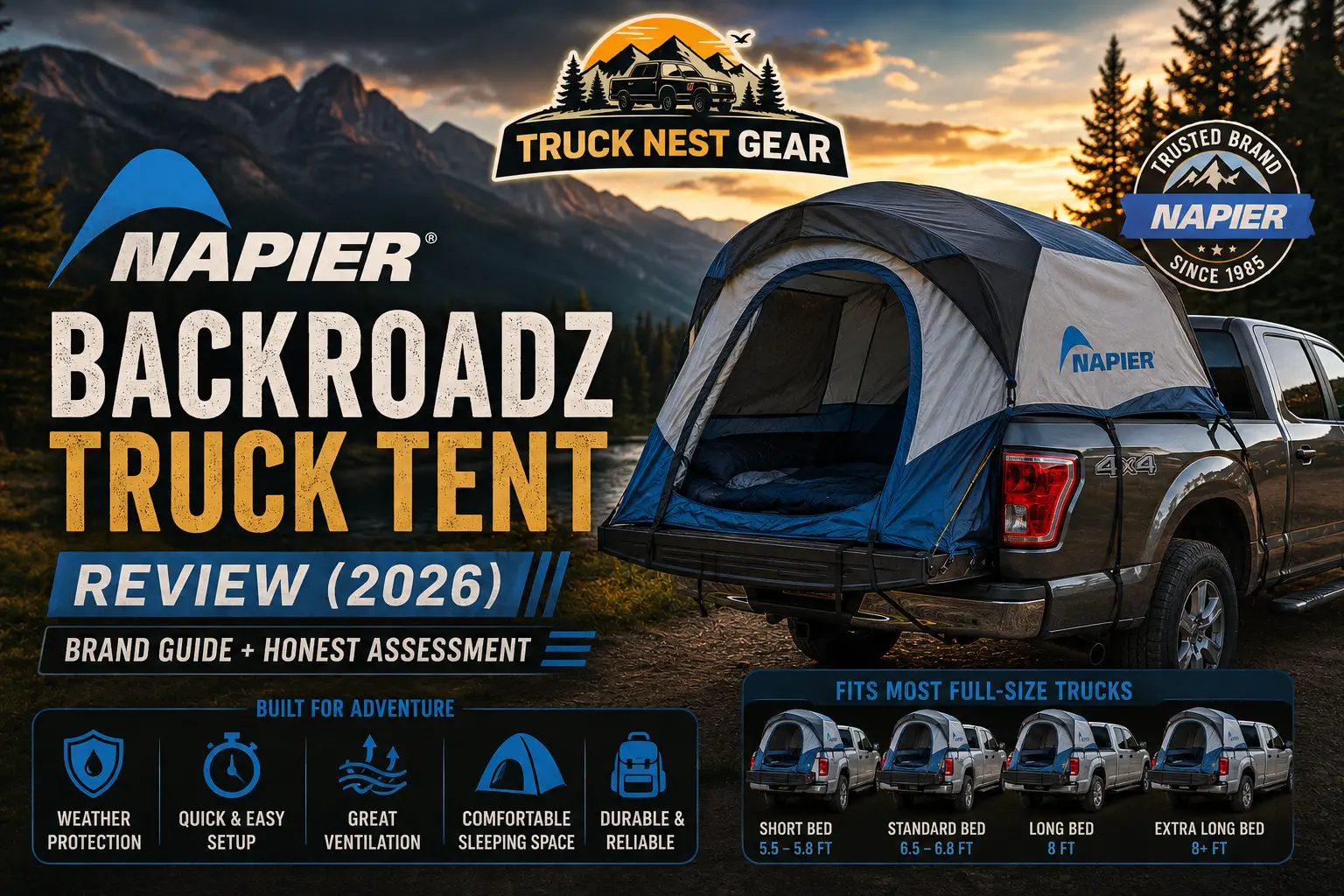
Napier Backroadz Truck Tent Review (2026): Brand Guide + Honest Assessment
Napier is the name most truck campers hear first, and for good reason: the company designed the first truck bed tent back in 1990 and has spent more than three decades refining the category since. The Backroadz Truck Tent is Napier’s core, highest-volume model, currently sitting at 4.6 stars across 5,546 ratings and an Amazon “Overall Pick” badge with more than 100 units sold in the past month alone.
This guide covers where Backroadz fits inside Napier’s broader lineup, then goes deep on the tent itself using Napier’s own technical documentation and a wide sample of verified owner experience.
About Napier
Napier’s own account of its history centers on a straightforward claim: it built the first truck tent in 1990 and has been refining the concept for over 35 years since. That tenure shows up in some unusually mature brand infrastructure for an outdoor gear company. Napier partners directly with automotive manufacturers’ engineering teams to verify tent compatibility with new truck models before they reach the market, and select tents are sold as Genuine Accessories through dealerships alongside the vehicles themselves.
That’s a meaningfully different trust signal than a typical Amazon-only gear brand, since it means real automotive engineers have signed off on fitment for at least some models.
The company also backs its products with a defined 1-year warranty on tents (30 days on accessories, 60 days on poles for its Second Life refurbished line), a documented warranty claims process, and a real physical returns infrastructure with separate U.S. and Canada processing addresses.
On the sustainability side, Napier plants a tree for every Backroadz tent sold, has cut packaging cardboard by 40%, and holds partnerships with Leave No Trace and Tread Lightly. None of that changes how a tent performs in the rain, but it’s the kind of operational depth that’s rare at this price point and worth knowing before you buy.
The Napier Lineup: Sportz, Backroadz, and Napier Custom
Napier organizes its truck and SUV tents into three tiers, and understanding the difference matters because the most commonly confused spec in this category is waterproof rating.
- Sportz
Napier’s premium line carries a 2,000mm PU waterproof coating on a polyester Oxford floor, along with extras the Backroadz line skips entirely, an additional rear-cab access window, built-in ceiling vents, and the option to add a 4-foot freestanding awning.
- Backroadz
This model, covered in depth in this guide, is Napier’s core, higher-volume line. It carries a 1,500mm PU waterproof coating and a polyethylene floor rather than Oxford fabric, and it deliberately skips the rear-cab window and ceiling vents that Sportz includes. This isn’t a lesser product so much as a leaner one: Napier’s own materials describe Backroadz as delivering the brand’s core innovation “minus a few of the fancier features.”
- Napier Custom
Covers co-branded tents designed for specific vehicles in partnership with individual automakers, sold as factory accessories rather than general aftermarket gear.
The distinction matters for anyone comparison-shopping within Napier’s own catalog, and it also explains why waterproofing numbers you’ll see quoted for “a Napier truck tent” vary depending on which line you’re actually looking at. 1,500mm and 2,000mm are both correct, just for different products.
Who the Backroadz Truck Tent Is For
The Backroadz Truck Tent is built for a truck owner who wants an established, widely-proven truck bed tent without paying Sportz-tier premium pricing, and who’s willing to spend real time on setup practice before a trip matters.
It’s a strong fit if you own a full-size or mid-size pickup, F-150, GMC, Tundra, Titan, Colorado, Canyon, Gladiator, and similar platforms all show up repeatedly in verified owner fitment reports, and you camp often enough that Napier’s three-decade track record and warranty backing are worth more to you than saving on a budget alternative.
It’s a weaker fit if you need a tent you can pitch solo in under ten minutes on the first try, since nearly every detailed owner account describes a genuinely awkward first setup regardless of experience level.
What You Actually Get
The waterproofing spec on this model is 1,500mm PU coating over a polyethylene floor, paired with a full rainfly, reinforced taped seams, and storm flaps over the windows, door, and vents. Napier’s own FAQ is candid that some water passing through seam needle holes is normal for any tent and isn’t a defect, a straightforward admission that matches what most owners actually report, which is strong rain performance rather than a flawless one.
Multiple reviewers describe staying dry through multi-night rain events, including one account of three straight nights of rain leaving the interior only slightly damp, not wet, and another describing the tent surviving sleet and snow without leaking at all.
The pole system uses two fiberglass poles with a color-coded clip attachment mechanism, which Napier markets as its signature setup shortcut. In practice, owner reports on real setup time vary enormously; some get it down to 5 minutes after repeated use, while first-time setups documented in detail range from 15 minutes up to a full 40 minutes, occasionally longer with two people working together.
The gap between marketed 10-minute setup and real first-attempt setup is consistent enough across independent reviews that it’s worth planning a practice run in your driveway before a real trip, not assuming the marketed time applies on day one.
Interior dimensions run 66 inches long by 50 inches wide with a maximum height of 62 inches, and multiple taller owners (6’4″ specifically) report being able to kneel and extend their arms fully without touching the ceiling, though full standing height depends on the specific size ordered. The tent ships with 9 adjustable straps for securing to the truck bed, plus a gear loft included in the base package for extra interior storage, a genuine convenience feature some competitors charge extra for or skip entirely.
Weight comes in at 16 pounds, and while Napier markets solo setup as achievable, the consistent owner recommendation is to assemble the tent on the ground first, then lift it into the bed. Attempting full assembly inside the truck bed alone is the single most commonly cited early frustration.
Seam construction uses taped seams on the rainfly, which Napier’s own documentation says makes seam sealer optional rather than necessary, though the brand does recommend applying a separate waterproofing spray every 12 to 24 months to maintain performance as the factory coating wears down with age and exposure.
What Owners Actually Report
Verified fitment reports across the review sample are broad and consistently positive: a 2024 F-150, a 2020 GMC short bed crew cab, a 2005 Nissan Titan, a Jeep Gladiator, a Chevy Colorado, a GMC Canyon, a Ford Maverick, and a Ford F-150 extended cab with a 6.5-foot bed are all confirmed working fits by independent owners, spanning the compact, regular, and full-size bed categories Napier sells.
Tonneau cover compatibility is, as with most tents in this category, dependent on cover type. Napier’s own FAQ states that retractable covers are compatible as-is, folding and hinged covers must be removed, and roll-up covers work as long as they’re under 6 inches high, with the caveat that a small gap between the tent and a rolled-up cover can let rain seep in at that seam.
Owner reports back this up directly: one owner running a roll-up tonneau with Velcro rails found the tent fit right over the rolled cover with no modification needed, while another running a BAK Revolver hard cover found the fit tight around the cover’s rails but workable with adjustment. A third owner with a different roll-up cover said the cover actually made the setup feel more secure once rolled up underneath.
The most significant recurring durability complaint is the elastic shock cord inside the poles. Two independent long-term owners report the cord snapping, one after extended use on a multi-week road trip, another after only a handful of uses during trip preparation, and both note the cord is thinner than what’s used in comparable poles from other brands they own.
Since the poles are held together end-to-end by this internal elastic, a snapped cord is a real trip-planning risk worth preparing for with spare cord or an early inspection, even though Napier’s warranty does cover broken poles under normal use within the first year.
The other consistent complaint is the door zipper design. One detailed reviewer noted the zipper track requires the door flap to be fully open for a comfortable entry or exit, and when fully open, the flap falls to the exterior, where it can pick up dirt or mud depending on the campsite surface. A separate reviewer also flagged that the securing straps could use more protective coating where they contact the truck’s paint, echoing a complaint that shows up across this entire tent category, not just this one brand.
On the positive side, wind and cold-weather performance draw consistently strong praise; owners report the tent holding steady through 30-40 mph gusts in near-freezing temperatures with light snow, and another describes no issues in comparable high-wind conditions. Ventilation also draws repeat praise, with owners specifically noting the ceiling vent and dual window design keep airflow strong even with the rainfly attached.
The Honest Limitations
First-time setup difficulty is the most consistent limitation across the entire review sample, regardless of the reviewer’s stated camping experience. The 10-minute marketed setup time is achievable, but only after you’ve assembled the tent at least once or twice already. Plan your first attempt for a driveway, not a campsite.
The elastic shock cord inside the poles is a real, if not universal, failure point. It doesn’t show up in every long-term review, but when it does appear, it appears independently across unrelated owners, which suggests it’s a genuine design weak spot rather than an isolated defect.
The door zipper and flap design creates a minor but real annoyance around keeping the tent interior clean, particularly on muddy or dusty campsites, since full entry requires the flap to swing outward and rest on the ground.
Strap protection at the point of contact with your truck’s paint is thinner than some owners would like, and this is worth monitoring over repeated use rather than assuming factory padding is sufficient protection long-term.
Finally, the 1,500mm waterproofing on this specific model, as opposed to the 2,000mm rating on Napier’s Sportz line, means Backroadz is built for reliable performance in typical three-season conditions, not treated as a guarantee against sustained, heavy, or wind-driven rain. Napier itself declines to publish official wind or UV ratings for exactly this reason, recommending campers take the tent down in genuinely severe weather rather than trust it to hold in conditions beyond typical camping use.
Tonneau Covers, Toolboxes, and Other Fitment Questions
Beyond the tonneau cover guidance above, Napier’s own documentation confirms the tent can be set up over a bed toolbox, with the recommendation to cover the toolbox’s corners to prevent them from tearing the tent floor from the inside. You’ll lose the interior space the toolbox occupies, but the fit itself isn’t an issue.
For truck owners with a bed cap, Napier confirms compatibility with specific model numbers as long as the cap height doesn’t exceed 80 inches, so it’s worth checking your cap’s exact height against your chosen tent model before ordering rather than assuming general compatibility.
Which Trucks Does It Fit
Based on verified owner reports, the Backroadz Truck Tent fits comfortably across full-size platforms including the Ford F-150 (both standard and extended cab configurations), GMC Sierra, and Nissan Titan, as well as mid-size platforms including the Chevy Colorado, GMC Canyon, Jeep Gladiator, and Ford Maverick.
Napier sells this tent in five distinct bed-length sizes, from Compact Short Bed (5 to 5.2 feet) through Full Size Long Bed (8 to 8.2 feet), so measuring your exact bed length before ordering matters more than trusting a “full-size” or “compact” label alone, particularly given how many owners in this review sample needed to make minor adjustments to get a clean fit on their specific cab and bed combination.
Final Verdict
Napier’s Backroadz Truck Tent earns its position as one of the most trusted names in truck bed camping through three decades of iteration, genuine automotive-engineering partnerships, and a warranty program that actually holds up broken poles as a covered failure rather than an exclusion.
Buy it if you camp regularly enough that a proven, warrantied tent is worth the mid-range price, and if you’re willing to treat the first setup as a practice run rather than expecting the marketed 10-minute time on day one. Skip it if you’re only testing truck camping once or twice and don’t want to spend Backroadz money to find out if you like it, or if you specifically need Sportz-tier waterproofing for regular exposure to heavy, sustained rain.
For nearly everyone in between, Backroadz is a genuinely dependable choice, and understanding how to set a truck bed tent up correctly before your first trip will save you most of the frustration first-time owners report.
This article contains affiliate links. As an Amazon Associate, TruckNestGear.com earns from qualifying purchases at no additional cost to you.