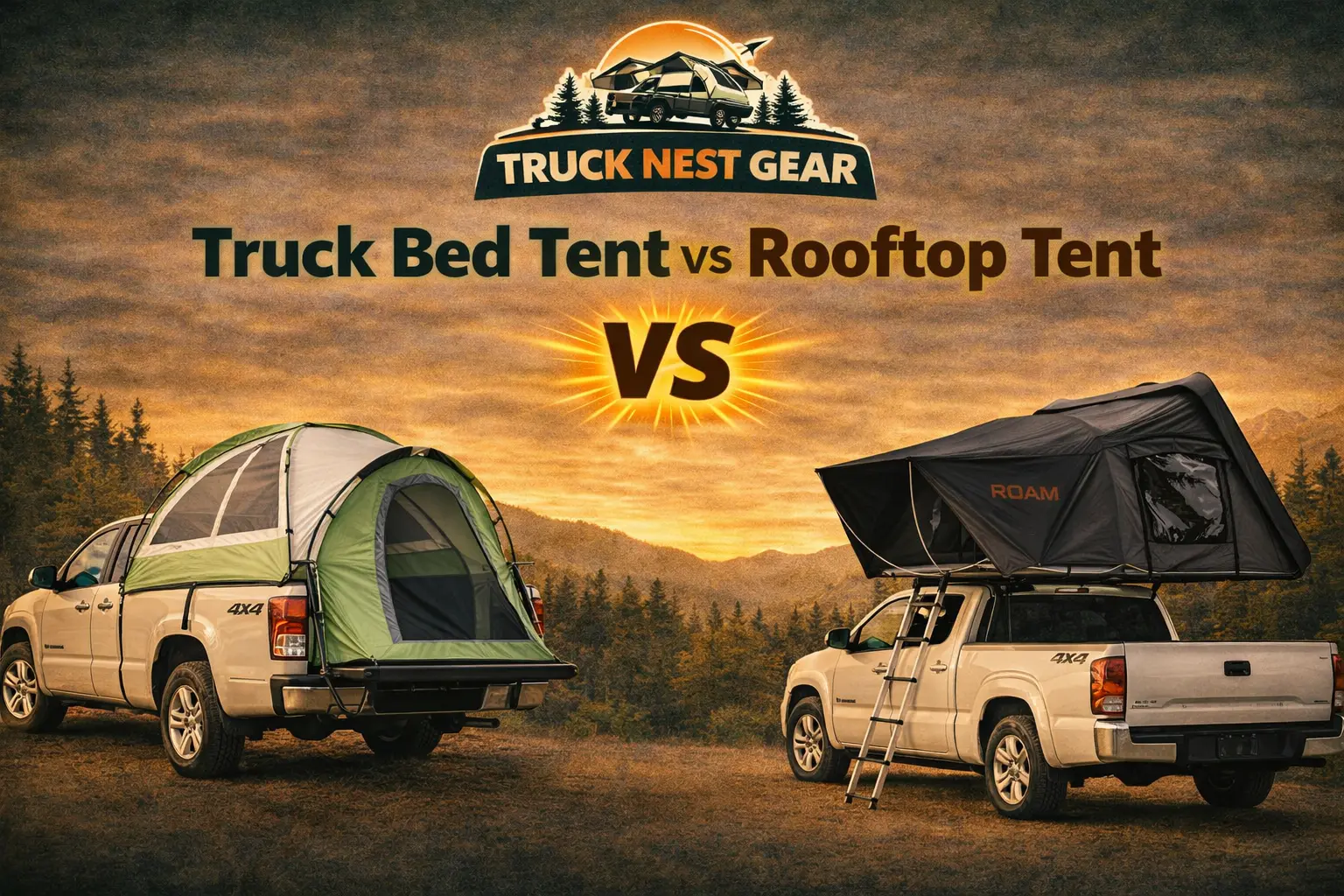
Truck Bed Tent vs. Rooftop Tent: Which Is Worth Your Money in 2026?
Two years ago, rooftop tents were everywhere. Every overlanding Instagram account, every off-road YouTube channel, every outdoor gear publication was talking about them like they were the only serious option for truck campers who wanted to sleep elevated and camp properly.
Then something interesting happened.
Experienced truck campers started doing the math. They compared real setup times, real price tags, real weight penalties, and real compatibility headaches, and a significant number of them arrived at the same conclusion: a truck bed tent delivers most of the same benefits at a fraction of the cost and complexity.
That does not mean rooftop tents are overrated. It means the right choice depends entirely on how you camp, where you camp, and what you actually value from an elevated sleeping setup. This guide breaks down both options with complete honesty, no brand bias, no affiliate-driven conclusions, so you can make a genuinely informed decision before spending anywhere from $200 to several thousand dollars.
What Exactly Are We Comparing?
Truck Bed Tent
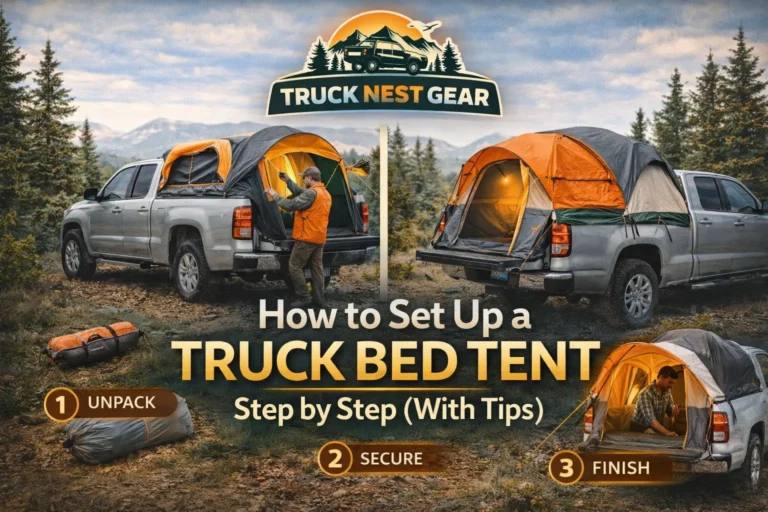
A truck bed tent is a fabric shelter that mounts inside the bed of a pickup truck, using the truck bed as its floor and foundation. It attaches via bed rail straps or clamps, uses a pole system for structure, and deploys at bed height, typically 24 to 36 inches off the ground. Truck bed tents are removed and stored between camping trips, leaving your truck bed fully functional for hauling and everyday use.
Rooftop Tent
A rooftop tent is a hard or soft shell shelter that mounts to a roof rack system on top of your vehicle. It deploys by unfolding or popping up from the roof, placing your sleeping surface 6 to 9 feet off the ground, depending on your vehicle height and rack system. Rooftop tents remain mounted between trips in most cases, which has significant implications for fuel economy, vehicle clearance, and everyday driving that most buyers underestimate before purchasing.
The Head-to-Head Comparison
Price — The Gap Is Enormous
This is the most immediately striking difference, and it is not a small gap.
Truck bed tents start at around $100 for entry-level models. Mid-range options with quality materials and full rainflies sit between $200 and $350. Premium canvas construction tops out around $400 to $500. Zero additional hardware required.
Rooftop tents start at approximately $800 to $1,000 for entry-level soft shell models, before factoring in the roof rack required to mount them, which adds another $300 to $800 depending on your vehicle and rack system. Mid-range rooftop tents sit between $1,500 and $2,500. Hard shell models from established brands regularly exceed $3,000 to $4,500.
The real total cost of a rooftop tent setup looks like this:
| Component | Estimated Cost |
|---|---|
| Entry-level soft shell RTT | $800 – $1,200 |
| Roof rack system | $300 – $800 |
| Total Entry Cost | $1,100 – $2,000 |
Compare that to a quality truck bed tent at $200 to $350 with no additional hardware, and the price difference becomes genuinely difficult to rationalize for the average weekend camper.
Verdict: Truck bed tent. The price advantage is overwhelming at every comparable tier.
Setup and Deployment Time
Both products market themselves as fast-deploying. The reality is more nuanced.
A standard pole-style truck bed tent takes 10 to 20 minutes for an experienced user. Hub-style and automatic-mechanism designs deploy in 3 to 7 minutes once you’re familiar with the system. Setup involves attaching bed rail straps, threading or clipping poles, securing the tailgate sleeve, and attaching the rainfly, steps that become genuinely fast with repetition. Most owners report that their second and third setups take half the time of their first.
Soft shell rooftop tents unfold and prop open in 2 to 5 minutes once the ladder is deployed, and this is where rooftop tents genuinely shine. Hard shell models are even faster; some open in under 60 seconds with a single gas-assisted lift. For single-deployment speed, the RTT wins clearly.
The comparison shifts when you factor in the full seasonal picture. Removing and remounting a rooftop tent, which typically weighs 100 to 180 pounds, is a two-person job that takes considerably longer than any truck bed tent setup. For campers who remove their RTT between trips, that process compounds across a season of use.
Verdict: Draw. RTTs win on single-deployment speed. Truck bed tents win on the full mounting and dismounting process over a season.
Weight and Vehicle Impact
Weight is where rooftop tents create consequences that extend well beyond the campsite.
Most truck bed tents weigh between 8 and 20 pounds. Stored in the truck bed below the vehicle’s center of gravity, they create zero impact on handling, fuel economy, or vehicle dynamics.
Rooftop tents weigh between 100 and 180 pounds for soft shell models and up to 280 pounds for hard shell designs. This weight sits on top of your vehicle, above the center of gravity, with three real-world consequences:
Fuel economy. The aerodynamic drag created by a rooftop tent mounted on a roof rack reduces fuel economy by an estimated 10 to 25 percent, depending on vehicle speed, tent profile, and rack design. For a truck averaging 20 mpg on the highway, that means a real-world reduction to roughly 15 to 18 mpg, a cost that compounds over every mile driven with the tent mounted, whether you’re camping or commuting.
Handling and stability. 150-plus pounds of tent and rack sitting above your vehicle’s center of gravity raises the rollover threshold, a meaningful consideration when driving on the uneven terrain that overlanders specifically seek out.
Parking clearance. A rooftop tent adds 8 to 14 inches to your vehicle’s height profile. This eliminates access to parking garages, drive-throughs, low-clearance bridges, and certain campsite entry gates, restrictions that affect everyday driving far more than most buyers anticipate before purchasing.
Verdict: Truck bed tent. The weight and vehicle impact of a rooftop tent create ongoing real-world costs and limitations that a truck bed tent never imposes.
Weather Protection and Comfort
This is where the comparison becomes most genuinely competitive, because both categories have improved significantly in recent years.
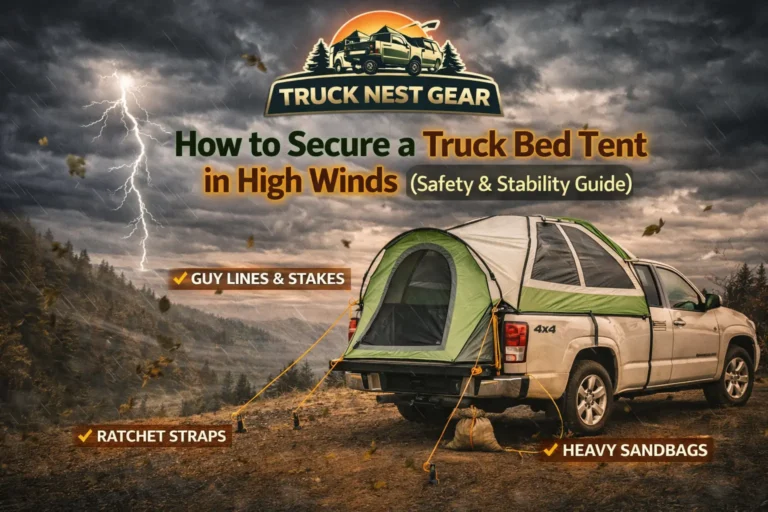
A quality truck bed tent with a full rainfly, taped seams, and a hydrostatic head rating of 2,000mm or above provides excellent protection in heavy rain and moderate wind. The truck bed itself provides a completely windproof floor and solid sidewall protection at ground level. The primary weather vulnerability is wind-driven rain reaching the lower tent walls and the tailgate sleeve junction, both manageable with proper setup technique and standard seam maintenance applied at the start of each camping season.
The elevation of a rooftop tent exposes it to significantly more wind than a truck bed tent, both in terms of wind speed at height and wind exposure on all four sides simultaneously. Quality rooftop tents address this with heavier fabric, stronger pole systems, and more robust attachment hardware, all of which contribute to their higher weight and price.
Hard shell rooftop tents with aluminum or ABS plastic shells offer genuinely exceptional weatherproofing that fabric truck bed tents cannot match in sustained extreme conditions. Soft shell RTTs are more comparable to premium truck bed tents in rain performance.
Sleeping elevated, away from ground, cold, insects, and moisture, is a genuine comfort advantage of rooftop tents. A truck bed tent at 24 to 36 inches of elevation provides most of the same ground-separation benefits at a fraction of the cost, though not at the same elevation or with the same panoramic experience.
Verdict: Hard shell RTT for extreme weather. Draw for three-season campground and trail camping.
Installation and Compatibility
Truck bed tents require zero permanent modification. Bed rail straps or clamps attach and detach in minutes, leave no marks, and require no drilling. Compatible with virtually any standard pickup truck with a matching bed size.
Rooftop tents require a roof rack system rated to carry both the static weight of the tent and the dynamic weight of occupants moving inside it overnight. Not all vehicles have factory roof rail systems capable of supporting this load. Certain RTT models are only compatible with specific rack brands or crossbar widths, a compatibility matrix that requires careful research before purchasing. For truck owners specifically, bed-mounted RTT systems offer a middle-ground solution but introduce their own compatibility and clearance considerations.
Verdict: Truck bed tent. Zero installation complexity, zero permanent modification, universal pickup truck compatibility.
The Overlanding and Lifestyle Factor
Most comparison guides avoid saying this directly: rooftop tents have a significant lifestyle and aesthetic appeal that truck bed tents simply do not replicate, and that appeal is real and legitimate.
Arriving at a remote campsite, deploying a rooftop tent, and sleeping 7 feet off the ground with a panoramic view has a genuine appeal that goes beyond pure practicality. The overlanding community has built a significant cultural identity around rooftop tents, and for people who share that identity, the premium is partly a membership in something larger than just a sleeping system.
For serious overlanders who camp in genuinely remote locations, crossing rivers, navigating rocky terrain, needing maximum ground clearance with a shelter that deploys in under two minutes, a rooftop tent earns its price and weight penalty through functional excellence in those specific conditions.
For weekend campers, campground users, and truck owners who want an elevated sleeping solution without a four-figure investment and permanent vehicle modification, a truck bed tent delivers exceptional value that the overlanding lifestyle marketing often obscures.
Verdict: RTT for serious overlanding. Truck bed tent for value-focused truck camping.
Resale Value and Long-Term Investment
Truck bed tents hold modest resale value, typically 30 to 50 percent of the original purchase price after one or two seasons. The low initial investment keeps the total cost of ownership very reasonable, even accounting for depreciation.
Quality rooftop tents, particularly hard shell models from established brands, hold surprisingly strong resale value, often 50 to 70 percent of original purchase price after several years of use. The high initial investment and strong secondary market both contribute to this retention.
Verdict: RTT on resale percentage. Truck bed tent on total cost of ownership.
Side-by-Side Summary
| Factor | Truck Bed Tent | Rooftop Tent |
|---|---|---|
| Entry Price | $100 – $500 | $1,100 – $4,500+ (with rack) |
| Setup Time | 5 – 20 minutes | 1 – 5 minutes (deployment only) |
| Weight | 8 – 20 lbs | 100 – 280 lbs |
| Fuel Economy Impact | Zero | 10 – 25% reduction |
| Vehicle Modification | None required | Roof rack required |
| Height Added to Vehicle | None | 8 – 14 inches |
| Weather Protection | Very good | Excellent (hard shell) |
| Elevation Off Ground | 24 – 36 inches | 72 – 108 inches |
| Parking Restrictions | None | Low-clearance limitations |
| Resale Value | Moderate | Strong |
| Best For | Value truck camping | Serious overlanding |
Who Should Choose a Truck Bed Tent?
A truck bed tent is the stronger choice if you:
- Want elevated truck camping without a four-figure investment
- Drive your truck daily and can’t accept fuel economy or clearance penalties
- Camp on weekends at established campgrounds or dispersed public land sites
- Want a shelter that stores completely between trips
- Own a standard pickup without an existing roof rack system
- Camp solo or with one partner and prioritize simplicity over prestige
The range of truck bed tents available in 2026 spans from honest entry-level options under $100 to premium all-weather canvas designs at $500, and choosing correctly within that range depends on how often you camp, what weather you’ll face, and which truck you’re fitting. The full breakdown of every major truck bed tent currently worth buying, matched by budget tier, bed size, camping style, and weather performance, is in the complete guide to the best truck bed tents for 2026, which covers every configuration from short-bed Tacomas to long-box HD trucks.
Who Should Choose a Rooftop Tent?
A rooftop tent is the stronger choice if you:
- Are a serious overlander camping in genuinely remote, technically demanding terrain
- Already have a compatible roof rack system installed
- Prioritize the fastest possible single-deployment setup
- Camp frequently enough to justify the fuel economy cost across a full season
- Want a shelter with strong resale value as part of a broader overlanding vehicle build
- Value the community and lifestyle identity that rooftop tents represent
Can You Own Both?
More truck campers than you might expect own both, and for good reason. A truck bed tent handles the majority of weekend camping trips efficiently and affordably. A rooftop tent serves as the dedicated shelter for serious multi-day overlanding expeditions where maximum ground clearance and rapid deployment matter most.
If your camping life spans both casual weekend trips and genuine backcountry expeditions, the two shelter types complement each other more naturally than they compete. The truck bed tent goes in the garage between overlanding trips. The RTT stays mounted when the serious terrain is the destination.
The Bottom Line
In 2026, the truck bed tent versus rooftop tent debate is less about which product is objectively better and more about honest self-assessment: who you are as a camper, how often you go out, what terrain you tackle, and what your budget actually allows.
For the overwhelming majority of pickup truck owners who camp regularly but are not building a dedicated expedition vehicle, a quality truck bed tent delivers 90 percent of the rooftop tent experience at 20 percent of the cost. That math is very difficult to argue with.
For the serious overlander who lives out of their truck on extended backcountry trips, a rooftop tent is a legitimate long-term investment that earns its price through years of reliable service in conditions that justify the weight, the cost, and the permanence.
If you’re still deciding which truck camping setup suits you overall, not just the tent type but the full picture of what equipment works for what camping style, the complete breakdown of all four truck camping shelter categories, matched to specific buyer profiles, is worth reading before you commit to either direction.