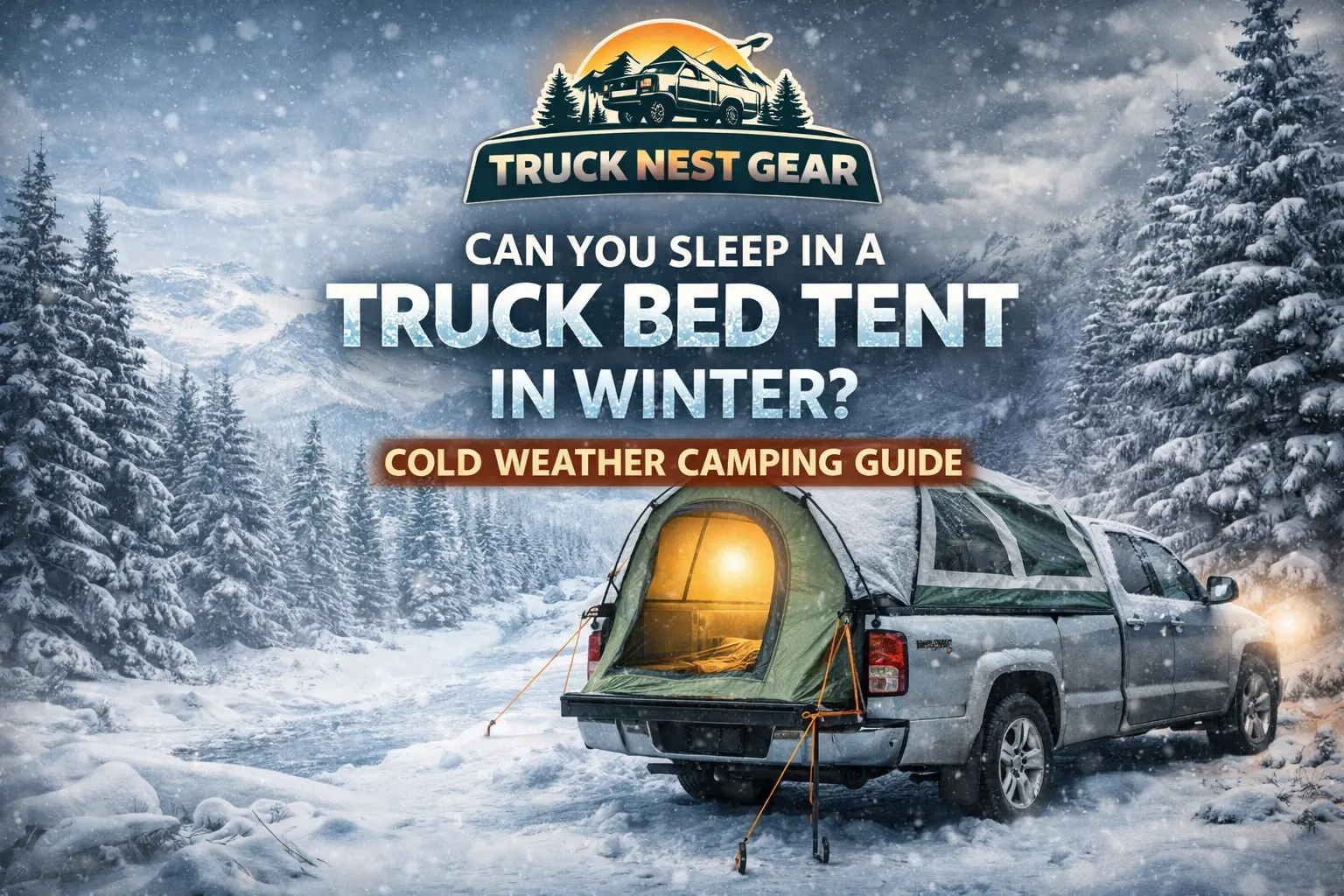
Can You Sleep in a Truck Bed Tent in Winter? (Cold Weather Camping Guide)
Most camping gear guides treat winter like a footnote. A brief disclaimer at the bottom of a product page that says something vague like “suitable for three-season use”, and leaves you to figure out on your own what that actually means when temperatures drop below freezing and snow is accumulating on your rainfly at midnight.
If you are reading this, you are asking a more specific and more serious question than most truck tent guides are willing to answer directly:
Can you actually sleep in a truck bed tent when it is genuinely cold outside, and do it safely and comfortably?
The answer is yes. But it comes with conditions, preparation requirements, and gear decisions that make winter truck tent camping fundamentally different from a warm-weather camping trip. Get those conditions right, and you will experience some of the most rewarding camping of your life, cold, quiet, remote, and entirely crowd-free. Get them wrong, and you are looking at a genuinely dangerous situation that no tent, regardless of price or quality, can protect you from on its own.
This guide covers everything honestly: the thermal realities of sleeping in a metal truck bed in winter, the gear you need, the setup techniques that retain heat, and the safety considerations that every cold-weather truck camper needs to understand before their first winter night out.
Before we go further, it is worth connecting this topic to the broader picture of truck tent durability and material performance in cold conditions. Understanding how long truck bed tents last and how cold weather specifically affects pole systems and fabric integrity gives important context for choosing a tent that is genuinely built for year-round use rather than one that will crack and fail when temperatures drop.
The Thermal Reality of a Truck Bed in Winter
To camp successfully in a truck bed tent during winter, you first need to understand the specific thermal environment you are sleeping in, because it is meaningfully different from sleeping in a ground tent or a rooftop tent in cold conditions.
The Metal Bed Problem
Your truck bed is made of steel or aluminum, both of which are excellent thermal conductors. This means that in cold weather, your truck bed actively draws heat away from anything resting on its surface, including your sleeping pad, your sleeping bag, and ultimately you.
This phenomenon is called conductive heat loss, and it is the primary thermal challenge of winter truck bed tent camping. Radiation and convection, the heat loss mechanisms that a quality sleeping bag addresses effectively, are secondary concerns compared to the cold metal surface directly beneath you.
A sleeping bag rated to 0°F placed directly on a bare metal truck bed in 20°F ambient temperature will not perform to its rated temperature. The conductive heat loss through the uninsulated floor overwhelms the bag’s insulating capacity from below.
The solution is not a warmer sleeping bag. The solution is insulating the floor, which we cover in detail in the gear section of this guide.
The Condensation Problem Multiplies in Winter
In warm weather, condensation inside a truck tent is a manageable nuisance. In winter, it becomes a more serious concern for two compounding reasons.
First, the temperature differential between the warm air inside the tent, heated by your body, and the cold tent walls and metal bed surface is dramatically larger in winter, causing moisture to condense faster and more heavily than in mild conditions.
Second, condensation that forms on your sleeping bag in winter does not simply make it damp; it progressively degrades the insulating loft of the fill material, particularly in down sleeping bags, where moisture causes the down clusters to clump and lose their thermal efficiency. A sleeping bag that loses loft from condensation exposure in a cold environment loses warmth at exactly the moment you need it most.
Managing winter condensation requires a more aggressive ventilation strategy than summer camping, a counterintuitive requirement that we explain fully in the setup section below.
Wind Chill at Truck Bed Height
A truck bed tent sits 24 to 36 inches off the ground, higher than a ground tent but lower than a rooftop tent. At this elevation, wind chill is a more significant factor than at ground level, particularly in open or exposed campsites.
Wind chill does not lower the temperature inside a well-sealed tent, but it dramatically accelerates heat loss through the tent walls, rainfly, and any gaps in the tailgate sleeve. A night at 25°F with 20mph wind creates a wind chill equivalent of approximately 11°F, and that effective temperature difference matters significantly for your sleeping system selection.
Campsite selection and truck orientation become active thermal management tools in winter camping, something we cover specifically in the setup section.
The Gear You Need for Winter Truck Bed Tent Camping
Winter truck bed tent camping requires a specific gear stack that addresses the unique thermal challenges of the environment. Each item in this list serves a distinct function; removing any one of them creates a vulnerability that the others cannot compensate for.
1. 🛏️ Sleeping System — Your Most Critical Investment
Sleeping Bag Temperature Rating: Your sleeping bag’s temperature rating is the foundation of your entire winter sleep system. The ISO and EN rating standards, the two internationally recognized testing protocols, provide reliable comparative data across brands.
For winter truck bed tent camping, follow this general guideline:
| Expected Low Temperature | Minimum Bag Rating |
| 32°F / 0°C | 20°F / -7°C rated bag |
| 20°F / -7°C | 0°F / -18°C rated bag |
| 10°F / -12°C | -20°F / -29°C rated bag |
| Below 0°F / -18°C | Expedition grade system required |
The buffer between expected temperature and bag rating is not conservative; it is the practical allowance for conductive heat loss through the truck bed floor, wind chill effects on the tent walls, and the natural variation in individual cold tolerance.
Down vs Synthetic Fill: This is a genuinely important decision for winter truck camping specifically.
Down fill offers superior warmth-to-weight ratio and compressibility, but it loses virtually all insulating capacity when wet. In a condensation-heavy truck tent winter environment, a down bag requires careful moisture management through a vapor barrier liner or a waterproof shell.
Synthetic fill retains approximately 80 percent of its insulating capacity when wet, a meaningful safety advantage in the condensation-rich winter truck tent environment. The trade-off is greater weight and bulk at equivalent warmth ratings.
For most winter truck campers who are not counting grams, a synthetic fill bag rated 20°F below your expected low temperature is the more practically reliable choice.
2. 🧊 Floor Insulation — Non-Negotiable in Winter
As established in the thermal reality section, floor insulation is not optional in winter truck bed camping; it is the single most impactful item in your entire cold-weather gear stack.
Option 1 — Closed Cell Foam Pad (Base Layer): A closed cell foam sleeping pad,, such as the Therm-a-Rest Z Lite or equivalent, placed directly on the truck bed metal surface as a base layer provides immediate, reliable conductive insulation. Closed cell foam cannot compress, cannot absorb moisture, and does not lose insulating capacity in any temperature. It is the most reliable floor insulation foundation available.
Option 2 — Insulated Air Pad (Comfort Layer): An insulated inflatable sleeping pad placed on top of the closed-cell foam base provides the sleeping comfort that foam alone cannot deliver. Look for an R-value, the insulation rating for sleeping pads, of R-4 or above for winter use, with R-6 or above for temperatures below 15°F.
The Two-Layer System: The most effective winter truck tent floor insulation combines both options, a closed-cell foam base layer topped with a high R-value insulated air pad. This two-layer system addresses conductive heat loss from the metal bed, provides comfortable sleeping surface cushioning, and adds a redundancy layer in case the inflatable pad develops a slow leak overnight.
Truck Bed Specific Option — Insulated Truck Bed Mat: Several manufacturers produce insulated truck bed mats specifically designed for the dimensions of standard truck beds. These mats combine a closed-cell foam core with a durable outer surface and fit precisely around wheel well humps, eliminating the gap areas where cold air infiltrates from below the tent floor fabric.
3. 🧥 Layered Sleeping Clothing System
What you wear to sleep in a winter truck tent matters as much as the sleeping bag around you. The layered clothing approach that works for cold-weather hiking applies directly to cold-weather sleeping.
Base Layer — Moisture Management: A merino wool or synthetic moisture-wicking base layer moves perspiration away from your skin, preventing the wet-cold cycle that causes rapid chilling. Avoid cotton entirely in winter sleeping situations; cotton absorbs and retains moisture against your skin, accelerating heat loss dramatically.
Mid Layer — Insulation: A lightweight down or synthetic insulated jacket and pants worn inside your sleeping bag add meaningful warmth without the bulk of a heavier bag. This mid-layer approach allows you to modulate your warmth system, removing the mid-layer if the night is warmer than expected, rather than being trapped in an oversized bag with no adjustment option.
Extremity Coverage: Heat loss from your head, hands, and feet in a cold sleeping environment is disproportionate to the surface area involved. A wool or fleece beanie, liner gloves, and wool or synthetic sleeping socks are non-negotiable additions to your winter truck tent sleep system. Many experienced winter campers also keep a chemical hand warmer packet in each sock on particularly cold nights.
4. ❄️ Four-Season or Winter-Rated Truck Tent
Not every truck bed tent is built for winter use, and attempting to winter camp in a three-season tent without the structural and thermal characteristics required for cold conditions creates real risks.
A truck tent suitable for genuine winter camping should have:
Aluminum Poles: As established in our truck bed tent durability guide, fiberglass poles become brittle and prone to shattering in freezing temperatures. Aluminum poles maintain their structural integrity across the full temperature range of winter camping; this is not a preference but a functional requirement for cold-weather use.
Snow Load Capacity: A quality winter-capable truck tent uses a steeper roofline geometry and stronger pole arcs to shed snow accumulation rather than allowing it to build up. Snow load on a flat or low-angle roofline creates structural stress that can collapse a three-season tent in a heavy snowfall.
Full Coverage Rainfly: A winter rainfly should extend to within a few inches of the truck bed rails on all sides, minimizing the exposed tent wall area that wind can drive snow and freezing rain against. Partial rainflies that leave significant tent wall area exposed are adequate for summer use but create dangerous cold spots in winter.
Sealed Seams Throughout: In freezing temperatures, water that penetrates an unsealed seam does not simply wet the interior; it can freeze and expand the seam opening, progressively worsening the leak with each freeze-thaw cycle through the night.
5. 🌡️ Heating Options — What Is Safe and What Is Not
This section requires complete directness, because heating decisions in an enclosed sleeping space carry genuine life-safety implications.
What Is Safe:
Electric Heating Blankets and Heated Sleeping Pads: Battery-powered or 12V vehicle-powered electric heating blankets and sleeping pad systems are the safest active heating option for truck tent winter camping. They produce zero combustion byproducts, create no carbon monoxide risk, and can be regulated precisely.
Chemical Hand and Foot Warmers: Air-activated chemical warmers placed inside your sleeping bag at the feet, against your core, or in your gloves provide localized heat with zero safety concerns. They are inexpensive, reliable, and genuinely effective at maintaining extremity warmth through the night.
Hot Water Bottle: A durable stainless steel water bottle filled with hot water and placed inside your sleeping bag near your core retains heat for three to five hours and raises bag’s interior temperature meaningfully. This is one of the oldest and most reliable cold-weather camping warmth strategies available.
What Is Dangerous:
Propane Heaters Inside the Tent: This requires no ambiguity; propane heaters should never be operated inside a closed truck bed tent. Even heaters marketed as “indoor safe” produce carbon monoxide in quantities that can reach dangerous concentrations in the enclosed space of a truck tent faster than most users realize. Carbon monoxide is odorless and colorless, and causes loss of consciousness before the victim recognizes the symptoms. It is fatal.
If you choose to use a propane heater in cold conditions, operate it outside the tent to pre-warm the interior before climbing in, then extinguish it completely and ventilate the space before closing the tent for sleep. Never operate it while sleeping.
Winter Setup Techniques That Retain Heat
The way you set up your truck tent in winter has a direct and significant impact on how warm you sleep. These techniques require no additional gear, only deliberate decision-making before and during setup.
Campsite Selection for Wind Protection
In winter, campsite selection is a thermal management decision as much as an aesthetic one. Position your truck with the cab facing the prevailing wind direction, placing the solid cab wall as your primary windbreak and keeping the more exposed tailgate side in the wind shadow.
Park adjacent to natural windbreaks where terrain allows; a stand of dense conifers on the windward side of your truck dramatically reduces the wind chill effect on the tent walls. Even a slight depression in the terrain that drops your truck below the wind line reduces effective wind chill meaningfully.
Avoid low-lying areas, valley bottoms, and depressions in open terrain. Cold air is denser than warm air and drains downhill, pooling in low areas and creating overnight temperatures several degrees colder than the surrounding terrain.
Insulate the Tailgate Gap
The tailgate sleeve junction, identified in our truck bed tent waterproofing guide as the primary leak point in rain, is equally the primary cold air infiltration point in winter. Even a well-fitted tailgate sleeve allows more cold air movement than is acceptable in freezing temperatures.
Supplement the tailgate sleeve seal with a reflective foam windshield sunshade, available at any auto parts store, cut to fit the inside face of your tailgate. This simple addition blocks the cold air convection that flows between the tailgate sleeve and the tailgate surface and adds a meaningful layer of radiant insulation to the rear entry point.
The Counterintuitive Ventilation Strategy
Here is the winter truck camping insight that surprises most first-time cold-weather campers: you need more ventilation in winter, not less.
The instinct is to seal the tent completely in cold weather, close every window, zip every vent, and eliminate every gap. But a completely sealed truck tent in winter creates the condensation conditions that wet your sleeping bag and progressively destroy its warmth throughout the night.
The correct approach is to maintain minimal but deliberate ventilation, opening a small mesh window on the lee side of the tent (away from the wind) by two to three inches. This small opening is sufficient to allow moisture vapor to escape without creating meaningful cold air drafts across your sleeping surface.
The test is simple: if you wake up to heavy condensation on the inner tent walls, increase ventilation. If you wake up cold with dry inner walls, reduce ventilation slightly. Two or three winter camping nights will calibrate your ideal balance for your specific tent and sleeping system combination.
Pre-Warm Your Sleeping Bag
Never climb into a cold sleeping bag and expect your body heat alone to warm it to comfort quickly. In genuinely cold temperatures, warming a cold bag from body heat alone takes 20 to 40 minutes of shivering, during which your core temperature is dropping rather than stabilizing.
Pre-warm your sleeping bag before climbing in using one of these methods:
- Place a hot water bottle inside the bag 20 to 30 minutes before sleep
- Use a battery-powered electric blanket inside the bag for 15 minutes before use
- Wear your full insulation layer stack inside the bag from the moment you climb in, rather than removing layers after you are already cold
Safety Checklist for Winter Truck Bed Tent Camping
Before every winter truck tent camping trip, confirm every item on this list:
- Sleeping bag rated at least 20°F below expected overnight low
- Two-layer floor insulation system in place (foam base + insulated pad)
- Aluminum pole tent confirmed, no fiberglass poles
- Full coverage rainfly with sealed seams
- Carbon monoxide detector present and battery tested
- No combustion heat sources planned for inside the tent
- Emergency bivvy or backup sleeping bag accessible
- Campsite selected for natural wind protection
- Tailgate gap supplemental insulation in place
- Someone outside your camping party knows your location and expected return
What Temperature Is Too Cold for a Truck Bed Tent?
With the right gear stack, four-season tent, properly rated sleeping system, adequate floor insulation, and appropriate layering, experienced winter truck campers regularly sleep comfortably in ambient temperatures down to 0°F to -10°F.
Below that threshold, the margin for error in gear selection, setup technique, and condensation management becomes very narrow. Temperatures below -10°F require expedition-level sleeping systems, active heating management, and experience levels that go beyond the scope of casual winter truck camping.
For most truck campers beginning their winter camping journey, targeting nights with lows between 15°F and 32°F provides a genuine cold-weather experience while keeping the gear requirements and margin for error at a manageable level. Build experience and refine your gear system progressively rather than starting with the most extreme conditions available.
Final Thoughts
Winter truck bed tent camping is not for every camper, but for those who embrace it, it opens up an entirely different relationship with the outdoors. Empty trails, silent campsites, crisp air, and the particular satisfaction of sleeping warm and comfortable in conditions that keep most campers at home.
The keys are understanding the thermal environment you are managing, building a gear stack that addresses every heat loss pathway, and applying the setup techniques that turn a standard truck tent into a genuinely capable cold-weather shelter.
When you are ready to identify the specific truck bed tent models that are genuinely built for cold-weather performance, with aluminum poles, full-coverage rainflies, and the structural integrity required for snow load, our complete, tested, and ranked guide to the best truck bed tents in 2026 evaluates every leading model against exactly these cold-weather performance standards.
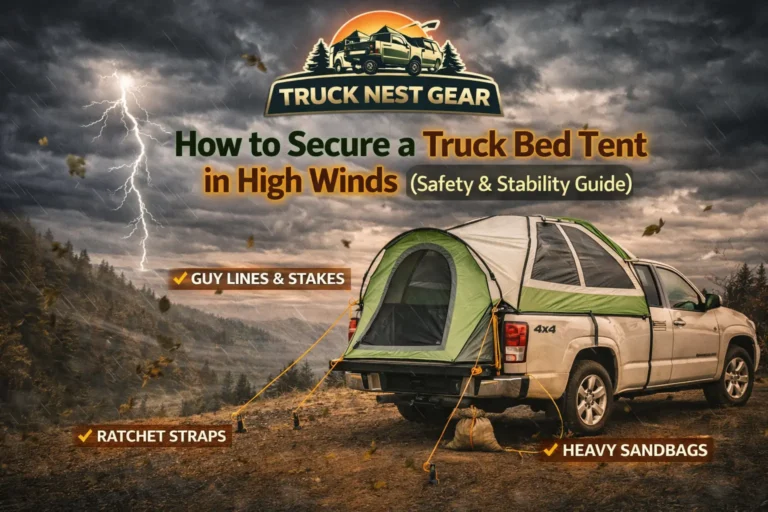
And once your cold-weather tent is selected, our dedicated article on how to secure a truck bed tent in high winds covers the stability and anchoring techniques that matter most when winter storms arrive at your campsite, because wind and cold are the two conditions that most frequently test a truck tent setup simultaneously.