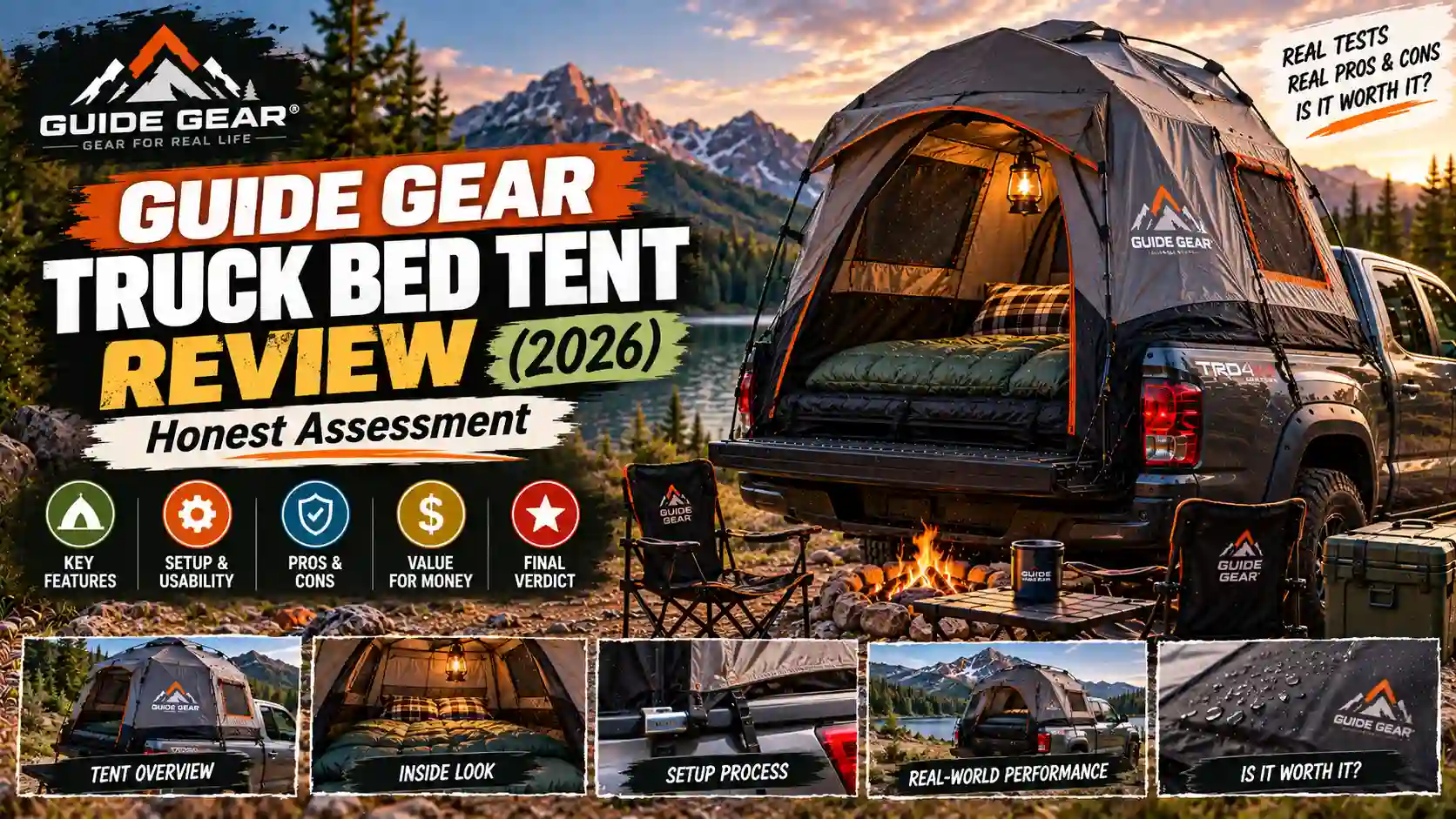
Guide Gear Truck Bed Tent Review (2026): Honest Assessment
Guide Gear is Sportsman’s Guide’s in-house value brand, not a specialty tent maker. The company has sold hunting and outdoor gear since 1970 and built Guide Gear as its private-label line to cover nearly every category in its catalog, from tree stands to coolers to truck tents.
That context matters for reading this review honestly: Guide Gear’s truck tent lineup competes almost entirely on price, and the real owner track record across Amazon, Walmart, and outdoor forums reflects exactly that tradeoff, genuinely good value for an occasional camper, with quality-control inconsistency that shows up often enough to take seriously.
Who This Tent Is For
This tent is built for a truck owner who wants the cheapest legitimate way into truck bed camping and is comfortable handling a bit of DIY troubleshooting, patching a torn pole pocket, sealing a zipper before a rainy trip, in exchange for a price meaningfully below Napier, Rightline Gear, or JOYTUTUS.
It’s a reasonable fit for someone testing whether truck camping suits them before spending more, or a hunter who wants to leave the tent set up on the truck between short outings. It’s a weaker fit for anyone who needs guaranteed pole durability out of the box or plans to camp through sustained heavy rain without a backup plan.
What You Actually Get
Guide Gear sells two genuinely different tents under the truck tent name, and it’s worth being clear about which one you’re looking at before buying. The standard Truck Tent uses 190T polyester with a 1,500mm water-resistant coating, a sewn-in polyethylene floor, and four shock-corded fiberglass poles, sold in a Compact size (fits 72-74 inch beds, 57-inch peak height, roughly 10 pounds) and a Full Size version (fits 79-81 inch beds, 63-inch peak height, roughly 11 pounds), though Guide Gear’s own printed manual lists 5.25 feet (63 inches) of headroom on the full-size version, so treat the exact peak-height figure as approximate across the brand’s own listings.
Separately, Guide Gear sells a Premium Truck Tent (also marketed as a Canopy Shelter/Truck Topper) with aluminum poles instead of fiberglass, a bathtub-style floor, eight tie-down straps instead of standard tension straps, a gear loft, a larger 42-by-34-inch door, and, the feature owners specifically call out as a standout, a front window that lines up with the truck’s rear cab window for direct access between the cab and tent without going outside.
Both versions include a full rainfly, mesh windows for ventilation, and storage pockets, and both are compatible with full-size beds across Chevy, Ford, GMC, Nissan, and Toyota trucks, with the explicit caveat from Guide Gear’s own listing that fit “may differ slightly from truck to truck.”
Current pricing sits in genuine budget territory; Walmart lists the Compact model around $98, with the standard line generally running well under $100 and the Premium version priced modestly higher.
What Owners Actually Report
Fitment reports are mostly positive on standard full-size and mid-size trucks. One detailed owner review confirms a clean fit on a 2013 Ford F-150 with a 6.5-foot bed, with roughly 4 inches of gap between the tailgate and the tent, small enough that the owner filled it with a pool noodle to block debris and rain without damaging the truck’s paint.
That same review flags a genuine, repeatable design detail: there’s a gap between the bed and tailgate on most trucks that can let water in if you don’t address it, so planning for that gap rather than assuming a perfect seal is worth doing before a rainy trip.
Fitment is not universal, though. One eBay reviewer running the tent on a 2007 Honda Ridgeline reported a poor fit specifically because of the Ridgeline’s sloped bed sides, a genuinely unusual bed geometry compared to a traditional flat-sided pickup, and had to adjust the strap routing in an unconventional way to get a workable, if “funny looking,” fit. If you’re shopping for a Ridgeline specifically, this is a real, documented mismatch worth knowing about rather than discovering after your order arrives.
Setup is where the split in owner sentiment shows up most clearly. Several owners describe assembly as reasonably quick once you understand the color-coded pole system, with one detailed review specifically praising the setup as intuitive and calling the poles-and-pockets system foolproof once you’ve done it.
But confusing or missing written instructions is one of the most frequently repeated complaints across the review sample and multiple independent review roundups, and it shows up specifically often enough that it reads as a real, recurring gap in what ships in the box rather than a one-off.
Pole and pocket durability is the clearest, most consistent weak point across the review sample. Multiple sources, including cross-referenced complaints on independent review aggregators and a detailed Amazon review describing a torn pole pocket during initial assembly, confirm this is a known issue rather than an isolated defect.
The general advice from owners who’ve been through it: flex the poles gently to fit rather than forcing or stretching the fabric to meet them, and expect the fabric to loosen slightly after the first assembly, which reduces the tearing risk on subsequent setups.
One hunter running the tent for repeated short hunting trips reported no pole problems at all, noting his own prior experience handling similar fiberglass poles in ground blinds, suggesting handling technique genuinely affects failure rate here, not just luck.
Weather resistance draws mixed but generally fair reviews given the price point. The 1,500mm coating is honestly rated for light-to-moderate rain rather than sustained downpours, and one detailed third-party review synthesis specifically flags leaky zippers as the point of failure in wetter conditions rather than the main fabric itself, the fix reported by owners is sealing the zippers and treating seams before a first rainy trip, similar to the seasoning advice given for budget tents generally in this category.
One hunter reported driving with the tent fully assembled on the truck at 30-35 mph on paved roads and 15-20 mph on dirt without issue, a genuinely unusual and specific data point about the tent’s stability under light vehicle movement, though this isn’t something Guide Gear’s own instructions endorse and shouldn’t be treated as an intended use case.
The cab-access front window on the Premium model draws specific, repeated praise as a standout feature; reviewers call it out directly as a highlight that distinguishes it from cheaper competitors lacking that option.
The Honest Limitations
Pole and pocket fragility is the tent’s clearest limitation. This isn’t a rare complaint buried in an otherwise clean review set; it shows up independently across Amazon reviews, hunting forum threads, and multiple third-party review roundups covering this exact product, which is a stronger signal than a single bad-unit story. Budget for the possibility of a replacement pole, and handle assembly gently rather than forcing pieces into place.
Instruction quality is a real, recurring gap. Enough owners across enough independent sources specifically flag missing or confusing written instructions that this reads as a genuine shortfall in what ships with the product, not an occasional printing error.
Waterproofing tops out at 1,500mm, honestly rated for light rain rather than sustained heavy weather, and zipper leaks specifically, not the main fabric, are the most commonly reported point of water intrusion in wetter conditions.
Fit isn’t universal across every truck bed shape, and the Honda Ridgeline’s sloped bed sides are a specific, documented case where this tent doesn’t fit cleanly without workaround strap routing.
Finally, Guide Gear’s broader brand reputation outside tents is genuinely mixed; one experienced outdoor forum poster specifically criticized the quality of Guide Gear’s clothing line while praising the durability of its boots, which is a useful reminder that “Guide Gear” spans a huge range of private-label products of varying quality, and a tent’s specific track record matters more than the brand name alone.
Comparisons
Against the Napier Backroadz Truck Tent, Guide Gear is meaningfully cheaper but gives up real ground on consistency; Napier’s three decades of tent-specific engineering and a warranty that explicitly covers broken poles under normal use are advantages Guide Gear doesn’t match, and Napier’s fitment track record across full-size and mid-size trucks is considerably more consistent than the pole and instruction complaints reported here.
Choose Napier if you camp often enough that reliability is worth the price gap; choose Guide Gear if you’re testing the waters and want to spend as little as possible finding out whether truck camping suits you.
Against JOYTUTUS, the comparison is close enough that one independent review synthesis put it in concrete terms: JOYTUTUS runs roughly $110 and scores only marginally higher overall than Guide Gear’s roughly $70-80 pricing, meaning Guide Gear delivers a large share of the same experience at a real discount.
JOYTUTUS’s own reported weak points- fiberglass pole breakage, seam and rainfly leak complaints- track closely with what Guide Gear owners report too, so neither tent should be bought expecting bulletproof pole durability at this price tier. Guide Gear’s specific edge is the cab-access window on its Premium model, a feature JOYTUTUS doesn’t offer.
Which Trucks It Fits
Based on verified owner reports and manufacturer sizing, the Full Size version fits trucks with a 79-to-81-inch bed with the tailgate down; Chevy Silverado, Ford F-Series, GMC Sierra, Nissan Titan, and Toyota Tundra are all listed as compatible, with a 2013 F-150 6.5-foot bed specifically confirmed by a detailed owner account.
The Compact version targets 72-to-74-inch beds. The one clear, documented exception in the review sample is the Honda Ridgeline, whose sloped bed sides caused a genuinely poor fit for one owner.
If you’re shopping for a Ridgeline specifically, our Ridgeline truck tent buying guide covers which tents actually handle that bed shape well. For anyone comparing this tent against other options in the same price bracket before deciding, our guide to the best cheap truck tents under $150 is worth reading alongside this review.
Final Verdict
Guide Gear’s truck tent is a legitimate budget option from a company that’s been selling value-priced outdoor gear for over five decades, and the real owner record backs up the basic pitch: it’s cheap, it mostly fits the trucks it claims to fit, and for occasional or first-time truck campers it does the job.
But the pole and pocket fragility, along with genuinely inconsistent instructions, show up too often across independent sources to treat as bad luck; buy this tent expecting to handle it carefully during assembly and budget mentally for a possible pole replacement, rather than assuming Napier-level durability at a third of the price.
For the buyer this tent is built for- testing the category, camping occasionally, prioritizing price above all else- it’s a reasonable, honestly reviewed choice. For anyone who camps often enough that reliability matters more than upfront cost, the extra money for Napier or Rightline Gear buys real peace of mind this tent doesn’t quite match.
This article contains affiliate links. As an Amazon Associate, TruckNestGear.com earns from qualifying purchases at no additional cost to you.