Best Foods to Cook Over a Campfire for Truck Bed Tent Campers
There is a specific pleasure in cooking over an open fire that a camp stove cannot replicate, the smell of woodsmoke, the sound of food sizzling on a cast iron grate, the way a foil packet produces steam when you open it after twenty minutes in the coals.
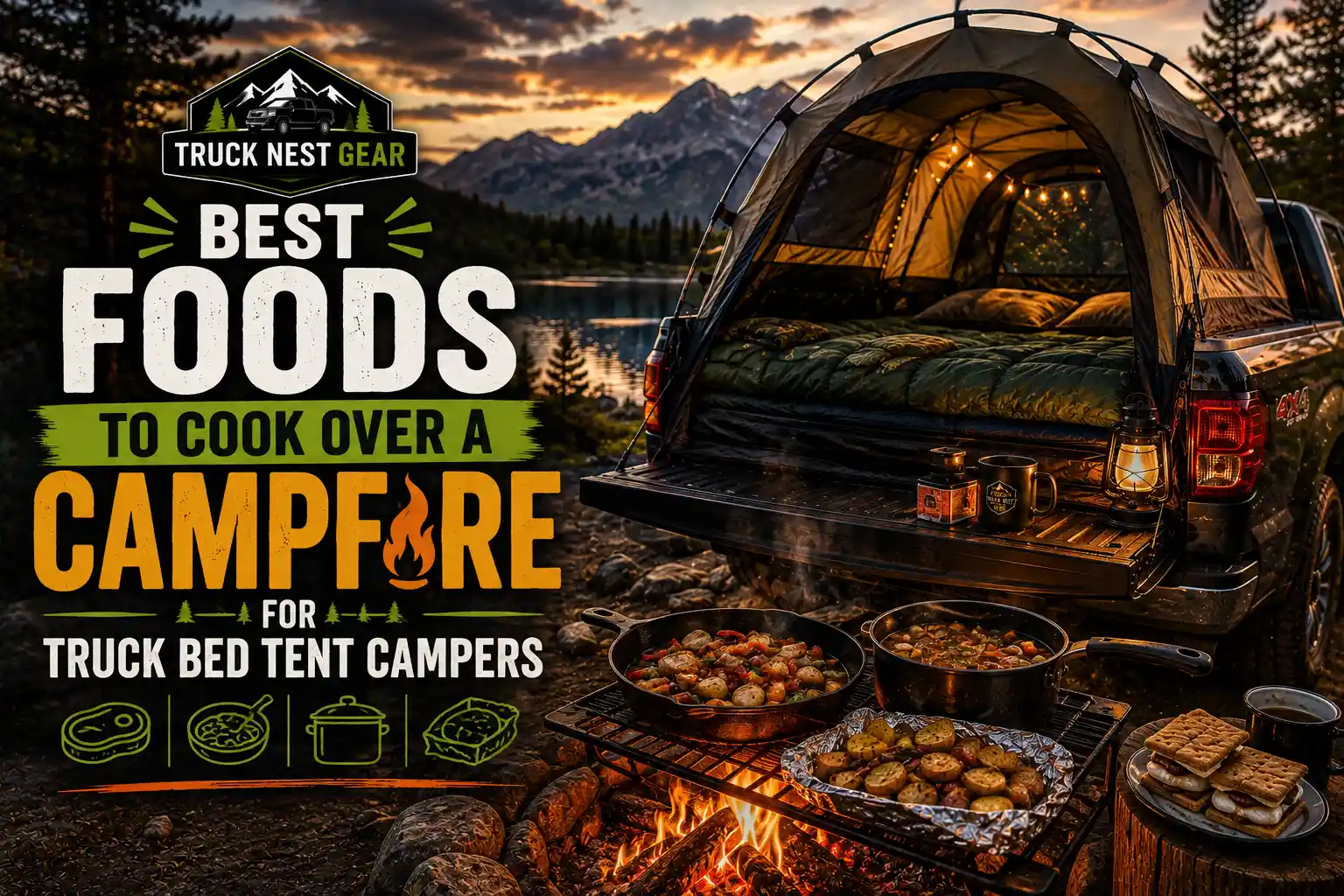
For truck bed tent campers, the campfire cooking setup has some specific advantages over what backpackers or car campers with a minivan can manage: a truck bed full of cooking supplies, a tailgate that functions as a prep surface, and the ability to carry a cast iron skillet without any weight penalty.
This guide covers the best campfire foods for truck bed tent campers, organized by technique rather than by food type, because the technique determines what equipment you need, how long the cooking takes, and what level of campfire management the food requires.
Before any cooking starts: check current fire restrictions for your specific land unit before building any campfire. Fire restrictions on BLM and National Forest land change frequently and are enforced regardless of whether a sign is posted at your dispersed campsite. A quick check of the land management unit’s website takes two minutes and avoids a citation and a fire prevention obligation.
The Truck Camping Campfire Cooking Advantage
A truck bed tent camper has three specific advantages over other campfire cooking methods.
The tailgate as a prep surface. A lowered tailgate at the rear of a full-size truck provides a prep surface at standing height, roughly 32 to 34 inches, that eliminates the crouching and ground-level food prep that backpackers and minimalist car campers deal with. A cutting board, a prep bowl, and a knife on the tailgate is a functional outdoor kitchen without any additional table setup.
Cargo capacity for real cookware. A truck bed can carry a 12-inch cast iron skillet, a Dutch oven, a camp grill grate, and a full set of cooking utensils without any weight compromise. Backpackers cook in titanium cups. Truck bed tent campers cook in real equipment.
The 12V power source for electric options. The truck’s 12V outlet and a portable power station support an electric kettle, an electric griddle, or a 12V slow cooker as alternatives or supplements to campfire cooking, options that no other camping format provides as readily.
Campfire Technique 1: Direct Flame Cooking on a Grate
A portable camp grill grate, a flat metal grid that sits over the fire on adjustable legs or that spans two rocks or log ends at each side of the fire, is the most versatile campfire cooking tool available and the starting point for most campfire meals.
- What cooks well on a grate:
Steaks and burgers. Direct flame grilling over a hot wood fire produces a smoke and char that a gas grill does not replicate. Allow the fire to burn down to a bed of coals with active flame before placing meat on the grate; cooking over active high flame produces scorched exteriors and raw interiors. A medium-hot coal bed with some active flame, at approximately hand-height 5-second heat level, is the correct grilling temperature for most cuts.
The truck bed camping advantage: bring the steaks you want, not the steaks that fit a backpacking weight limit. A 16-ounce ribeye in a zip-lock bag from the IGBC-certified cooler is entirely practical for a truck bed tent camping dinner in a way it is not for any other backcountry format.
Chicken thighs. Chicken thighs handle campfire heat significantly better than chicken breasts — the higher fat content prevents the dry, overcooked result that campfire chicken breast almost always produces. Marinate thighs before the trip in a zip-lock bag.
Cook skin-side down on the grate over medium coals for 8 to 10 minutes per side, or until the internal temperature reaches 165°F. A meat thermometer, weighing under an ounce and costing under ten dollars, is the single most useful campfire cooking tool for truck campers who cook meat.
Corn on the cob. Soaked in water for 30 minutes before cooking, corn in the husk placed directly on the grate over medium coals steams inside its own husk while developing grill marks on the exterior. 15 to 20 minutes, turning every 5 minutes. Pull back the husk, brush with butter, salt, and pepper. One of the simplest and most satisfying campfire sides available.
Asparagus, bell peppers, and zucchini. Vegetables with enough structural integrity to hold together on a grate- asparagus, sliced bell peppers, zucchini rounds, mushrooms- cook in 5 to 10 minutes over medium coals and char beautifully without becoming mush. Toss in olive oil and salt before cooking. The campfire char on vegetables produces a flavor that home cooking rarely achieves.
Campfire Technique 2: Foil Packet Cooking
Foil packet cooking is the technique that delivers the greatest reward for the least active fire management. Food sealed in heavy-duty aluminum foil and placed in or near the coals cooks in its own steam, no grate required, no flipping, no active fire tending.
What cooks well in foil packets:
Salmon with lemon and herbs. A salmon fillet on a bed of sliced lemon with dill, salt, and olive oil, sealed in a double layer of heavy-duty foil, placed on a bed of coals for 12 to 15 minutes, produces a perfectly steamed fish that requires no cooking skill and no active management. Open carefully, the steam releases hot when the packet is first opened. This is the campfire meal that surprises people who expected hot dogs.
Potato and vegetable packets. Diced potatoes with sliced onion, bell pepper, garlic, olive oil, salt, pepper, and any spice combination you prefer, sealed in foil and cooked on the coals for 25 to 35 minutes. The potatoes steam until tender and develop crispy edges where they contact the foil. Add pre-cooked sausage slices to make it a complete meal in one packet.
This is the most forgiving campfire recipe available, almost impossible to ruin, easy to scale for any number of people, and requiring only a cutting board and a knife for prep.
Shrimp with butter and garlic. Shrimp in a foil packet with butter, minced garlic, lemon juice, and parsley cooks in 8 to 10 minutes on moderate coals. The butter melts into a sauce as the shrimp cook. Serve directly from the foil packet with bread for dipping. Shrimp are safe to carry in an ice-cold cooler for the first night of a camping trip and cook faster than any other protein over a campfire.
Banana boats. A banana split lengthwise but still in the peel, filled with chocolate chips and mini marshmallows, sealed in foil and placed on coals for 5 to 8 minutes. The banana softens, and the chocolate melts into a dessert that requires no plates, no bowls, and no cleanup beyond the foil. This is the dessert that converts children to campfire cooking and takes under ten minutes from concept to consumption.
Campfire Technique 3: Cast Iron Skillet on Coals
A cast iron skillet placed directly on a stable bed of coals, not on a grate above the fire, but on the coal bed itself, functions as a campfire griddle that holds heat more evenly and for longer than any other campfire cookware. The thermal mass of cast iron distributes heat across the cooking surface and maintains temperature through the cooking process in a way that thin aluminum or stainless steel cannot.
Cast iron is the one piece of cookware that is genuinely worth the weight penalty in a truck bed camping context, and in a truck bed, there is no meaningful weight penalty.
What cooks well in cast iron on coals:
Camp breakfast skillet. Diced potato, sliced onion, and bell pepper cooked in olive oil or butter in a cast iron skillet on moderate coals, then pushed to the side as eggs are scrambled or fried in the center. Salt, pepper, and any spice or cheese you carried. This is the breakfast that makes every subsequent morning at a non-camping location feel like a disappointment.
Pan sauce steaks. Sear steaks in a cast iron skillet on hot coals with butter, garlic, and rosemary, basting continuously as the butter clarifies and the garlic softens. The same technique that works in a restaurant kitchen on a high-heat burner translates directly to a cast iron skillet on a bed of hardwood coals, the heat source is different, the result is indistinguishable.
Campfire pizza. A pre-made pizza dough pressed thin onto a lightly oiled cast iron skillet, topped with sauce, cheese, and any pre-cooked toppings, covered with a lid or a piece of foil, and cooked on moderate coals for 10 to 15 minutes.
The bottom develops a crispy crust from the cast iron, the cheese melts from the trapped steam, and the toppings heat through. This is genuinely impressive campfire cooking that requires almost no active management once the lid is on.
Skillet cookies. A single batch of chocolate chip cookie dough pressed into a cast iron skillet, covered, and cooked on low coals for 12 to 15 minutes. Serve directly from the skillet with a spoon. The exterior sets and the center remains molten. No plates required.
Campfire Technique 4: Stick Cooking
The most primitive campfire cooking technique is also the most immediately satisfying: food on a stick held over or near the flame. No equipment required beyond the food and a suitable stick.
What cooks well on a stick:
Hot dogs and sausages. The default campfire food for good reason; they are pre-cooked, so the goal is heat-through and char rather than food safety. They cook in 3 to 5 minutes of rotation over moderate flame, and they are impossible to ruin beyond burning the exterior. For truck bed tent campers with children, hot dogs on sticks are the activity that makes campfire cooking genuinely participatory for every age.
Marshmallows. The classic. The debate between golden-brown slow-toasted and full-flame incineration is a matter of personal principle rather than culinary consensus. Both are correct. A fully melted marshmallow on a graham cracker with a piece of chocolate, the s’more, is the campfire food with the most powerful nostalgia-to-effort ratio in the entire outdoor cooking canon.
Bread on a stick. Refrigerator biscuit dough or a simple flour-water-salt dough wrapped spirally around a green stick and held over coals until golden produces a camp bread that is eaten directly off the stick. This is the campfire food that consistently surprises adults who encounter it for the first time; the bread has a smoke and char from the stick and the fire that no baked bread replicates.
Campfire Technique 5: Dutch Oven Cooking
A cast iron Dutch oven with a flanged lid that holds coals on top is the campfire cooking tool that produces the most impressive results for multi-night truck bed tent camping trips. The flanged lid allows coals to be placed both above and below the oven, creating an environment that approximates oven cooking rather than stovetop cooking.
A Dutch oven meal requires planning and 45 to 90 minutes of cooking time, appropriate for a camp where you are settled for the afternoon and the fire is already established.
What cooks well in a Dutch oven:
Campfire chili. Browned ground beef with onion, garlic, canned tomatoes, kidney beans, and chili spice blend, cooked covered with coals on and under the Dutch oven for 45 minutes. The flavors develop in the enclosed, smoky environment in a way that stovetop chili does not. Serves 4 to 6 people from a single cook. Pairs with cornbread cooked in the same Dutch oven on the second batch.
Campfire cobbler. Canned fruit, peaches, cherries, or mixed berry, with a dry cake mix poured over the top and a little butter placed in pieces across the surface. Cooked covered with coals on top for 30 to 40 minutes until the cake mix sets. This is the camp dessert that requires the least cooking skill, the fewest ingredients, and produces the strongest positive reaction from anyone eating it.
Pot roast. A chuck roast with potatoes, carrots, onion, beef broth, and herbs, cooked in a covered Dutch oven on moderate coals for 3 to 4 hours. The connective tissue in the chuck roast breaks down in the moist heat environment and produces a fork-tender result that is the most impressive and least actively demanding campfire meal available. Leave the lid on and trust the coals.
Food Safety Over a Campfire
Campfire cooking does not regulate temperature the way a gas burner does, and the variability of wood fire heat requires more attention to food safety than cooking at home.
Meat must reach safe internal temperatures regardless of how it looks from the outside. A chicken thigh that is charred on the exterior can be undercooked at the bone. A hot coal bed produces inconsistent heat across the cooking surface, and the area directly over a coal pocket is significantly hotter than the area between coals. Use a meat thermometer: chicken to 165°F, ground beef to 160°F, whole steaks and roasts to 145°F with a 3-minute rest.
Perishable foods, meat, dairy, eggs should be stored at 40°F or below until cooking. A well-iced IGBC-certified hard-sided cooler or a 12V compressor cooler maintains this temperature reliably. Food from a cooler that has been in direct afternoon sun without adequate ice is not reliably safe to cook and eat.
Keep raw meat separate from ready-to-eat foods in the cooler and during prep. Use a dedicated cutting board or surface for raw meat prep, separate from the surface used for vegetables and ready-to-eat items. Wash hands after handling raw meat, hand sanitizer is the field substitute when water and soap are not immediately available.
The Truck Camping Campfire Cooking Kit
These are the items that make campfire cooking at a truck bed tent camp genuinely functional rather than improvised:
A camp grill grate with adjustable legs, stores flat in the truck bed, sets up over any fire pit.
A 10-inch or 12-inch cast iron skillet, the one piece of heavy cookware worth carrying when weight is not a constraint.
A 6-quart cast iron Dutch oven with a flanged lid, for multi-night camps where a real meal is the plan.
Heavy-duty aluminum foil, one roll handles an entire weekend of foil packet cooking.
A meat thermometer, under an ounce, under ten dollars, eliminates guessing on protein doneness.
Long-handled tongs and a spatula rated for cast iron temperatures, with silicone handles that do not conduct heat from the fire.
A heat-resistant leather or welding glove, for adjusting Dutch oven lids and camp grate positions over active coals.
A fire-safe cutting board, one designated board for camp use that stays in the truck camping kit permanently.