TruckNestGear is reader-supported. When you buy through links on our site, we may earn an affiliate commission at no extra cost to you. As an Amazon Associate we earn from qualifying purchases. Learn more
The Chevrolet Avalanche is one of the most misunderstood trucks in the tent compatibility space. Generic truck tent brands either ignore it entirely, list it with a vague “may not fit” disclaimer, or, worse, claim compatibility when their product doesn’t actually work on the Avalanche’s unique rail system.
This guide exists because Avalanche owners deserve a straight answer. The Avalanche was produced from 2002 to 2013 and is no longer manufactured, which means two things: the used truck market is the only way to own one, and purpose-built tent availability in 2026 requires used-market sourcing. We cover exactly what fits, why generic tents fail on this truck specifically, what the used market looks like right now, and what your practical alternatives are if a purpose-built Avalanche tent can’t be found in acceptable condition.
Why the Chevy Avalanche Is Different From Every Other Truck
Before looking at any specific tent, understanding the Avalanche’s MidGate system is essential — because it’s the reason generic tents don’t work on this truck, and it’s the reason only two brands ever built a product specifically designed for it.
What Is the MidGate?
The Chevrolet Avalanche was built around a feature called the MidGate: a fold-down panel between the truck cab and the cargo bed that, when opened, extends the bed forward into the rear passenger area. In the standard closed position, the Avalanche has a 5.25-foot open bed — 63 inches. When the MidGate is opened and the rear seats folded down, the effective bed length extends to approximately 8 feet, creating a continuous flat floor from the tailgate to the front of the rear passenger compartment.
For tent camping, the Avalanche is used in the closed MidGate configuration. But that 5.25-foot bed creates an immediate sizing problem: standard 5.5-foot tents are slightly too large, and standard 5-foot mid-size tents are slightly too small. The Avalanche doesn’t fall neatly into either standard size category, which is why generic sizing databases either exclude it or produce inaccurate compatibility claims.
The Composite Cladding Rail Problem
The larger technical problem is the Avalanche’s bed rail design. Rather than the standard steel bed rails found on the F-150, Silverado, Tacoma, and virtually every other full-size truck, the Avalanche uses composite cladding panels along the bed sides. These panels create a fundamentally different rail profile.
Hook-based and cam-buckle strap systems designed for steel rails don’t seat correctly on composite cladding. In practice, this means the tent shifts and slides, particularly at the front cab-side attachment point, in wind and rain. Multiple Avalanche owners who attempted to use the Rightline Gear 110730 universal design reported exactly this failure mode. The straps simply don’t grip composite cladding the way they grip steel rails.
This is not a minor fitment note. It’s the reason only two tent brands, CampRight and Napier, ever engineered products that work correctly on this truck.
Chevy Avalanche Bed Specifications
| Generation | Years | Bed Length | Tent Notes |
|---|---|---|---|
| 1st Gen Avalanche | 2002–2006 | 5.25 ft (closed MidGate), ~8 ft (open MidGate) | Composite cladding on bed sides. CampRight and Napier Avalanche models designed for this configuration. |
| 2nd Gen Avalanche | 2007–2013 | 5.25 ft (closed MidGate), ~8 ft (open MidGate) | Revised exterior styling, same MidGate system. Same tent options apply to both generations. |
The Two Tents That Actually Fit a Chevy Avalanche
Both products reviewed below were specifically engineered for the Avalanche’s composite cladding rail profile and 5.25-foot closed-MidGate bed configuration. Neither is in current production. Sourcing in 2026 is a used-market exercise, which is covered in full in the section immediately following these reviews.
CampRight Avalanche Truck Tent: Best Avalanche-Specific Option
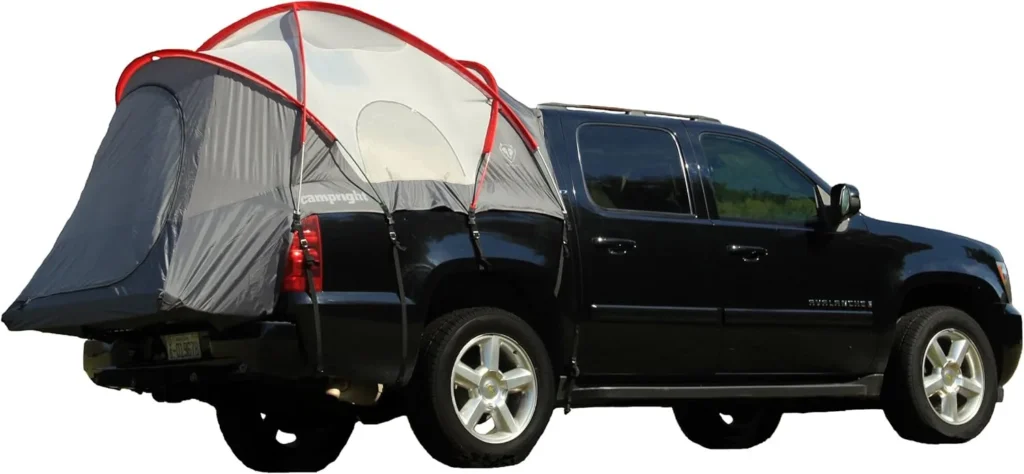
CampRight built their tent business around the Chevrolet Avalanche. Their products addressed all three fitment challenges that defeat generic tents on this vehicle: the composite cladding rail profile that hook-based systems can’t grip, the 5.25-foot bed length that sits between standard size categories, and the attachment geometry that differs from every other full-size truck. The result is a tent that fits correctly and attaches securely, something no universal design achieves on the Avalanche.
Among Avalanche owners who camp with their trucks, the CampRight has the deepest community documentation of any Avalanche tent. Owner forums, particularly avalancheenthusiast.com and GM truck communities, contain years of setup tips, condition assessments on used units, and guidance on identifying good versus degraded examples. That accumulated owner knowledge is a genuine advantage when buying a discontinued product on the used market, because you’re not navigating it alone.
The critical reality in 2026: CampRight tents are no longer manufactured. They exist only as used or new-old-stock units through eBay, Facebook Marketplace, and Avalanche owner forums. A well-maintained CampRight in good condition, clean fabric, straight poles, intact attachment hardware, is still the best Avalanche tent available. A degraded unit with UV-faded fabric and bent poles is not worth any price.
- Designed from the ground up for the Chevrolet Avalanche — not a generic tent with a fitment footnote
- Attachment system engineered for the composite cladding rail profile
- Available in variants covering both 1st gen (2002–2006) and 2nd gen (2007–2013) Avalanche.
- The most community-documented Avalanche tent with the deepest owner forum support.
- Discontinued — available used or new-old-stock only.
- Replacement parts are extremely limited given the brand is no longer operating
Napier Sportz Avalanche Truck Tent — Equally Valid Alternative
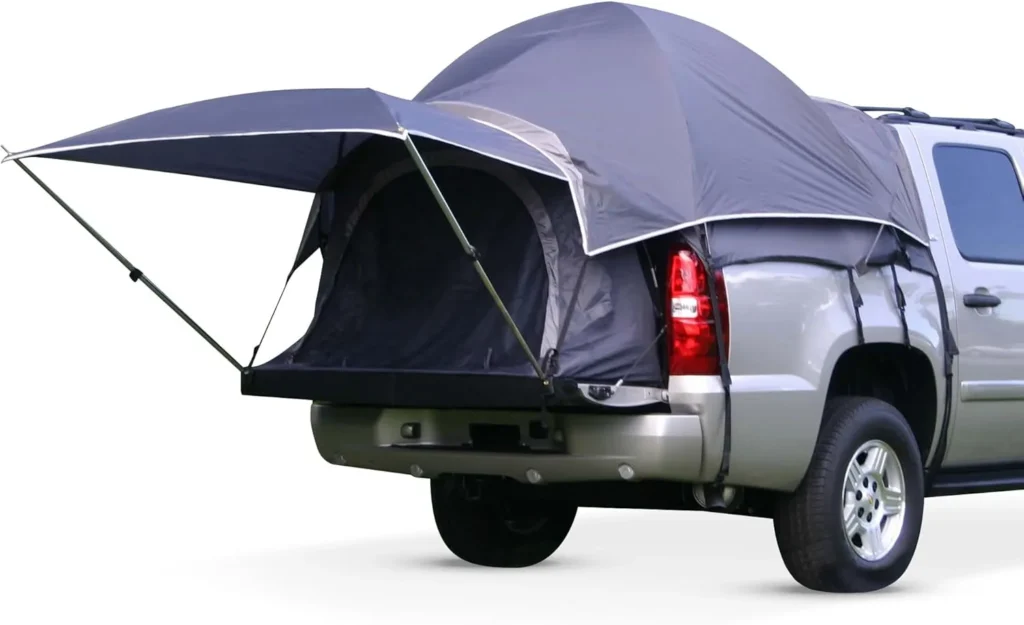
The Napier Sportz Avalanche tent was designed with the same Avalanche-specific engineering intent as the CampRight, purpose-built attachment hardware for the composite cladding rails, correct sizing for the 5.25-foot closed-MidGate configuration, and a design that accounts for the Avalanche’s unique bed geometry.
The practical advantage over the CampRight in 2026 is availability. Napier’s broader distribution network means used and new-old-stock Napier Avalanche tents appear more frequently across resale channels than the more narrowly distributed CampRight. Napier also remains an active company with a current product line, which gives a marginally better chance of sourcing replacement poles or hardware directly, worth contacting them before assuming parts are unavailable.
The choice between the CampRight and Napier Avalanche models in practice comes down entirely to which one you can find in better condition at a fair price. Both are correct products for this truck. Do not choose either sight-unseen from a remote seller; inspect fabric, poles, and attachment hardware before committing to any price.
- Engineered specifically for the Chevrolet Avalanche
- Napier’s brand track record means design intent and build quality are well-documented
- Better used-market availability than CampRight.
- Napier remains active — contact them directly regarding replacement parts for this model.
- Also discontinued and available used or new-old-stock only.
- As a larger brand with a broad current product line, Avalanche-specific parts may be lower priority than current models.
- Slightly less community documentation than CampRight for Avalanche-specific attachment details.
Where to source: eBay (search “Napier Sportz Avalanche tent”), Facebook Marketplace, Napier’s own website (contact directly for new-old-stock), Avalanche owner forums.
The Reality of Buying an Avalanche Tent in 2026
This needs to be stated plainly: buying a tent for a 2002–2013 Avalanche in 2026 is entirely a used-market exercise. New production of Avalanche-specific tents stopped when the truck was discontinued in 2013. Both purpose-built brands are discontinued. There is no new-production option.
Current used-market prices for CampRight and Napier Avalanche tents range from approximately $60 to $180, depending on condition. A well-preserved tent with clean fabric, straight poles, and intact attachment hardware in the $100–$140 range is a reasonable purchase. A faded, bent-pole unit at $180 is not.
Where to look:
- eBay: search “CampRight Avalanche tent” and “Napier Sportz Avalanche tent.”
- Facebook Marketplace: search by your region with the same terms
- avalancheenthusiast.com classifieds section
- GM truck forums: members often list gear before it reaches eBay
What to inspect before buying:
- Fabric for UV fading, tears, and PU coating delamination (runs or peeling on the inner fabric surface)
- Poles for bends and broken ferrules at the connection points
- Attachment hardware for corrosion and missing hooks or buckles
- Floor for punctures and degraded seam sealing
What to avoid:
- Tents stored outdoors or in non-climate-controlled spaces, UV and moisture degradation is severe
- Listings with no close-up inspection photos of the fabric interior and attachment hardware
- Sellers who cannot answer specific questions about how the tent was stored and how many seasons it was used
Can a Generic Universal Tent Work on an Avalanche?
No, not reliably. The Rightline Gear 110730, which performs across most mid-size and full-size truck configurations, does not work correctly on the Avalanche. Its cam-buckle strap system requires a standard steel bed rail to grip properly. The Avalanche’s composite cladding panels have a different profile that causes the straps to slide and shift, particularly at the front cab-side attachment point, in wind and rain. Multiple Avalanche owners have documented this failure in forum threads, and it’s not a setup error. It’s a fundamental incompatibility between the attachment system and the rail material.
Practical Alternatives If a Purpose-Built Tent Can’t Be Found
If neither a CampRight nor a Napier Avalanche tent can be sourced in acceptable condition, these are the three alternatives worth considering, in order of practicality.
Rooftop tent on a roof rack. A rooftop tent mounted on a Thule or Yakima rack above the Avalanche’s cab bypasses the bed rail compatibility problem entirely. The tent has no interaction with the composite cladding or the bed dimensions. For Avalanche owners who camp regularly and are open to the rooftop tent format, this is the cleanest solution. The full breakdown of how hard-shell and soft-shell rooftop tents compare, including what a quality roof rack adds to the total cost, is covered in the complete rooftop tent guide for truck campers.
Ground tent beside the truck with the MidGate open for storage. The Avalanche’s open MidGate configuration creates an approximately 8-foot flat cargo area accessible from outside. Using a quality free-standing ground tent alongside the truck while using the open MidGate bed for enclosed gear storage, coolers, equipment, bags locked inside the extended cab-bed space is a practical and secure setup that plays to the Avalanche’s unique strengths rather than working around them.
Truck cap over the closed MidGate bed. A hard fiberglass truck cap fitted to the Avalanche’s 5.25-foot closed-MidGate bed creates a fully enclosed sleeping and storage space. Combined with a sleeping pad and appropriate bedding, this converts the truck bed into a weatherproof shelter without any of the rail compatibility concerns that affect tent systems. It’s a more permanent modification than a tent, but for Avalanche owners who want the most weather-capable sleeping solution, a well-fitted cap is worth considering.
Frequently Asked Questions
What truck tent fits a Chevy Avalanche?
Only two tents were ever designed specifically for the Chevy Avalanche: the CampRight Avalanche tent and the Napier Sportz Avalanche tent. Both are discontinued and available used only. Generic universal tents, including the Rightline Gear 110730 and standard Napier models, do not fit correctly due to the Avalanche’s composite cladding rail profile and 5.25-foot bed dimensions that sit outside standard size categories. Search eBay, Facebook Marketplace, and Avalanche owner forums for used examples, and inspect fabric and hardware carefully before purchasing.
What is the CampRight Avalanche truck tent?
CampRight was a tent brand whose flagship product was designed specifically for the Chevrolet Avalanche. Their attachment system was engineered for the Avalanche’s composite cladding rail profile rather than the standard steel rails that generic tents are designed around, and the tent dimensions were sized for the 5.25-foot closed-MidGate bed. CampRight tents are discontinued, and the brand is no longer operating, but well-maintained used examples remain the best Avalanche tent option available. Avalanche owner communities at avalancheenthusiast.com are the most reliable source for buying guidance and condition assessment help.
Can I use a Rightline Gear 110730 on a Chevy Avalanche?
Not reliably. The Rightline 110730’s cam-buckle strap system is designed to grip standard steel bed rails. The Avalanche’s composite cladding panels present a different surface profile that prevents the straps from achieving the same grip. Multiple Avalanche owners have documented the tent shifting at the front attachment point in wind, which is a structural failure in conditions where a tent needs to hold the most. The Rightline is an excellent tent for most trucks; it’s simply the wrong attachment system for the Avalanche’s specific rail design.
What is the Chevy Avalanche MidGate, and how does it affect tent camping?
The MidGate is the Avalanche’s defining feature: a fold-down panel between the cab and the cargo bed that, when opened, extends the bed into the rear passenger area. For tent camping, the closed MidGate configuration is used, giving a 5.25-foot bed. This length sits between standard tent size categories, slightly short for standard 5.5-foot tents, slightly long for 5-foot mid-size tents, which is one of the reasons generic tents produce poor fitment on this truck.
The Avalanche is discontinued: is it worth sourcing a purpose-built tent?
If you camp regularly in your Avalanche and find a CampRight or Napier Avalanche tent in good condition for $80–$150, it is worth buying. It is the correct product for the truck, and a well-maintained example will perform properly in ways that generic alternatives cannot. If you cannot find one in acceptable condition after a reasonable search, a rooftop tent on a roof rack is the cleanest alternative, it avoids the bed rail compatibility problem entirely and opens up a wide range of current-production tent options.
Final Verdict
The Chevy Avalanche has a narrow but clear answer: CampRight or Napier Avalanche-specific models, sourced through the used market. No generic truck tent works correctly on this truck’s composite cladding rails and non-standard bed dimensions.
In 2026, finding these tents requires patience: eBay, Facebook Marketplace, and Avalanche owner forums, with careful condition inspection before purchase. Budget $100–$140 for a well-preserved example and walk away from anything showing significant fabric degradation or hardware damage, regardless of the asking price.
If purpose-built Avalanche tents cannot be sourced in good condition, a rooftop tent on a quality roof rack is the most practical alternative, it sidesteps the bed rail compatibility problem completely and gives access to the full range of current-production rooftop tent options.
Affiliate disclosure: Some links in this guide are affiliate links. If you purchase through them, we earn a small commission at no additional cost to you. This does not affect our recommendations — no brand has paid for placement in this guide.