
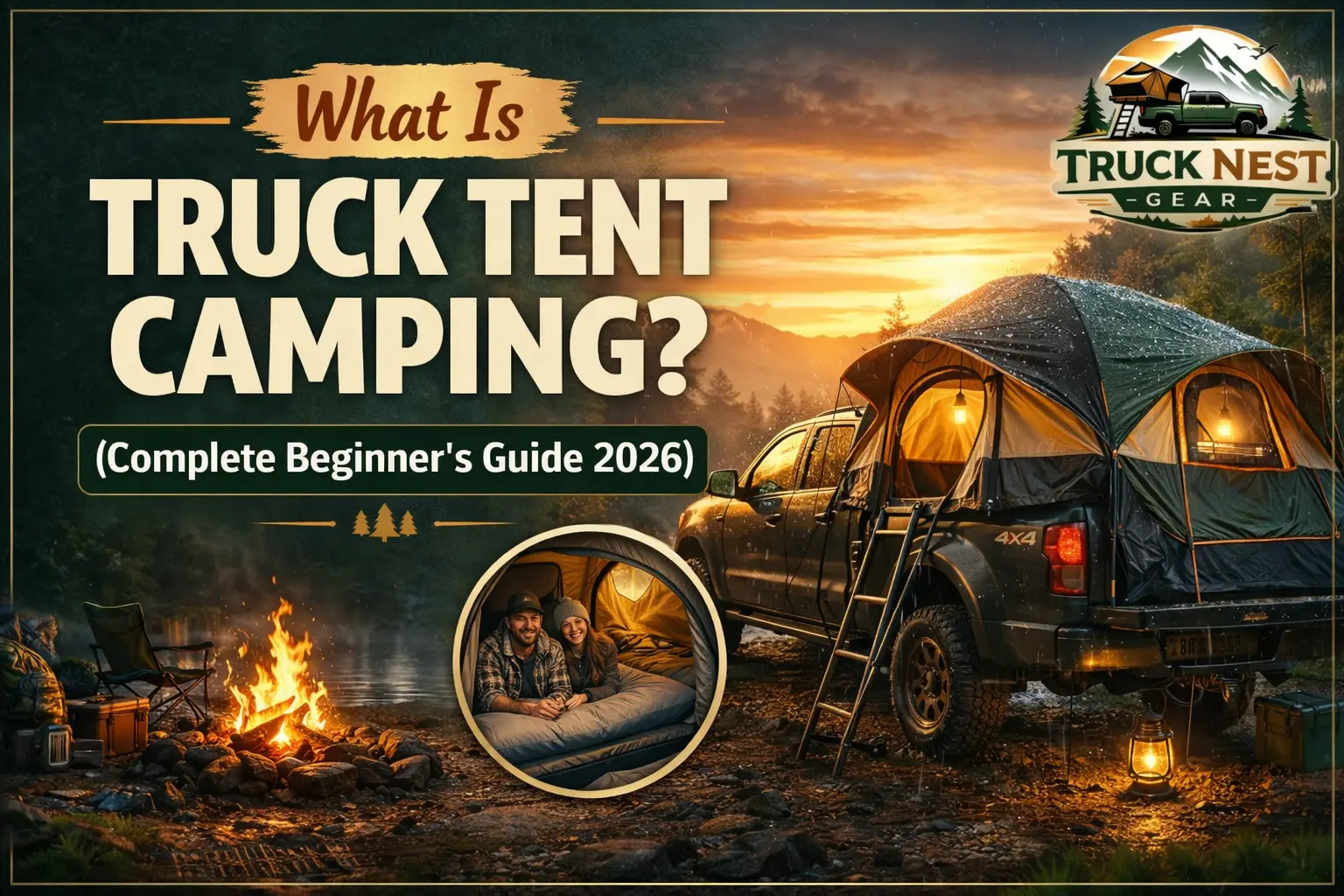
What Is Truck Tent Camping? (Complete Beginner’s Guide 2026)
| ⚡ In a nutshell Truck tent camping is sleeping in a tent that attaches to your pickup truck’s bed, elevating you off the ground inside a weatherproof shelter. The tent clips or straps to your bed rails and covers the tailgate opening, turning your truck bed into a bedroom. No campsite mat, no sleeping bag on the dirt, you sleep on an air mattress or sleeping pad inside the tent, inside the truck. Entry cost: ~$80–90 for a budget tent. Setup time: 10–20 minutes. Truck requirement: any standard pickup with a 5’–8′ bed. |
Truck tent camping has grown steadily since Napier Outdoors launched the first commercial truck bed tent in 1994. Today, it’s a mainstream camping option for pickup truck owners across North America, particularly for hunters, road trippers, overlanders, and anyone who wants to sleep elevated off the ground without the cost or complexity of a rooftop tent or truck camper.
This guide covers everything a first-timer needs to know: what truck tent camping actually is, how it works, what you need to get started, who it’s best suited for, and how it compares to other camping options. If you already know what a truck tent is and just need a product recommendation, jump straight to our buying guides linked throughout.
What Is a Truck Tent?
A truck tent is a purpose-built tent designed to fit inside and over a pickup truck’s bed. It attaches to the bed via adjustable straps or clips on the rail system, with a sealed floor that covers the bed surface and a tailgate flap that closes the opening at the rear. When set up, the tent body sits inside and above the truck bed, supported by fiberglass or aluminum poles that run through internal sleeves, the same basic structure as a freestanding tent, adapted to truck bed dimensions.
Most truck tents include a mesh door at the tailgate end for entry and exit, mesh windows on the sides for ventilation, and a full rainfly that covers the outer shell for weather protection. Premium models add features like a built-in awning, a cab access panel (a zippered opening connecting the tent to the truck’s rear window), and additional ceiling vents.
The tent mounts above the truck’s wheel wells, so interior width is roughly 48–54 inches, depending on your truck model, enough for two adults on sleeping pads, or a queen-sized air mattress in a standard (6.5′) bed. Interior height ranges from about 4.5 feet in entry-level tents to 5’10” in premium models.
| 🚛 Key dimensions to know: Sleeping area: approximately 5’×4′ to 7’×4′ depending on bed length Interior height: 4.5 ft (budget) to 5’10” (Napier Sportz 57 Series)Weight capacity: truck bed rated to 1,000–2,000 lbs, tent adds ~10–15 lbs Sleeping capacity: 2 adults comfortably, 3 if one is a child Bed size needed: minimum 5′ bed (Ford Maverick, Tacoma short bed) |
How Does a Truck Tent Work?
Setting up a truck tent is a 10–20 minute process on first use, faster with practice. Here’s the basic sequence for a standard Napier-style tent:
| 1 | Lower the tailgate: Open your tailgate fully and park on level ground if possible. The tent attaches and opens from the rear. |
| 2 | Thread the poles: Insert color-coded fiberglass poles through the corresponding pole sleeves in the tent body. Each sleeve is color-marked to match the pole — no guesswork. |
| 3 | Position the tent in the bed: Lay the tent into the truck bed with the floor flat, the tailgate flap hanging over the tailgate, and the pole tips positioned at the four bed corners. |
| 4 | Attach the straps: Hook the adjustable straps over the bed rails at the designated attachment points. Tighten until the tent body is taut against the bed sides and rails. |
| 5 | Raise the tent: Flex the poles into their curved positions to erect the tent body. The structure self-supports once the poles are under tension. |
| 6 | Deploy the rainfly: Drape the rainfly over the tent body and secure it at the attachment points. In clear weather, the rainfly can be omitted for better ventilation and stargazing. |
| 7 | Add sleeping gear: Place your air mattress or sleeping pad inside the tent, add bedding, and you’re ready. The truck bed liner or tent floor is your base. |
Teardown is the reverse, takes 10–15 minutes. The whole tent packs into a carry bag roughly the size of a large duffel, which stores easily in the truck cab or under the tonneau cover when not in use.
Who Is Truck Tent Camping Best For?
Truck tent camping hits a specific sweet spot. It’s not for everyone — but for the right camper, it’s the most practical sleeping setup available.
| ✅ Truck tent camping is ideal for: Hunters, sleeping in your truck at the trailhead eliminates the walk from a distant campground. Camo models blend into the environment. The cab access panel lets you run a heater cord from the truck. Road trippers, pull off at a scenic spot, set up in 15 minutes, sleep, and drive on in the morning. No booking campgrounds, no hotel check-in. Overlanders, the truck bed tent integrates naturally with overland setups. Lower cost than a rooftop tent, faster deployment than a ground tent. Weekend campers, already driving a pickup to the campground? The tent lives in the bed and deploys without unloading your gear (floorless models) or with a 15-minute setup. Beginners, lower barrier to entry than rooftop tents ($80 vs. $1,000+), more comfortable than a ground tent, no special vehicle modifications required. ❌ Truck tent camping is not ideal for: Campers without a pickup truck, truck tents require a standard pickup bed. SUVs and vans have different geometries. Families needing 3+ adult sleeping spaces: the truck bed accommodates 2 adults. Families typically need additional ground tents alongside. Campers who leave gear in the bed (floored models): floored tents require a clear bed. The Rightline Gear floorless design solves this, but it’s the exception. Winter camping in sub-freezing temperatures: budget polyester tents have minimal insulation. Canvas tents (Kodiak Canvas) are the exception, but cost $400+. |
Truck Bed Tent vs. Ground Tent: How They Compare
The most common comparison first-timers make. Here’s the honest side-by-side.
| Factor | Ground moisture/insects | Ground Tent |
| Setup time | 10–20 min | 5–10 min |
| Depends on the ground surface | ✅ Elevated — not an issue | ❌ Need groundsheet + site selection |
| Site flexibility | ❌ Need a flat, legal parking spot | ✅ Any flat ground will do |
| Comfort | ✅ Air mattress in truck bed | Depends on ground surface |
| Weather protection | ✅ Steel bed as base — no pooling | Wildfire/flood risk |
| Cost to start | $80–90 | $30–500+ (wide range) |
| Vehicle required | ✅ Pickup truck | ❌ None — any campsite |
| Storage when not in use | Compact duffel bag | Compact duffel bag |
| Max sleepers | 2 adults | As many as the tent size allows |
| Wildfire / flood risk | Lower — can drive away | Higher — must break camp |
For a deeper look at truck tent types, including rooftop tents, truck camper shells, and cab-over designs, see our Best Truck Tents for Camping.
What You Need to Get Started
The barrier to entry for truck tent camping is genuinely low. Here’s the complete starter list.
Essential (Required)
| A pickup truck with a 5’–8′ bed: any standard pickup qualifies. Crew cab short beds (F-150, Tacoma), regular cabs, and long beds all work. Confirm your exact bed measurement before buying a tent. A truck bed tent: matched to your specific bed size. See the sizing section below. A sleeping surface: an air mattress, self-inflating sleeping pad, or foam pad. A standard queen air mattress fits a 6.5’+ bed; for a 5.5′ bed, use a full-size or two twin pads. A sleeping bag or bedding: temperature rating matched to your expected nighttime low. |
Strongly Recommended
| A pillow and extra insulation layer: truck bed metal conducts cold upward even through a sleeping pad. A closed-cell foam base layer under your air mattress adds warmth. A headlamp or lantern: the Napier Sportz 57 has a built-in lantern hook; budget tents don’t. Any camping lantern works. Condensation management: crack a window vent slightly, even in cold weather. Two people sleeping generate significant moisture; closed vents lead to wet walls by morning. Leveling blocks: if your campsite is on a slope, parking on level ground improves sleep quality significantly. Camco leveling blocks ($15–20) are compact and reusable. |
Optional Upgrades
| Truck bed air mattress (truck-specific shape): standard rectangular mattresses leave gaps at the wheel wells. Truck-specific air mattresses (AirBedz, Rightline) are contoured to fit around the wells and use the full bed area. 12V portable heater or fan: the Napier Sportz 57 Series cab access panel lets you run a cord from your truck’s power outlet. Useful for shoulder-season comfort. Bed mat or carpet liner: reduces noise from movement and adds comfort underfoot when sitting up. |
How to Choose the Right Size Truck Tent
Truck tents are sized to bed length, buying the wrong size means the tent won’t attach properly or will leave gaps that let in rain, insects, and cold air. Here’s how to get it right.
| 📏 Step 1: Measure your truck bed: Measure the inside length of your truck bed with the tailgate closed. This is the measurement that determines which model to buy, not the advertised bed size from the manufacturer, which refers to the outside length and can differ by 3–6 inches. 📋 Step 2: Match to tent model 5′ bed (compact short): F-150 SuperCrew 5.5′, Tacoma short bed crew, Ford Maverick: Napier 19022 / 570225.5’–6′ bed (standard short), Tacoma long bed, F-150 SuperCab 6.5′, Colorado/Canyon: Napier 19033 / 570446.5′ bed (standard full), F-150 regular 6.5′, Silverado/Sierra standard: Napier 19066 / 570668′ bed (long), F-150 XL 8′, Tundra long, RAM long bed: Napier 57890 ✅ Step 3: Verify with the brand’s compatibility checker: Napier’s truck compatibility database at napieroutdoors.com lists verified fits by make, model, year, and cab configuration. Always confirm before purchasing. |
Is Truck Tent Camping Worth It?
The short answer: yes, for pickup truck owners who camp at least 2–3 times per year. Here’s the case for and against.
| The case for truck tent camping: Lowest cost to sleep elevated: a truck bed tent at $80–100 is 10–15x cheaper than a rooftop tent ($800–2,000+) and delivers the same benefit of sleeping off the ground. You already own the platform: if you have a pickup truck, the only incremental cost is the tent. There’s no roof rack, no installation, no vehicle modification. Fastest setup in its class: 10–20 minutes vs. 45–90 minutes for a ground camp with kitchen setup. Ideal for overnight stops where you just need to sleep. More comfortable than a ground tent: the truck bed is a stable, level, dry platform that doesn’t pool water and isn’t subject to ground insects, roots, or rocks. Combines with your existing camping gear: your ground tent, sleeping bag, pillow, and lantern all transfer directly. The case against: Requires a pickup truck: not an option if you’re in a sedan, SUV, or van. Limited sleeping capacity: 2 adults is the practical maximum. Families need supplemental tents. Budget tents have real durability limits: expect 2–3 seasons of use from a $90 tent with 3–4 trips per year. Not a lifetime product at entry price. Cab connection is limited to premium models: the awning and power access panel are Sportz 57 Series features. Budget tents don’t include them. |
Frequently Asked Questions
Do I need a special truck for a truck tent?
No special modifications are needed. Any standard pickup truck with a 5’–8′ bed works with a truck tent. The tent attaches via adjustable straps over the bed rails, no drilling, no permanent hardware, no rack required.
The only requirement is that your tailgate functions normally (opens flat) and your bed rails are intact.
Can two people sleep in a truck tent?
Yes, two adults is the standard capacity for a truck bed tent in a 6′ or longer bed. A queen-sized air mattress fits a 6.5’+ bed comfortably. For a 5.5′ bed (common on crew cab configurations like the F-150 SuperCrew), use a full-size air mattress or two sleeping pads side by side.
Three people can sleep in a truck tent, but it’s tight, typically one adult and two children, or three slim adults in a longer bed.
Can you use a truck tent with a tonneau cover?
It depends on the cover type and the tent model. The Napier Backroadz 19 Series is the most explicitly documented truck tent for tonneau cover compatibility, it works with retractable and soft roll-up covers that sit under 6 inches when rolled up.
Hard folding (tri-fold) and hard one-piece covers must be removed before setup for most tent models. The Rightline Gear floorless design has the broadest general tonneau cover compatibility. Always check your specific tent model’s documentation before assuming compatibility.
Is a truck tent waterproof?
Quality truck tents, Napier, Rightline, Kodiak Canvas, are weatherproof under normal rain conditions. Entry-level tents use PU1200mm–2000mm polyurethane coating on the rainfly and floor. Napier tents add taped seams for better rain resistance. Canvas tents (Kodiak Canvas) are genuinely all-weather and handle sustained rain better than polyester.
Budget tents perform adequately in light to moderate rain; sustained heavy rain can expose seam weaknesses in the lowest-rated models. Applying seam sealer ($8–12 at any outdoor retailer) to a new budget tent significantly improves performance.
How much does truck tent camping cost to get started?
The minimum entry cost is approximately $80–100 for a budget truck bed tent (JOYTUTUS 2.0 or WildFinder) plus $20–40 for an air mattress if you don’t own one. A solid mid-range setup, Napier Backroadz 19 ($140), a truck-specific air mattress ($60), and a leveling block set ($20), runs approximately $220 total.
Compare this to a rooftop tent setup, which starts at $800–1,000 for the tent alone, or a truck camper, which starts at $5,000+.
What’s the difference between a truck bed tent and a rooftop tent?
A truck bed tent sits inside and over the truck’s bed, you sleep in the bed itself, at bed height (approximately 2–3 feet off the ground). A rooftop tent mounts on the roof of the vehicle via a rack, you sleep at roof height (6–8 feet off the ground), reached by a ladder. Rooftop tents cost $800–3,000+, require a roof rack installation ($200–600), and stay mounted on the vehicle.
Truck bed tents cost $80–500, require no installation, and store in a duffel bag. For most buyers, a truck bed tent delivers 80% of the rooftop tent experience at 10% of the cost.