
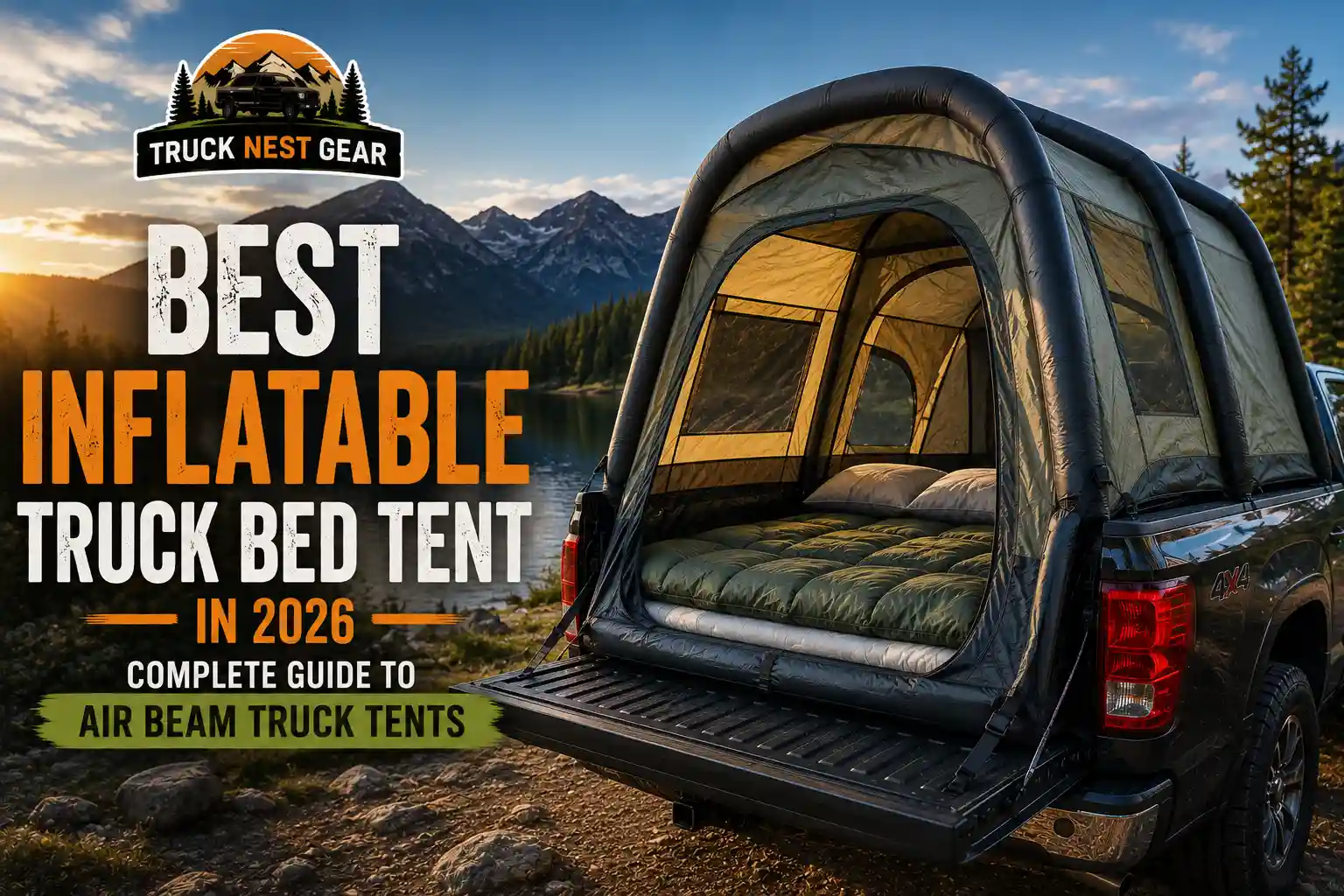
TruckNestGear is reader-supported. When you buy through links on our site, we may earn an affiliate commission at no extra cost to you. As an Amazon Associate we earn from qualifying purchases. Learn more
There is a moment every truck bed tent camper knows. You are at the campsite after a long drive. The light is going. You are tired. You open the carry bag, pull out the tent body, and then spend the next 25 minutes threading fiberglass poles through fabric sleeves, seating each joint, connecting grommets, and tightening straps, while a mosquito finds every inch of exposed skin.
Inflatable truck bed tents exist because a meaningful number of truck campers decided that poles were the problem, and air was the solution.
Instead of a fiberglass or aluminum pole system that requires threading, clicking, and tensioning, an inflatable truck bed tent uses air beam technology, sealed tubes built directly into the tent structure that inflate with a hand pump or electric pump to create the tent’s rigid form. Connect the pump. Inflate for 3 to 5 minutes. The tent is up.
This guide covers what inflatable truck bed tents are, how they differ from traditional pole tents, which models are worth buying in 2026, how the sleeping system inside an inflatable tent works, and the honest trade-offs that every buyer should understand before choosing air beams over poles.
What Is an Inflatable Truck Bed Tent?
An inflatable truck bed tent is a truck bed shelter where the structural frame is replaced entirely by inflatable air beams, pressurized tubes of air that hold the tent fabric in its deployed shape without any rigid poles.
Looking at the images, the distinction from traditional truck bed tents is immediately apparent. Where a Napier Sportz 57 Series has a flat-ish pole-supported roofline, inflatable models like the Niphean, VEVOR inflatable, and similar designs feature a smooth, rounded dome or tunnel shape, the natural geometry created by air pressure rather than rigid angles. The shape is inherently more aerodynamic, and the absence of pole joints and sleeve seams gives the tent a cleaner, more unified profile both visually and structurally.
The attachment to the truck bed follows the same basic principles as traditional designs: straps or clamps on the bed rails, a tailgate sleeve that drapes over and around the lowered tailgate, and guy lines for additional wind stability. The structural difference is entirely in what holds the tent upright.
Inflatable Air Beam Technology: How It Works
The air beam system in an inflatable truck bed tent operates on the same principle as inflatable stand-up paddleboard construction: high-pressure air contained within sealed cylindrical chambers creates a rigid, load-bearing structure.
Each air beam is a sealed tube integrated into the tent body fabric. A single valve port on each beam connects to the pump nozzle. You inflate each beam to the recommended pressure, typically 7 to 10 PSI depending on the design, and the pressurized tubes push outward against the tent fabric, creating the tent’s shape.
The resulting structure is genuinely rigid under normal conditions. One reviewer drove slowly with an inflatable tent inflated to reposition the truck, and it held up without collapse. The rounded dome geometry that air pressure creates naturally distributes wind load more evenly than flat-sided pole designs, which is one reason inflatable tents often perform better in moderate wind despite lacking the rigid pole framework.
The pump is always included. Most current inflatable truck bed tents ship with a hand pump. Some also accept a 12V electric pump connection, which further reduces setup time but adds a power dependency.
Inflatable Truck Bed Tent vs Traditional Pole Tent: The Honest Comparison
Understanding where inflatable tents win and where they lose is the foundation of the buying decision.
Setup Speed: Air Wins Clearly
Most modern designs inflate in under five minutes with a 12V or manual pump. For a camper arriving at a dispersed site in fading light or setting up after a long driving day, 5 minutes versus 20 minutes is a meaningful difference. The learning curve is also flat; there is no pole threading sequence to memorize, no color-coded sections to match, no grommets to seat. Connect pump, inflate, done.
Traditional pole tents get faster with practice, and experienced pole tent users can deploy in 10 to 15 minutes. But the floor of the learning curve for a first-time user is genuinely lower on an inflatable.
Structural Durability: Trade-offs in Both Directions
A fiberglass pole can shatter in cold temperatures, a known failure mode covered in detail across the tent durability content on this site. An aluminum pole can bend under sustained high wind. Both failure modes are repairable in the field with a pole repair sleeve or with tape.
An air beam puncture, a small tear or valve failure, reduces pressure in that beam section, causing that section of the tent to partially deflate and sag. Punctures are rare with quality air beam designs, but the consequence of one in the field is more difficult to address than a bent pole. A repair kit with patch material is worth carrying in the same bag as the pump.
Air beam pressure drops in cold temperatures as the air inside contracts. A tent that was properly inflated at 60°F may feel slightly less rigid by morning if overnight temperatures drop to 35°F. Re-inflation takes 2 minutes and restores the structure fully. This is a minor operational habit, not a significant limitation.
Shape and Interior Space
The rounded dome or tunnel shape of an inflatable truck bed tent is not just visual. The curved roofline creates more usable interior volume than a flat-topped pole design of equivalent length and width. The walls lean outward at a curve rather than meeting the roof at a sharp angle, which means the full-width sleeping area extends further toward the tent walls before the roofline drops.
The VEVOR inflatable, the Niphean, and the dual-use green design shown in the product images all demonstrate this, the interior looks noticeably more spacious than a traditional pole tent of similar truck bed coverage area.
Pack Size and Weight
Deflated air beams are thinner and more flexible than rigid pole bundles. An inflatable truck bed tent typically packs smaller than an equivalent pole tent when deflated; the fabric folds down without the dimensional constraint that pole sections impose. The carry bags shown with the Niphean and VEVOR designs are noticeably flat and soft compared to traditional pole tent carry bags.
Weight is comparable across categories; inflatable designs in the 13 to 18-pound range are similar to quality mid-range pole tents.
Best Inflatable Truck Bed Tents in 2026
Niphean Inflatable Truck Bed Tent: Best Overall
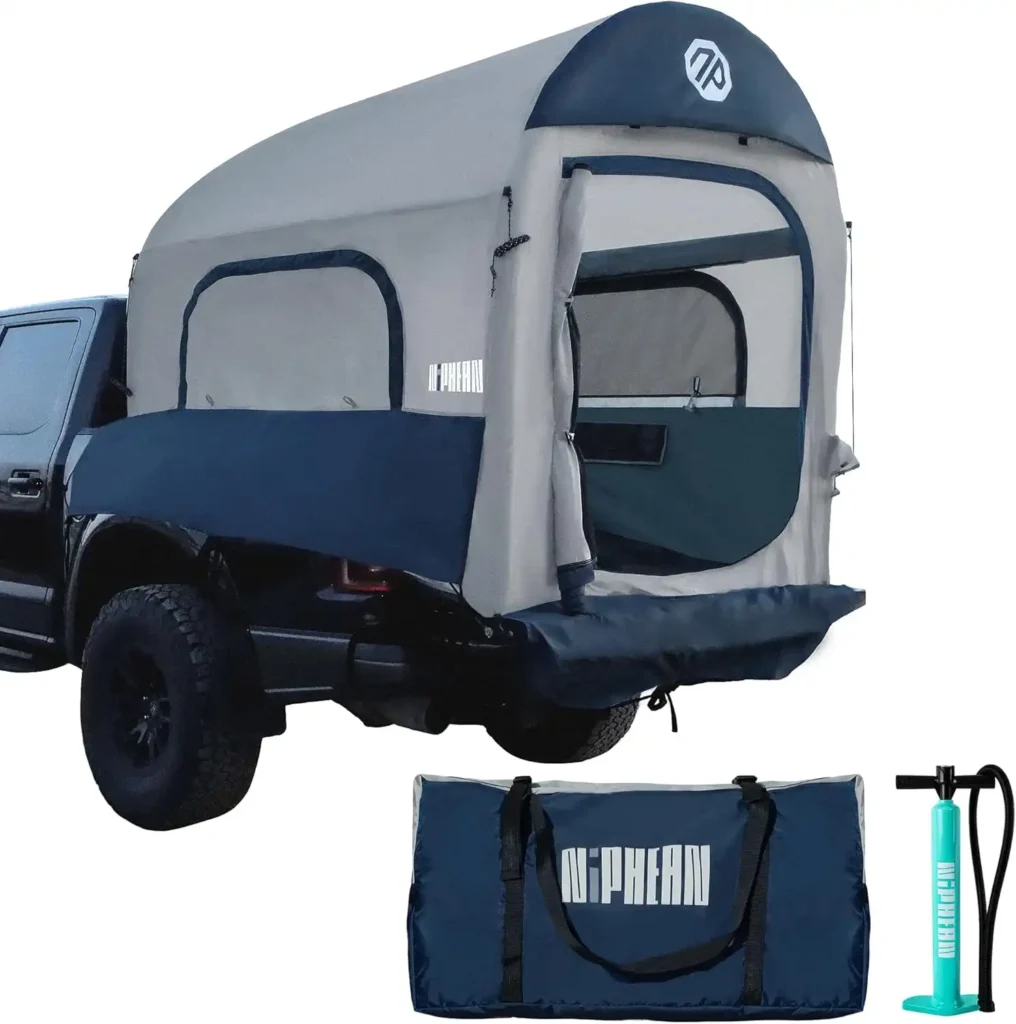
The Niphean is the most feature-complete inflatable truck bed tent currently available, and it earns the top position based on three specific advantages: its dual-use capability, its PU3000mm waterproofing rating, and the quality of its inflatable frame system.
The Niphean stands out with its dual-use capability; set it up in your truck bed OR on the ground as a traditional tent, making it incredibly versatile. The air beam structure that makes it fast to deploy in the truck bed also makes it a freestanding ground tent when the truck bed mount is removed. For overlanders, hunters, and campers who want one shelter system that covers multiple scenarios, this is a genuine differentiator.
The PU3000mm waterproofing on the rainfly is the highest rating in this category, meaningfully above the PU2000mm that represents the standard in the mid-range pole tent market. At PU3000mm, the Niphean handles sustained heavy rain and horizontal wind-driven rain with the same reliability as premium pole designs.
The Niphean is rated for 4 seasons and offers solid weather protection for typical camping scenarios. The rounded dome geometry that air pressure creates sheds water efficiently from the roofline without the pooling risk that flat-topped designs face.
The air beam inflation process takes approximately 3 to 5 minutes with the included hand pump. An integrated valve system allows all beams to be connected in sequence rather than individually. A 12V electric pump connection is also compatible, reducing setup time further for campers with a portable power station in the truck.
The Niphean’s inflatable design drastically simplifies setup compared to traditional pole-based truck tents. It also boasts a surprisingly spacious interior for its class. The peak height, enabled by the dome shape, is noticeably taller than flat-roofed designs of equivalent truck bed coverage.
Available in sizes covering 5.5-foot through 8-foot truck beds, including sizing for full-size trucks (F-150, RAM 1500, Silverado) and long-box HD trucks.
- PU3000mm waterproofing — highest in this category
- Dual-use truck bed and ground tent capability
- Dome shape maximizes interior volume. 3 to 5-minute inflation setup
- 4-season rating. Includes hand pump
- Air beam puncture is the primary failure risk — carry patch kit
- Air pressure monitoring needed in cold temperatures
- Less established brand track record than Napier’s 30-year history
VEVOR Inflatable Truck Bed Tent: Best Budget Inflatable Option
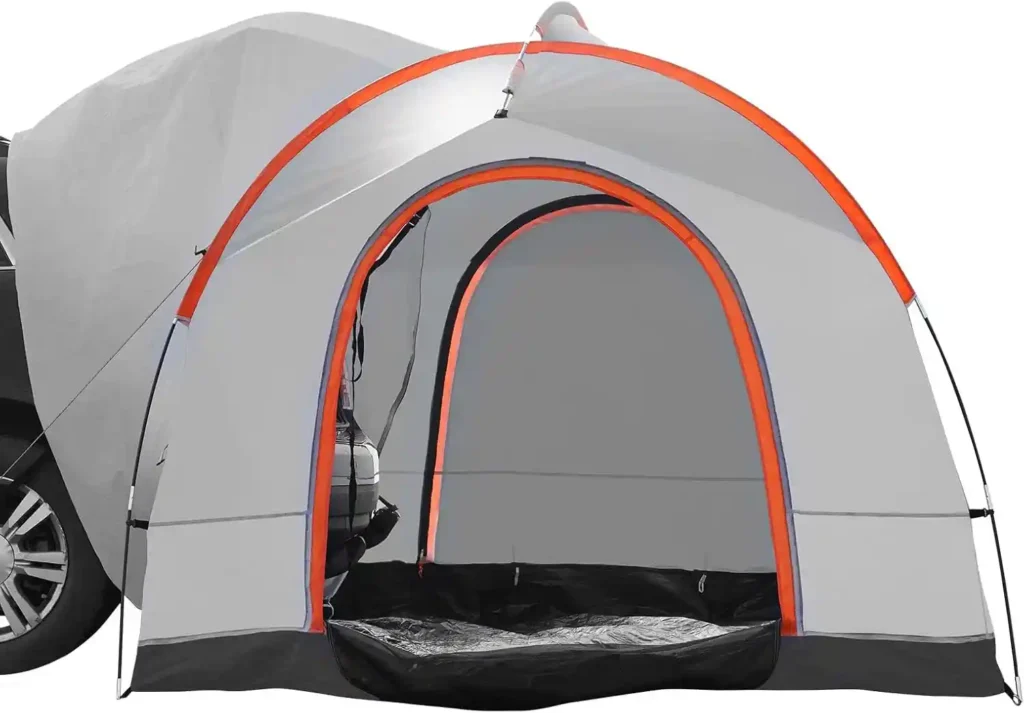
VEVOR’s tent is made for adventurers who want reliability at an affordable price, and the owner review data from VEVOR’s own platform provides useful real-world calibration. One owner reported that it “works exactly as advertised.” Another noted it “stayed warm and dry” through a surprise thunderstorm. The most consistent complaint: sizing runs slightly small in some configurations, and instructions are not clearly written.
The VEVOR inflatable design uses a box-shaped roofline rather than the rounded dome of the Niphean, creating a different aesthetic and a slightly different interior space profile. The box shape provides more consistent headroom across the full tent width compared to a dome that peaks in the center, which some users prefer for getting dressed and moving around inside the tent.
PU2000mm waterproofing with a double-layer construction provides adequate weather performance for three-season campground use. The rainfly vents are functional, but one reviewer noted they wished the vents in the rainfly were larger, a ventilation limitation worth knowing for warm-weather camping.
VEVOR’s tent fits a full-size Chevy short bed well, according to one verified owner. The 5.5- to 6-foot sizing covers the F-150 SuperCrew, RAM 1500 Crew Cab, and Silverado Crew Cab configurations. A 6.5-foot variant is available for standard bed trucks.
- Most accessible price point in the inflatable truck bed tent category
- Box shape provides consistent headroom
- PU2000mm double-layer construction
- Works across major full-size truck short bed configurations.
- Sizing can run slightly small — verify your specific bed measurement against VEVOR’s specifications carefully
- Instructions unclear according to multiple owners
- Rainfly vents smaller than ideal for warm-weather ventilation.
Dual-Use Inflatable Truck Bed and Ground Tent: Best for Versatility
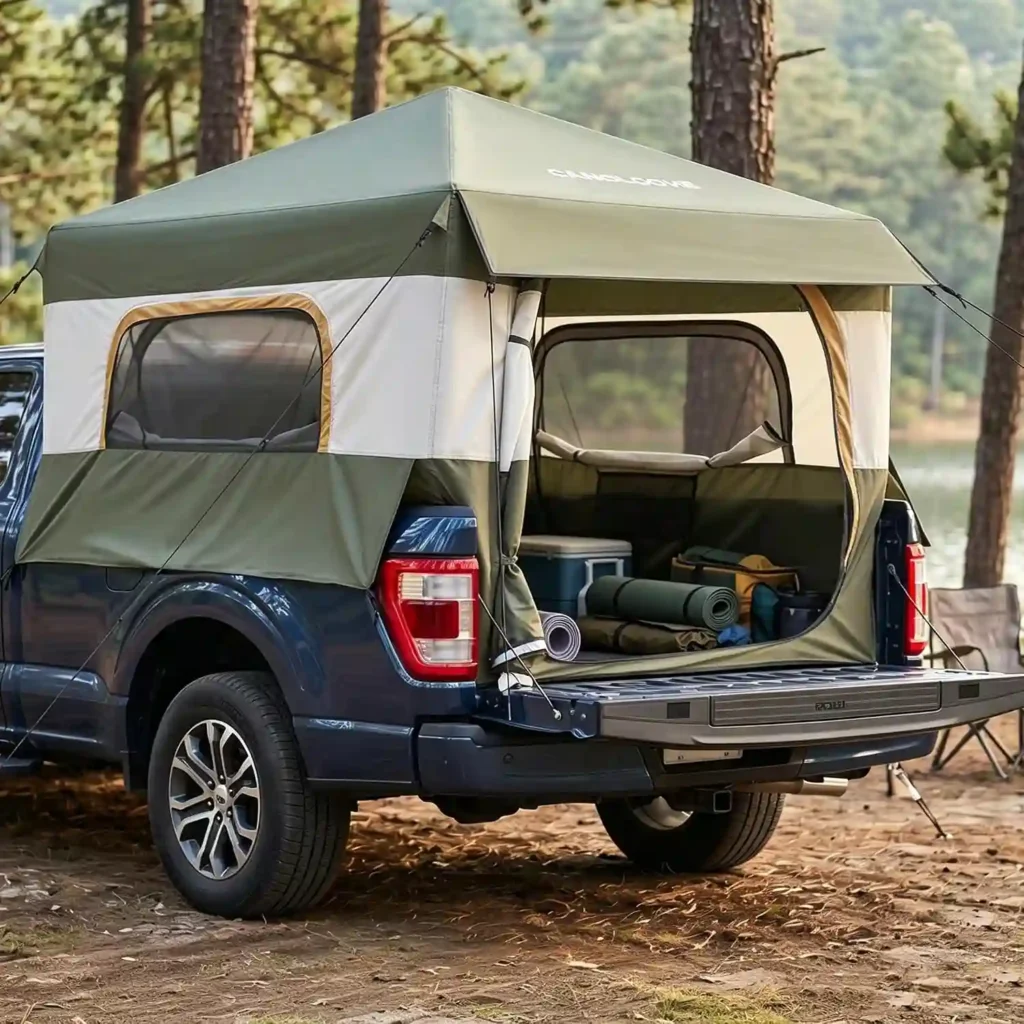
The green dual-use design shown in the product images represents the category’s most practical form factor for campers who want maximum flexibility from a single shelter. Available in 5.5-foot and 8-foot variants, it covers the two most underserved size categories, compact truck short beds and long-box HD truck configurations, that many single-size inflatable designs skip.
The dual-use designation means genuine dual deployment; the tent body attaches to the truck bed rails for vehicle-mounted use, and the same tent body deploys as a freestanding inflatable ground tent when the truck bed attachment points are disconnected. The inflatable frame makes both configurations equally fast, which is the key difference from traditional pole tents where dual-use designs involve compromises in both configurations.
Waterproof all-weather rating at PU2000mm. The rounded arch shape sheds water from the roofline effectively in sustained rain. Multiple mesh windows on each side provide cross-ventilation in warm conditions.
- Genuine dual-use truck bed and ground tent capability
- Available in 5.5-foot and 8-foot variants — broadest size coverage in this category
- Waterproof all-weather construction
- Arch dome shape for efficient rain shedding.
- Less established brand than Niphean or VEVOR with a smaller verified owner review base
- Sizing verification particularly important for compact trucks in the 5.5-foot category
The Sleeping System Inside an Inflatable Truck Bed Tent
The tent structure is the outer shell. What goes inside determines whether the night is genuinely comfortable or just sheltered. The sleeping system requirements for an inflatable truck bed tent are identical to those for a traditional pole tent; the inflatable frame does not change the cold metal truck bed beneath you.
The Floor Problem Remains
The metal truck bed conducts heat away from your sleeping surface regardless of whether the tent above it has poles or air beams. The floor insulation requirement– closed-cell foam base layer plus insulated sleeping surface, is the same for both tent types. This is worth stating explicitly because some buyers assume the tent upgrade addresses all comfort variables. It addresses the structure and weather protection. The sleeping surface is a separate system.
Inflatable Camping Pad: The Natural Complement
An inflatable camping pad, a pressurized sleeping pad that inflates to provide cushioning and insulation — is the most common sleeping surface inside an inflatable truck bed tent, partly because of the conceptual pairing (two inflatable systems working together) and partly because inflatable pads are the most comfortable single-item sleeping surface available for the truck bed camping context.
A quality inflatable camping pad for truck bed use should have:
R-value of 4 or above for three-season use. R-value measures thermal resistance, how well the pad insulates against the cold metal bed surface below. An inflatable pad at R-2 placed on a bare metal truck bed in 45°F conditions will allow meaningful heat loss through the floor. An R-4 pad with a closed-cell foam base layer beneath it handles most shoulder-season conditions reliably.
Width appropriate for your sleeping configuration. Standard inflatable camping pads are 20 to 25 inches wide, adequate for a single sleeper, narrow for a couple. Truck-specific inflatable mattresses at queen width (approximately 60 inches) are available from AirBedz and Rightline Gear with wheel-well contoured designs that fill the full truck bed width more effectively than standard rectangular pads.
Integrated or compatible pump. An inflatable camping pad inside an inflatable truck bed tent means two separate inflation operations: the tent structure and the sleeping surface. A pad with a built-in pump or compatibility with the same 12V electric pump used for the tent streamlines this.
Self-Inflating Camping Mattress: A Middle Path
Between a traditional foam sleeping pad and a fully pressurized inflatable mattress lies the self-inflating camping mattress, an open-cell foam core inside an airtight fabric shell that partially inflates when the valve is opened by drawing in air through the foam structure, then topped off with a few breaths or pump strokes.
A self-inflating camping mattress addresses the two main limitations of both extreme options. Unlike a fully pressurized inflatable, it retains meaningful insulation even if pressure is partially lost overnight; the open-cell foam core maintains R-value even when the air chamber is compromised. Unlike a closed-cell foam pad, it provides genuine sleeping comfort with body-contouring cushioning rather than firm foam resistance.
For truck bed use, a self-inflating camping mattress at 2 to 3 inches of inflation thickness and R-4 or above handles most three-season conditions as a standalone sleeping surface. Below 40°F overnight, place a closed-cell foam base layer beneath it for the additional thermal break that the metal truck bed requires.
Self-inflating camping mattress sizing for truck beds follows the same width constraints as other pads; standard widths of 20 to 25 inches work for solo campers, and truck-specific wide versions or queen-sized options address couple configurations.
The Complete Inflatable Truck Bed Tent Sleep System
Summer and warm fall (overnight lows above 50°F):
- Inflatable camping pad or self-inflating camping mattress directly on truck bed liner
- Sleeping bag rated to 35°F or above
- Pillow
Three-season (overnight lows 30°F to 50°F):
- Closed-cell foam base pad (Z Lite Sol or equivalent) directly on metal bed
- Self-inflating camping mattress at R-4 or above on top of foam base
- Sleeping bag rated to 15°F to 20°F (with 20°F buffer for metal bed factor)
- Sleeping bag liner for adjustable warmth across variable overnight temperatures
Cold shoulder season (overnight lows below 30°F):
- Closed-cell foam base pad
- Self-inflating camping mattress at R-6 or above
- Sleeping bag rated to 0°F or below
- Full layered sleep clothing system including base layer, mid-layer, beanie, gloves, and wool socks
Inflatable Truck Bed Tent Buying Guide
Size Compatibility: Same Rules, More Critical
The bed sizing requirements for inflatable truck bed tents follow the same principles as traditional designs: measure your interior bed length from the inside face of the tailgate to the inside cab wall, and match that measurement to the tent’s specified size range.
The sizing concern is slightly more critical for inflatable designs because the air beam structure is less adjustable than a pole system. Traditional pole tents have some flexibility in how tightly the straps are tensioned and how the poles seat at the corners. Air beam structures inflate to a fixed geometry; if that geometry does not match your bed dimensions, the tent will not attach and seal correctly regardless of how you adjust the straps.
Verify your specific truck’s interior bed measurement against the inflatable tent’s specifications, not just the general “short bed” or “full-size” designation.
Pump Options and Power Planning
Every inflatable truck bed tent on this list includes a hand pump. The hand pump works and is the zero-dependency option: no power required, no additional equipment needed.
For campers who prefer faster inflation or who plan to set up frequently, a 12V electric pump significantly reduces inflation time and physical effort. Most quality inflatable truck bed tents accept standard air mattress pump nozzle size, verify compatibility before purchasing a separate electric pump.
If you carry a portable power station in the truck, the electric pump connects to it via a 12V adapter. If not, the truck’s 12V cigarette lighter outlet powers most electric pumps through a standard adapter.
Air Pressure Monitoring in Cold Weather
Cold temperatures cause air pressure inside sealed chambers to drop as the air contracts. An inflatable truck bed tent inflated to correct pressure at 65°F ambient temperature will have lower internal pressure by morning if overnight temperatures drop to 35°F. The tent will not collapse, but it may feel less rigid than at deployment.
The correct response is a brief re-inflation in the morning, which takes 2 to 3 minutes with the hand pump. For cold-weather camping, keep the pump accessible inside the tent or in the truck cab rather than in the carry bag in the truck bed.
Puncture Risk and Repair
Air beam punctures are the primary failure risk specific to inflatable designs. Most quality air beams use TPU (thermoplastic polyurethane) coated fabric rather than standard PVC, which resists abrasion and puncture more reliably than cheaper materials.
Carry a standard inflatable repair kit, the same type used for air mattresses and inflatable paddleboards, alongside the pump. A repair patch applied to a small puncture restores the beam to full pressure in minutes. A large tear or valve failure is a more significant problem; the Niphean and VEVOR designs have multiple independent air beams, so a single beam failure does not collapse the entire tent.
Waterproofing: Ratings to Look For
PU2000mm is the minimum waterproofing standard for reliable three-season truck tent use. PU3000mm provides additional margin in sustained heavy rain and is the rating found on the Niphean and premium inflatable designs.
The seam construction matters as much as the fabric rating. Taped seams, where waterproof tape covers the stitching from inside, outperform coated seams in sustained rain. Verify seam construction in the product specifications rather than relying solely on the PU rating.
FAQs
What is an inflatable truck bed tent?
An inflatable truck bed tent is a truck bed shelter where the structural frame is made entirely of inflatable air beams rather than traditional fiberglass or aluminum poles. The air beams are integrated into the tent body fabric and inflate via a hand or electric pump to create the tent’s rigid structure in 3 to 5 minutes. The result is the same enclosed sleeping space as a traditional truck bed tent, assembled significantly faster with no pole threading required.
How long does it take to set up an inflatable truck bed tent?
Most inflatable truck bed tents fully deploy in 3 to 5 minutes with the included hand pump, or under 2 minutes with a 12V electric pump. This is significantly faster than traditional pole tent setups, which typically take 10 to 20 minutes depending on the model and the user’s experience level. Breakdown is equally fast: open the valves, the air beams deflate, the tent fabric folds flat, and it packs back into the carry bag in 5 to 8 minutes.
Are inflatable truck bed tents waterproof?
Yes, with quality construction. Current inflatable truck bed tents use PU-coated fabric at 2,000mm to 3,000mm hydrostatic head ratings with sealed seam construction. The Niphean at PU3000mm provides the highest waterproofing rating in the category. The rounded dome or arch shape of most inflatable designs sheds water efficiently from the roofline, reducing the pooling risk that affects flatter pole tent profiles.
Apply a DWR spray treatment to the outer fabric at the start of each camping season to maintain beading performance as the factory coating degrades with use.
Can inflatable truck bed tents be used as ground tents?
Several models, including the Niphean and the dual-use green design, are explicitly rated for both truck bed and ground tent deployment. The inflatable frame creates a freestanding structure that does not require the truck bed rails for support, allowing the same tent to deploy on the ground when the truck bed attachment points are disconnected. This dual-use capability is specific to inflatable designs, traditional pole truck bed tents are generally not designed for ground deployment.
What sleeping pad works best inside an inflatable truck bed tent?
The sleeping surface requirements inside an inflatable truck bed tent are identical to any truck bed tent; the inflatable structure does not address the cold metal bed beneath you. A two-layer system works best: a closed-cell foam base pad placed directly on the metal bed for thermal break, topped with either an inflatable camping pad at R-4 or above or a self-inflating camping mattress at similar R-value for sleeping comfort. For summer camping above 55°F overnight, a quality inflatable camping pad or self-inflating mattress alone without the foam base layer is often adequate.
Are inflatable truck bed tents more durable than pole tents?
In different ways, yes and no. Inflatable tents eliminate pole breakage, the single most common failure mode in fiberglass pole designs, particularly in cold temperatures. They have no joints to slip loose and no sleeves to tear from pole tip pressure. Their vulnerability is puncture; a small tear in an air beam reduces pressure in that section. With quality TPU-coated air beams and a repair kit on hand, punctures are field-repairable. Overall, neither design is objectively more durable, they fail in different ways, and the right choice depends on where you camp and how you manage your gear.
Final Verdict
The inflatable truck bed tent is not a gimmick. It is a genuine alternative to traditional pole designs that solves the pole system’s core inconveniences- threading, joint seating, cold-weather brittleness- with a different structural approach that trades a few minutes of pump work for a simpler, faster setup experience.
For campers who prioritize setup speed, who camp in environments where first-time pole threading frustration is a real barrier, or who want a dual-use shelter that works both in the truck bed and on the ground, inflatable truck bed tents are the most practical option in the category.
The Niphean is the strongest current option across waterproofing rating, interior volume, dual-use capability, and build quality. The VEVOR inflatable is the accessible entry point for buyers who want to try the category without a premium investment.
The sleeping system inside- an inflatable camping pad, self-inflating camping mattress, or a combination with a foam base layer- is chosen by the same criteria as any truck bed tent sleeping system. The tent structure above you changes with the inflatable upgrade. The cold metal bed beneath you does not.
Affiliate disclosure: Some links in this guide are affiliate links. If you purchase through them, we earn a small commission at no additional cost to you. This does not affect our recommendations: no brand has paid for placement in this guide.