Stargazing From a Truck Bed Tent: The Unexpected Perfect Setup
Most camping gear guides cover stargazing as an afterthought, a footnote about leaving the rainfly off and hoping for clear skies. The truck bed tent camping format, it turns out, is one of the most naturally suited setups for serious stargazing available to a non-backpacking camper, and the reasons are specific enough to be worth explaining rather than assumed.
This guide covers why the truck bed tent works so well for stargazing, how to get the most out of the setup on a clear night, where the best dark sky destinations for truck tent campers are concentrated, and the practical details, moon phase, dark adaptation, and the Bortle Scale that turn a clear night into a genuinely memorable one.
Why a Truck Bed Tent Is One of the Best Stargazing Platforms Available
The connection between truck bed tents and stargazing is not obvious until you think through what the format actually provides.
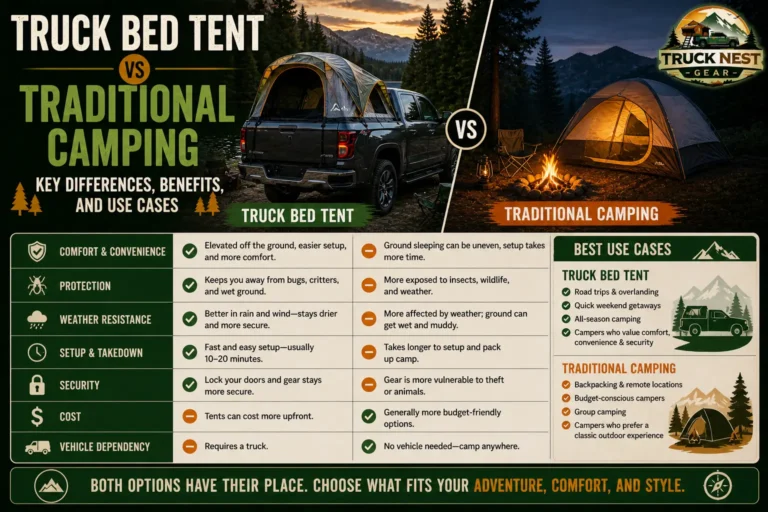
The mesh roof. Most quality truck bed tents, the Napier Sportz 57 Series, the Rightline Gear 110730, and others at the mid-range and above, include a mesh roof panel or mesh windows that allow unobstructed views of the sky while inside the tent.
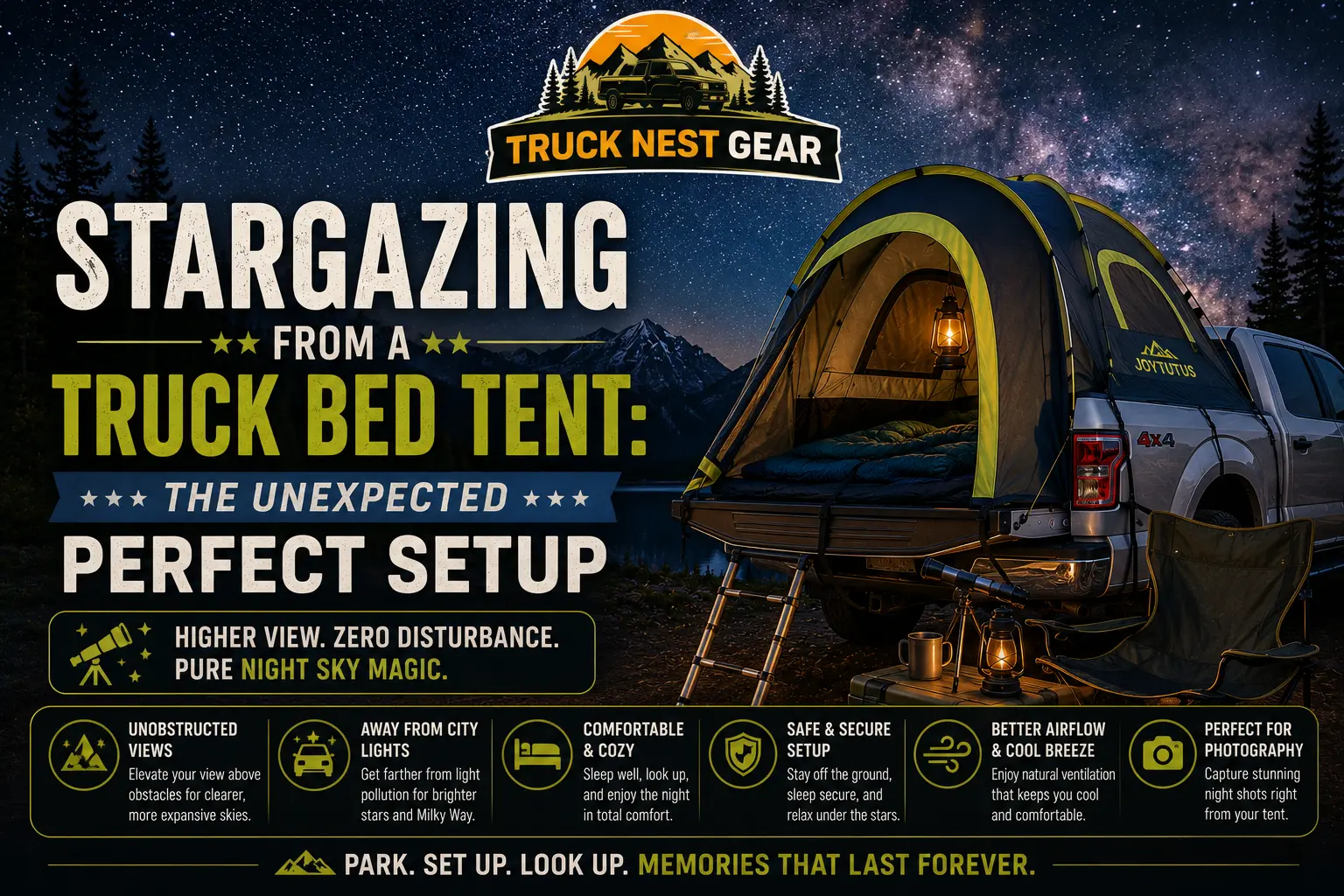
On a clear, dry night with no rain expected, leaving the rainfly off and sleeping beneath the mesh roof turns the truck bed tent into an open-air observatory at bed height. You lie on your back on an air mattress in an elevated, comfortable sleeping position and look directly up at the sky through mesh that blocks insects but not photons.
This is fundamentally different from stargazing at a ground-level campsite where you either crane your neck standing up, lie on a ground cloth in the dirt, or look out through an open tent door at a limited slice of sky.
The truck bed tent’s elevated, flat, comfortable sleeping platform with a mesh overhead view is the closest thing to a private observatory that most campers will ever experience without specialized equipment.
The elevation. A truck bed tent positions you 24 to 36 inches above the ground. This removes horizon obstructions from low vegetation that can block sky views at ground level and provides a slightly wider angular view of the sky than a ground-level sleeping position. In flat open terrain, desert hardpan, alpine meadows, and high desert plateaus, this elevation advantage is minimal. In areas with low brush or grass, it matters more.
The mobility. The most important factor in stargazing is sky darkness, and sky darkness is almost entirely determined by distance from artificial light pollution. A truck bed tent on a pickup truck can drive to the darkest available sky within range and set up in 15 minutes. No other camping format combines this level of dark sky accessibility with this level of sleeping comfort.
The Rainfly Decision: When to Leave It Off
Leaving the rainfly off a truck bed tent for stargazing is the most important setup decision of the night, and it comes down to one question: how confident are you that it will not rain?
A light rain shower on an exposed truck bed tent with no rainfly is an immediate problem; you wake up wet, and the sleeping bag and mattress are soaked before you can react. Check the forecast, including hourly probability, before making the rainfly decision.
In the desert Southwest in summer, afternoon thunderstorms typically clear by evening and overnight rain probability drops to near zero. In the Pacific Northwest or at elevation in the Rockies, clear evening skies can turn quickly. Know your region’s weather patterns.
The practical rule: if overnight rain probability is less than 10 percent and no thunderstorm activity is forecast within 50 miles, leaving the rainfly off is generally reasonable. If there is any meaningful rain probability, keep the rainfly accessible, attached but not deployed, so you can put it up quickly if conditions change without fully waking up.
Some truck tent designs allow the rainfly to be partially deployed, covering the tailgate end while leaving the mesh roof section exposed. This provides rain protection at the most vulnerable entry point while maintaining the overhead mesh view. Check whether your specific tent model allows this configuration before depending on it.
Understanding Sky Darkness: The Bortle Scale
Not all dark skies are equally dark, and the difference between a Class 5 sky and a Class 2 sky is the difference between seeing a few hundred stars and seeing the full Milky Way structure with the naked eye.
The Bortle Scale, developed by amateur astronomer John Bortle in 2001, rates sky darkness from Class 1 (the darkest skies on Earth, found only in the most remote locations) to Class 9 (the most light-polluted urban skies where only the brightest stars are visible).
Most suburban locations are Class 7 to 8. Most state and national parks away from major cities are Class 4 to 6. The best designated dark sky locations in the United States reach Class 1 to 2.
At Class 4 or below, the Milky Way is clearly visible as a structure rather than a faint smear. The zodiacal light, a faint glow along the ecliptic caused by sunlight reflecting off interplanetary dust, becomes visible before dawn at Class 3 and below. Airglow, the faint luminescence of Earth’s upper atmosphere, is detectable at Class 2 and below. At Class 1 skies, the Milky Way casts a faint shadow.
The Light Pollution Map at lightpollutionmap.info overlays Bortle Scale data on satellite imagery and lets you identify the nearest dark sky zones to any starting location. This is the most useful pre-trip planning tool for a stargazing truck camping trip; it turns the abstract concept of “dark skies” into a specific driving direction and distance.
Best Dark Sky Destinations for Truck Bed Tent Campers
The United States has an extraordinary concentration of dark sky resources, and the regions with the darkest skies are also the regions most accessible to dispersed truck tent camping on public land.
- Big Bend National Park and the Greater Big Bend Dark Sky Reserve, Texas
The National Park Service Night Sky Team has measured Big Bend’s skies as the darkest in the lower 48 states. Big Bend earned its Gold Tier International Dark Sky Park certification in 2012, and the surrounding Greater Big Bend International Dark Sky Reserve, certified in 2022, encompasses McDonald Observatory near Fort Davis, where regular Star Parties pair high-power telescope viewing with public astronomy programs.
The remoteness of far west Texas keeps light pollution minimal from all directions. Dispersed camping on BLM land surrounding the park provides access to the same dark skies without park camping fees. Best viewing windows are fall and winter when the galactic core sets early, and the winter Milky Way rises.
- Utah’s Dark Sky Country: Moab, Arches, Canyonlands, and Natural Bridges
Utah is the predominant state for dark skies, with more than two dozen Dark Sky Places. The city of Moab is an International Dark Sky Community that draws visitors as a haven for outdoor recreation.
The area encompasses the Arches and Canyonlands national parks, as well as the Natural Bridges and Hovenweep national monuments. Natural Bridges National Monument was the world’s first International Dark Sky Park, designated in 2007.
The canyon topography blocks any distant light pollution from multiple directions simultaneously. BLM land surrounding the Moab area provides extensive dispersed camping access at similar sky darkness to the park interior without the camping fee.
- The Oregon Outback and Hart Mountain Dark Sky Sanctuary
The Oregon Outback, which stretches across 2.5 million acres, is the world’s largest International Dark Sky Sanctuary, with future plans to expand to 11.4 million acres. The remoteness of southeastern Oregon, hours from any significant population center in any direction, produces sky darkness that rivals the Southwest desert. Hart Mountain National Antelope Refuge and the Warner Valley area provide dispersed BLM camping access within some of the darkest skies in North America.
- Central Idaho Dark Sky Reserve
Central Idaho was recently named an International Dark Sky Reserve, one of only 20 locations in the world. The Sawtooth National Recreation Area and the Frank Church River of No Return Wilderness surround Stanley, Idaho, which sits at the center of one of the country’s most recognized dark sky designations.
The combination of high elevation, clean air, and remoteness from population centers creates exceptional viewing conditions. Forest Service dispersed camping on the surrounding national forest land provides accessible truck tent sites within the reserve.
- Cherry Springs State Park, Pennsylvania
Cherry Springs State Park offers perfect night sky viewing conditions, raised on a plateau above the valleys which shield light from nearby towns. The park is the first International Dark Sky site on the East Coast, where up to 30,000 stars and celestial features are visible on a clear night.
For truck tent campers in the Northeast, Cherry Springs provides Class 2 skies within driving range of the major eastern population corridor, a rare combination. The park’s camping area is specifically oriented for astronomy with designated dark zones and night sky event programming.
- Great Sand Dunes National Park, Colorado
Great Sand Dunes earned International Dark Sky Park certification with the Sangre de Cristo mountain range blocking light pollution from Colorado’s Front Range cities. The park’s dry air, high elevation, and lack of light pollution make it an ideal dark sky destination.
The surrounding BLM land provides dispersed camping access, and the dune field itself creates an unobstructed 360-degree horizon that is exceptional for observing horizon-level phenomena like zodiacal light and the galactic core rising or setting.
Planning a Stargazing Truck Tent Trip: What Actually Matters
Moon phase is the single most important planning variable. A full moon washes out all but the brightest stars and makes Milky Way viewing impossible. A new moon or the days immediately surrounding it provide the darkest possible nights.
Plan your trip around the new moon calendar for the best sky darkness, particularly for Milky Way viewing. The US Naval Observatory publishes moon phase calendars at aa.usno.navy.mil that cover any date and location.
Seasonal Milky Way visibility. The galactic core, the brightest and most visually dramatic portion of the Milky Way, is visible from the Northern Hemisphere from approximately March through October, with peak visibility in July and August when the core is highest in the sky.
From November through February, the galactic core is below the horizon in the Northern Hemisphere, and winter stargazing focuses on the Orion region and winter constellations.
Dark adaptation. The human eye takes approximately 20 to 30 minutes to fully adapt to darkness. Any white light exposure during this period resets the adaptation clock. Use only red-light headlamps or flashlights at the campsite during a stargazing session; red light does not reset dark adaptation in the way white light does. The red light mode on most quality headlamps serves this function. Avoid looking at your phone screen without a red filter application during the adaptation period.
Smoke and humidity. Wildfire smoke in the western United States, a growing seasonal factor from August through October, significantly degrades sky transparency even when skies appear clear to the eye. Smoke at altitude scatters light and reduces star count even in low-pollution locations.
Check air quality index alongside the weather forecast for fall stargazing trips in fire-prone regions. High humidity similarly degrades transparency; desert environments in the Southwest and Great Basin consistently produce the clearest skies for astronomical viewing.
The Practical Stargazing Setup for a Truck Bed Tent Night
Getting everything right on a stargazing truck tent night takes about 10 minutes of preparation beyond a normal camping setup.
Leave the rainfly off or partially deployed if conditions allow, as covered above. Position the truck with the tailgate facing the darkest part of the sky, typically south in the Northern Hemisphere where the galactic core rises, rather than facing the camp area or any ambient light source. If there are other campers or vehicles nearby, orient the tailgate away from their headlights and lanterns.
Establish your red-light protocol before full dark. Switch every light source at the campsite to red mode or cover it. Inform any camping partners about the no-white-light rule during the adaptation period. Set up your sleeping surface, air mattress, sleeping bag, and pillow before it gets dark so you are not fumbling with setup during the adaptation window.
Once fully dark-adapted, lying in the truck bed tent beneath the mesh roof with a pair of 7×50 or 10×50 binoculars provides a qualitatively different experience from naked-eye viewing alone.
Binoculars at this aperture reveal detail in nebulae, open clusters, and the Milky Way structure that the naked eye cannot resolve. They require no setup, no alignment, and no power, the most accessible astronomical instrument available for a truck camping context.
The Truck Bed Tent Stargazing Advantage Worth Stating Directly
Sleeping in a truck bed tent on a clear night at a dark sky location, rainfly off, lying on a comfortable air mattress, looking straight up through the mesh at a Class 2 or Class 3 sky, is one of the more remarkable experiences available without leaving the planet.
The Milky Way overhead from a truck bed elevation is different from the same view through a car window or from a chair beside a campfire. It is immersive in the way that good sleeping environments are immersive: the sky fills your entire visual field, and the only thing between you and it is a mesh fabric designed to let everything through except the insects.
Most people who experience this once find that stargazing becomes a meaningful part of how they choose camping destinations going forward. The truck tent format, almost by accident of design, turns every clear night in a dark sky location into an observatory.